Fresh Herbs at Your Fingertips: Sunny Windowsill Growing Guide
Why Grow Herbs on a Sunny Windowsill
A sunny kitchen windowsill turns unused space into a productive herb garden that delivers fresh flavour exactly when you need it. No garden required, no long trips to the grocery store for wilted sprigs that cost more than they’re worth.
Growing herbs indoors on a bright window ledge means you control everything: the soil stays clean, pests stay minimal, and you harvest only what each dish needs. The herbs sit three steps from your cutting board. You’ll use more fresh herbs in your cooking simply because they’re there, transforming everyday meals with flavours that dried versions can’t match.
A south-facing window in the Northern Hemisphere (or north-facing in the Southern Hemisphere) provides the intense light that Mediterranean herbs need. East or west windows work too, as long as they’re unobstructed and receive at least 6 hours of direct sun daily. This guide focuses on that bright, sunny exposure because it supports the widest range of culinary herbs and produces the most vigorous growth.
Getting Started: Light, Containers and Basic Care
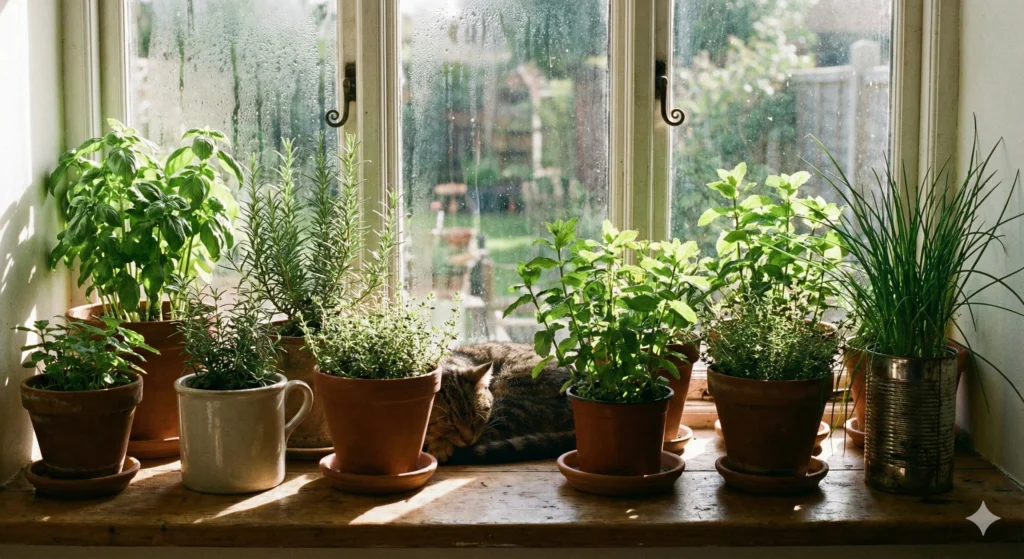
Light is everything. Your windowsill needs at least 6 hours of direct sunlight daily for most culinary herbs to thrive. Morning sun through an east window works beautifully for basil and parsley. Afternoon sun from the west suits hardier herbs like rosemary and thyme. A south-facing sill (in the Northern Hemisphere) provides all-day intensity that every herb on this list will appreciate.
If your herbs stretch tall and pale with long gaps between leaves, they’re reaching for light they’re not getting. Move them closer to the glass or accept that the spot won’t support sun-loving varieties.
Containers must have drainage holes. This single feature matters more than material, colour, or price. Terracotta breathes and dries faster, which helps prevent overwatering. Plastic or glazed ceramic holds moisture longer, useful if you travel often or forget to water. Match the pot to your habits.
Start with containers 12–15 cm wide for single herb plants. Basil, parsley, and coriander develop substantial root systems and benefit from this space. Thyme and chives tolerate slightly smaller pots. Avoid saucers that let roots sit in standing water; if you need to catch drips, empty the saucer 15 minutes after watering.
Use light, well-draining potting mix, not garden soil. Garden soil compacts in containers, suffocating roots and creating soggy conditions that kill herbs faster than underwatering. A quality potting mix designed for containers contains peat or coir, perlite or vermiculite, and often a small amount of compost. It holds moisture without becoming waterlogged.
Water when the top 1–2 cm of soil feels dry. Push your finger into the mix; if it’s damp, wait. If it’s dry and the pot feels light when you lift it, water thoroughly until it runs from the drainage holes. Most windowsill herbs die from overwatering, not drought. Mediterranean herbs (rosemary, thyme) prefer drier conditions between waterings. Basil, parsley, and coriander like consistent moisture but never soggy roots.
Best Herbs for a Sunny Kitchen Windowsill
Basil
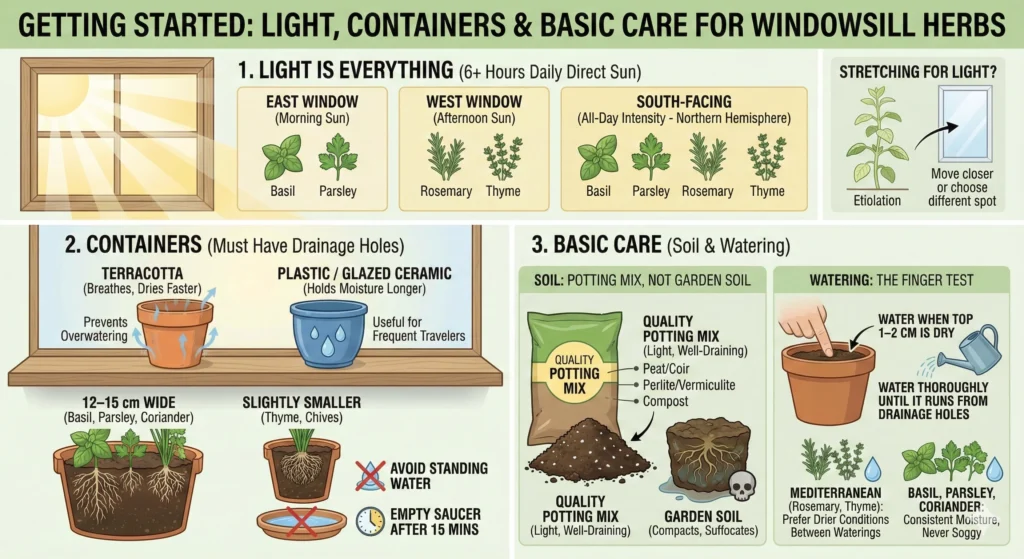
Basil thrives in warmth and bright light, making a sunny windowsill ideal if your kitchen stays above 15°C. It needs 6–8 hours of direct sun and consistent moisture—let the top centimetre of soil dry between waterings, but don’t let it wilt. Use a 15 cm pot minimum and pinch off the growing tips every week or two once the plant reaches 15 cm tall. This pinching removes the top two leaves from each stem, forcing the plant to branch sideways instead of shooting upward into flower. More branches mean more leaves and a longer harvest window.
Fresh basil transforms simple dishes instantly. Tear leaves into tomato salads, layer them in sandwiches, or blend them into pesto when you’ve harvested a generous handful. Add basil at the end of cooking—toss it into hot pasta with olive oil in the last 30 seconds, or scatter it over pizza straight from the oven. Heat destroys basil’s delicate oils, so save it for finishing rather than long simmering. The flavour pairs naturally with tomatoes, mozzarella, garlic, lemon, and olive oil.
Parsley
Parsley tolerates slightly less light than basil but still performs best with 5–6 hours of direct sun. It grows steadily in cooler conditions, even thriving when windowsill temperatures dip to 10°C at night. Use a pot at least 15 cm deep to accommodate its taproot. Water when the top layer of soil dries out; parsley handles moisture better than drought. Harvest outer stems from the base, cutting just above soil level. This encourages the centre to keep producing new growth throughout the season.
Flat-leaf parsley carries a clean, bright, slightly peppery flavour that works in nearly every savoury dish. Chop it into grain salads, scrambled eggs, roasted vegetables, and soups. Unlike basil, parsley withstands cooking, so add it to stews and sauces in the last 10 minutes for colour and freshness. Stems hold more flavour than leaves—mince them finely for marinades or toss whole stems into stock. Parsley cuts richness in butter sauces, lifts the flavour of roasted chicken, and brightens anything with garlic or lemon.
Coriander / Cilantro
Coriander bolts to seed quickly in warm, bright conditions, which makes it tricky on a sunny windowsill but manageable with the right approach. Sow seeds directly in a 12 cm pot every 3–4 weeks for continuous supply rather than trying to keep one plant alive indefinitely. It prefers bright light but tolerates some afternoon shade when temperatures climb above 24°C. Water frequently; coriander wilts fast in dry soil. Accept that this herb has a short productive window—harvest leaves aggressively as soon as plants reach 10 cm tall.
Coriander’s polarising flavour is essential in Mexican, Thai, Vietnamese, and Indian cooking. Chop leaves into salsas, scatter them over tacos, or blend them into chutneys and curry pastes. Add coriander at the end of cooking or use it raw—heat kills its brightness within seconds. Stems are just as flavourful as leaves and add texture to stir-fries and noodle soups. The flavour complements lime, chilli, cumin, ginger, and coconut. If you’re growing coriander for the seeds rather than leaves, let it flower and dry on the plant, but that’s a different project than a kitchen windowsill herb garden.
Chives
Chives are nearly indestructible on a sunny windowsill. They tolerate a wide range of light levels but produce the best flavour and most vigorous growth with 5–6 hours of sun. Plant them in a 12 cm pot and water when the top layer of soil dries. Chives grow in clumps; harvest by snipping individual stems at the base with scissors, taking no more than a third of the plant at once. They’ll regrow quickly. Divide crowded clumps every year or two by gently pulling the root ball apart and repotting sections.
Use chives anywhere you want a mild onion flavour without the sharpness of raw onion. Snip them fresh over baked potatoes, stir them into softened butter for bread or steak, fold them into omelettes, or scatter them on soups just before serving. Chives lose their flavour when cooked, so treat them as a finishing herb. They pair well with cream, cheese, eggs, potatoes, and fish. The purple flowers are edible and add a mild onion note to salads, though flowering reduces leaf production, so remove buds if you want continuous harvests.
Mint
Mint grows aggressively, even in a pot, and adapts to various light conditions, but a sunny windowsill produces the most aromatic leaves. Give it 4–6 hours of sun and keep the soil consistently moist—mint wilts dramatically when dry but bounces back after watering. Use a 15 cm pot minimum and don’t worry about pruning technique; mint forgives rough handling. Pinch off stems liberally to keep it bushy and prevent it from getting leggy. Expect it to outgrow its container within a season.
Mint’s clean, cooling flavour suits both sweet and savoury dishes. Tear leaves into fruit salads, muddle them for drinks (mojitos, iced tea, lemonade), or chop them into yoghurt-based sauces for grilled lamb or vegetables. Mint complements chocolate, lime, strawberries, peas, cucumbers, and anything with Middle Eastern or North African spices. Add it at the end of cooking or use it raw—heat turns mint murky and bitter. A small handful of mint steeped in boiling water makes a simple, caffeine-free tea that aids digestion after heavy meals.
Rosemary
Rosemary needs intense light—at least 6 hours of direct sun—and prefers dry conditions between waterings. Let the top half of the soil dry out completely before watering again; overwatering kills rosemary faster than any other mistake. Use a terracotta pot for faster drainage and place it in the brightest spot on your windowsill. Rosemary grows slowly indoors and tolerates dry indoor air better than most herbs. Prune it lightly and often by snipping off tips for cooking; this keeps it compact and encourages branching.
Rosemary’s piney, resinous flavour suits long-cooked dishes and stands up to high heat. Strip leaves from woody stems and chop them finely—whole leaves are tough and unpleasant to chew. Add rosemary early in cooking: toss it with roasted potatoes or root vegetables before they go in the oven, stir it into braises and stews, or press it into meat before roasting. It pairs with garlic, lemon, olive oil, lamb, chicken, white beans, and winter squash. A little goes far; too much rosemary tastes medicinal and bitter.
Thyme
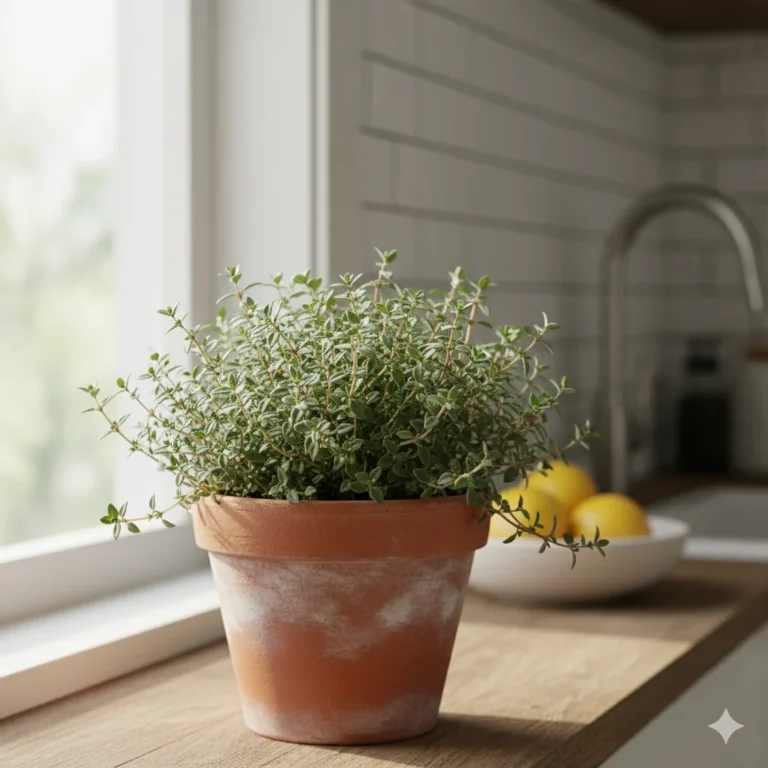
Thyme thrives in the same bright, dry conditions as rosemary and is even more forgiving of neglect. It needs 6 hours of direct sun and infrequent watering—let the top 2–3 cm of soil dry between waterings. Plant it in a shallow pot (8–10 cm deep) with excellent drainage; thyme develops a shallow root system and resents soggy soil. Harvest by snipping off 5–7 cm stem tips throughout the growing season. Thyme grows slowly but steadily and rarely needs aggressive pruning.
Thyme’s earthy, slightly minty flavour works in nearly every savoury dish and withstands long cooking times without losing potency. Strip tiny leaves from stems by running your fingers down the stem against the direction of growth, or toss whole sprigs into soups and stews and remove them before serving. Thyme belongs in roasted vegetables, marinades for meat and fish, tomato sauces, lentil soups, and mushroom dishes. It pairs naturally with garlic, bay leaves, parsley, lemon, butter, and wine-based sauces. Add it early in cooking to let the flavour infuse the dish.
Daily Care Tips for Healthy Windowsill Herbs
Rotate pots every few days. Herbs reach toward the strongest light, which means the side facing away from the window grows weaker and sparser. Quarter-turn each pot twice a week to encourage even growth on all sides.
Watch for leggy, stretched growth. Long stems with widely spaced leaves signal insufficient light. Move the plant closer to the window, prune it back to encourage compact regrowth, or accept that your windowsill doesn’t provide enough sun for that particular herb.
Don’t fertilise heavily. Windowsill herbs grow more slowly than garden plants and need less nutrition. Overfed herbs produce lush, watery growth with weak flavour. Use a liquid fertiliser diluted to half the recommended strength once every 4–6 weeks during active growth. Skip fertilising entirely during winter if growth slows.
Pinch back herbs regularly. Pinching removes the growing tip from each stem, forcing the plant to branch. More branches mean more leaves and a bushier, more productive plant. Start pinching basil, mint, and other soft-stemmed herbs as soon as they reach 15 cm tall. Do it every week or two throughout the growing season.
Remove flowers immediately on leafy herbs. Basil, coriander, and parsley shift energy into seed production once they flower, which makes leaves bitter and stops new growth. Pinch off flower buds as soon as you spot them to extend the harvest. The exception: let chives flower if you want edible blooms, but expect fewer leaves during flowering.
Wipe dust off leaves monthly. Dust blocks light and reduces photosynthesis. Wipe leaves gently with a damp cloth or give the entire plant a lukewarm shower in the sink, then let it drain thoroughly before returning it to the windowsill.
How to Harvest Herbs for Maximum Flavour
Harvest in the morning after dew dries but before afternoon heat. This timing captures herbs when their essential oils are most concentrated, delivering stronger flavour to your dishes.
Cut, don’t tear. Use clean scissors or pruners to snip stems cleanly. Tearing damages plant tissue and creates entry points for disease.
For bushy herbs like basil and mint, cut stems just above a leaf node (the point where leaves emerge from the stem). New branches will sprout from that node, giving you two stems where you had one. Always leave at least two-thirds of the plant intact so it can recover quickly.
For clump-forming herbs like parsley and chives, harvest outer stems first. Cut them at the base, leaving the centre of the plant to continue growing. This method provides continuous harvests without weakening the plant.
For woody herbs like rosemary and thyme, snip 5–7 cm from stem tips. Avoid cutting into old, brown wood; these herbs struggle to regenerate from old growth. Take only what you need for cooking rather than shearing the entire plant.
Harvest aggressively. Most herbs produce more when you cut them regularly. A lightly harvested basil plant will bolt to flower within weeks. A plant you pinch back every few days will produce for months.
Using Fresh Herbs in Everyday Cooking
Fresh herbs fall into two categories: delicate finishing herbs and hardy cooking herbs. Understanding this distinction prevents flavour loss and disappointment.
Finishing herbs lose their character when heated. Basil, coriander, chives, parsley (to some extent), and mint belong in this category. Add them in the final moments of cooking or scatter them raw over finished dishes. Tear basil into hot pasta off the heat. Chop parsley into a stew during the last 5 minutes. Fold coriander into rice as it rests. The residual heat warms the herbs and releases their oils without destroying them.
Cooking herbs withstand and often benefit from heat. Rosemary, thyme, and bay leaves (not covered here, but similar) release their flavour gradually during cooking. Add them early: toss rosemary with vegetables before roasting, simmer thyme in tomato sauce, or press it into meat before it hits the pan. Remove woody stems before serving if they’re large enough to be unpleasant.
Start with small amounts. Fresh herbs taste more vibrant than dried versions, and it’s easy to overdo it. Begin with a tablespoon of chopped soft herbs or a teaspoon of woody herbs per serving, taste, and add more if needed.
Pair herbs with complementary flavours. Basil loves tomatoes and garlic. Mint brightens lamb and pairs with fruit. Rosemary enhances roasted potatoes. Thyme works in nearly everything savoury. Parsley and chives function as all-purpose finishers that lift dishes without dominating them.
Layer herbs for complexity. Cook with thyme, finish with parsley. Start with rosemary, end with chives. Using two herbs—one cooked, one fresh—creates depth that a single herb can’t achieve.
Make compound butters. Soften butter to room temperature, chop herbs finely, and mix them together with a pinch of salt. Roll the mixture into a log in plastic wrap and refrigerate. Slice off rounds to melt over grilled meat, fish, vegetables, or bread. This method preserves herbs for weeks and delivers concentrated flavour.
Blend herbs into dressings and sauces. Whisk chopped herbs into vinaigrettes, yoghurt sauces, or mayonnaise-based dips. The fat carries flavour and keeps herbs fresh-tasting even after a day or two in the fridge.
Storing Extras: Don’t Let Herbs Go to Waste
Even small windowsill plants occasionally produce faster than you can use them. Don’t let excess go to waste.
Refrigerate fresh-cut stems properly. Treat soft-stemmed herbs (basil, parsley, coriander) like flowers: trim the ends and stand them in a glass with 2–3 cm of water, then cover loosely with a plastic bag and refrigerate. They’ll stay fresh for 5–7 days. Store woody herbs (rosemary, thyme) wrapped in a barely damp paper towel inside a sealed plastic bag in the crisper drawer.
Freeze herbs in oil. Chop herbs roughly, pack them into ice cube trays, and cover with olive oil. Freeze solid, then pop the cubes into a freezer bag. Drop a cube directly into soups, stews, or sautés—the oil melts and releases the herbs. This works particularly well for basil, parsley, and coriander.
Dry woody herbs. Tie thyme or rosemary stems into small bundles and hang them upside down in a warm, dark, well-ventilated spot for 1–2 weeks until brittle. Strip leaves from stems and store in an airtight jar. Dried herbs lose most of their brightness, but they’re better than nothing in long-cooked dishes.
Make pesto or herb pastes. Blend a large handful of basil, parsley, or coriander with olive oil, garlic, nuts (optional), and salt. Store in a jar in the fridge with a thin layer of olive oil on top to prevent oxidation. Use it within a week on pasta, sandwiches, or as a marinade base.
Putting It All Together: Sample Windowsill Plan
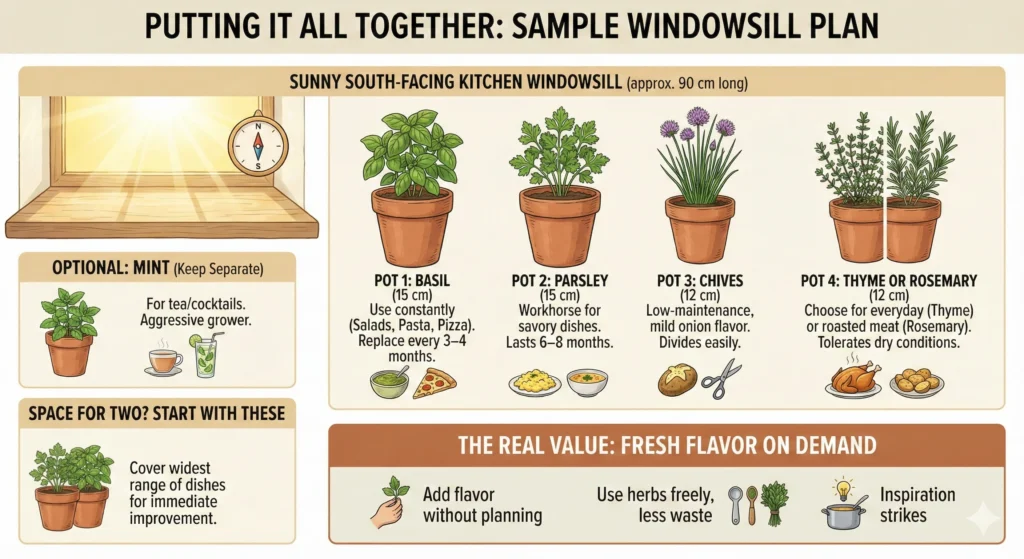
A sunny south-facing kitchen windowsill roughly 90 cm long can comfortably hold three to four herb pots with room for air circulation. Here’s a practical starting setup for everyday cooking:
Pot 1: Basil (15 cm pot). Use it constantly in summer dishes—tomato salads, pasta, pizzas, and pesto. Expect to replace it every 3–4 months as it eventually bolts despite your best efforts.
Pot 2: Parsley (15 cm pot). Your workhorse herb for nearly everything savoury. One plant produces steadily for 6–8 months before you need to start a replacement.
Pot 3: Chives (12 cm pot). Low-maintenance, reliable, and useful as a mild onion substitute and finishing herb. Divides easily when it outgrows its pot.
Pot 4: Thyme or rosemary (12 cm pot). Choose based on what you cook more often. Thyme suits everyday dishes; rosemary excels with roasted meat and potatoes. Both tolerate dry conditions if you forget to water occasionally.
This combination gives you fresh herbs for salads, eggs, pasta, roasted vegetables, soups, and most weeknight dinners. Add mint in a fifth pot if you drink tea or cocktails regularly, but keep it separate—mint outcompetes other herbs when planted together.
If you only have space for two pots, start with parsley and basil. They cover the widest range of dishes and give you the most immediate improvement in everyday cooking. Add others as you discover what you reach for most often.
Your sunny windowsill herb garden won’t replace a grocery store, but it will change how you cook. You’ll add fresh flavour without planning, use herbs more freely because they’re free, and waste less because you harvest only what each dish needs. That’s the real value: fresh herbs at your fingertips, exactly when inspiration strikes.