Magical Night-Blooming Flowers for Small City Gardens
After a long workday, stepping onto your balcony or patio into a cloud of sweet fragrance and pale, glowing blooms is one of urban gardening’s most rewarding experiences. Night-blooming flowers—plants that open their petals primarily or exclusively after sunset—transform cramped city spaces into evening sanctuaries. For apartment dwellers and homeowners with limited outdoor areas, these plants offer maximum sensory impact in minimal square footage, since you’re most likely to enjoy your garden during evening hours anyway.
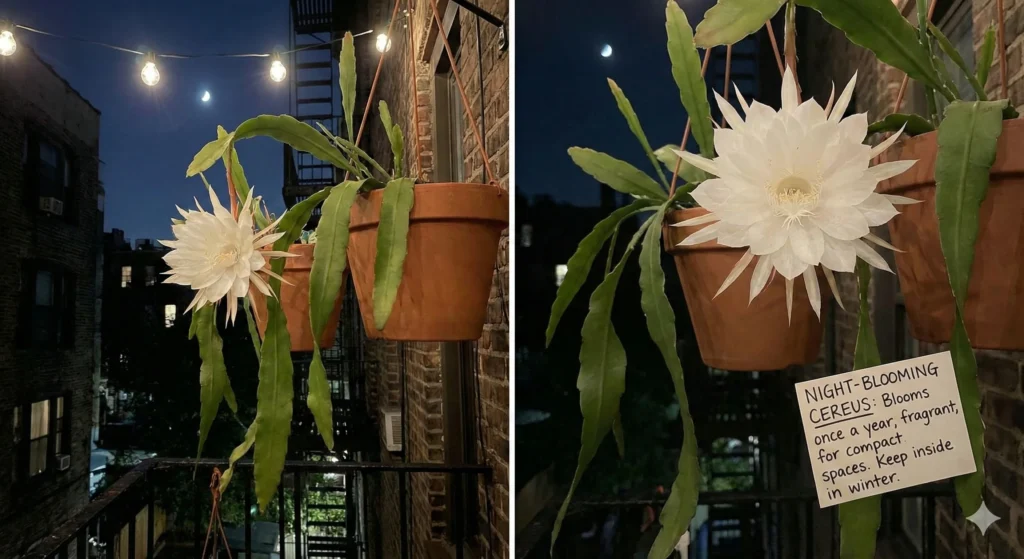
These flowers that bloom at night are perfect for small USA city gardens because they align perfectly with urban lifestyles. Most city gardeners work conventional hours, arriving home just as traditional flowers close for the day. By choosing flowers that bloom at night, you create a garden that performs when you’re actually present to appreciate it. Many of these plants also thrive in containers, making them ideal for balconies, rooftop terraces, and pocket-sized patios from USDA zones 3 through 10.
What Flowers Bloom at Night?
Flowers that open at night have evolved to attract nocturnal pollinators—primarily moths, but also bats in warmer regions and certain beetle species. These plants typically share several characteristics: pale or white petals that reflect moonlight and ambient city glow, intense fragrance that carries on evening air, and tubular or open flower shapes suited to hovering insects.
The timing mechanism is fascinating. Many night bloomers respond to decreasing light levels and cooler evening temperatures, which trigger their petals to unfurl. Some species bloom exclusively at night (meaning flowers close by dawn and never open during day), while others are crepuscular bloomers that open in late afternoon and remain accessible through the following morning. This biological clock is driven by circadian rhythms within the plant, fine-tuned over millennia to match pollinator activity patterns.
Complete List of Night-Blooming Flowers
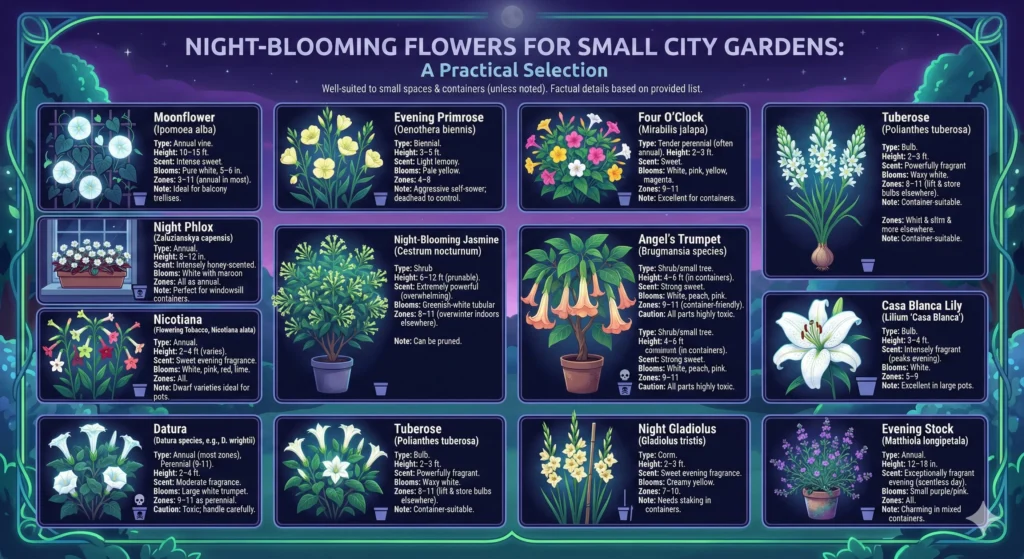
Here’s a practical selection of night-blooming plants well-suited to small city gardens. All grow successfully in containers unless otherwise noted:
Moonflower (Ipomoea alba) – Annual vine, 10–15 feet, intense sweet fragrance, pure white blooms 5–6 inches across. Zones 3–11 (grown as annual in most areas). Ideal for trellises on balconies.
Evening Primrose (Oenothera biennis) – Biennial, 3–5 feet, light lemony scent, pale yellow blooms. Zones 4–8. Can self-sow aggressively; deadhead to control.
Four O’Clock (Mirabilis jalapa) – Tender perennial (annual in most zones), 2–3 feet, sweet fragrance, blooms in white, pink, yellow, or magenta. Zones 9–11. Excellent for containers.
Night Phlox (Zaluzianskya capensis) – Annual, 8–12 inches, intensely honey-scented, white flowers with maroon undersides. All zones as annual. Perfect for windowsill containers.
Night-Blooming Jasmine (Cestrum nocturnum) – Shrub, 6–12 feet (can be pruned smaller), extremely powerful fragrance (can be overwhelming), greenish-white tubular flowers. Zones 8–11; overwinter indoors elsewhere.
Angel’s Trumpet (Brugmansia species) – Shrub/small tree, 4–6 feet in containers, large pendulous trumpet flowers in white, peach, or pink, strong sweet scent. Zones 9–11; container-friendly for overwintering. Caution: All parts highly toxic.
Nicotiana (Flowering Tobacco, Nicotiana alata) – Annual, 2–4 feet depending on variety, sweet evening fragrance, tubular flowers in white, pink, red, lime. All zones. Dwarf varieties ideal for pots.
Tuberose (Polianthes tuberosa) – Bulb, 2–3 feet, one of the most powerfully fragrant flowers, waxy white blooms. Zones 8–11; lift and store bulbs elsewhere. Container-suitable.
Casa Blanca Lily (Lilium ‘Casa Blanca’) – Bulb, 3–4 feet, intensely fragrant white flowers (bloom day and night, but scent peaks in evening). Zones 5–9. Excellent in large pots.
Datura (Datura species, especially D. wrightii) – Annual in most zones, 2–4 feet, large white trumpet flowers, moderate fragrance. Caution: Toxic; handle carefully. Zones 9–11 as perennial.
Night Gladiolus (Gladiolus tristis) – Corm, 2–3 feet, sweet evening fragrance, creamy yellow flowers. Zones 7–10. Needs staking in containers.
Evening Stock (Matthiola longipetala) – Annual, 12–18 inches, exceptionally fragrant in evening (scentless by day), small purple/pink flowers. All zones. Charming in mixed containers.
Best White Night-Blooming Flowers for Small Gardens
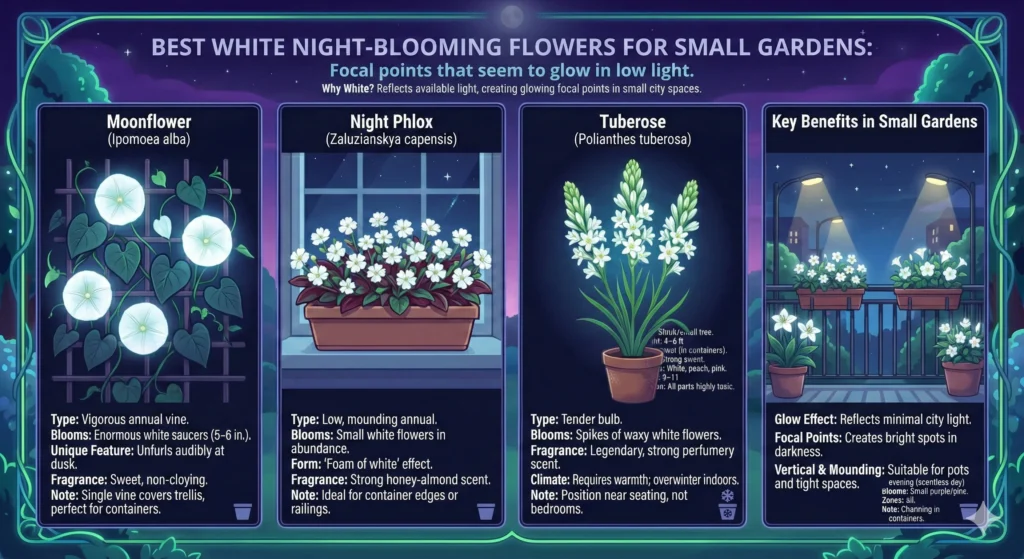
White flowers that bloom at night are the workhorses of evening gardens, and for good reason: they reflect available light better than any other color. In a small city space, where you might depend on streetlights, neighbor’s porch lights, or your own minimal outdoor lighting, white blooms create focal points that seem to glow.
Moonflower is the quintessential choice. This vigorous annual vine produces enormous white saucers that unfurl audibly at dusk—you can actually hear a faint rustle as each flower opens over about twenty minutes. The fragrance is sweet without being cloying, and a single vine on a 6-foot trellis can produce dozens of blooms per night in mid-to-late summer. Because moonflower is an annual, you needn’t worry about it overtaking your space; plant seeds in a 5-gallon container with a trellis or railing support, and you’ll have a vertical wall of fragrance.
Night Phlox offers a completely different form factor—low, mounding, perfect for the front edge of a container or hanging slightly over a railing. The flowers are individually small (about ½ inch), but they’re produced in such abundance that the overall effect is a foam of white. The fragrance, described as honey-almond, is disproportionately strong for such tiny blooms.
Tuberose is worth highlighting separately. While it requires warmer conditions to thrive (think Mediterranean or subtropical climates in the USA), it can be grown successfully in containers throughout the country if you’re willing to lift the bulbs before frost or overwinter the pots in a garage. A cluster of five to seven tuberose bulbs in a 12-inch pot will produce multiple spikes of waxy white flowers whose fragrance is legendary in perfumery. Position tuberose near your primary seating area, not next to bedroom windows, as the scent can be overwhelming in enclosed spaces.
Yellow and Purple Flowers That Bloom at Night
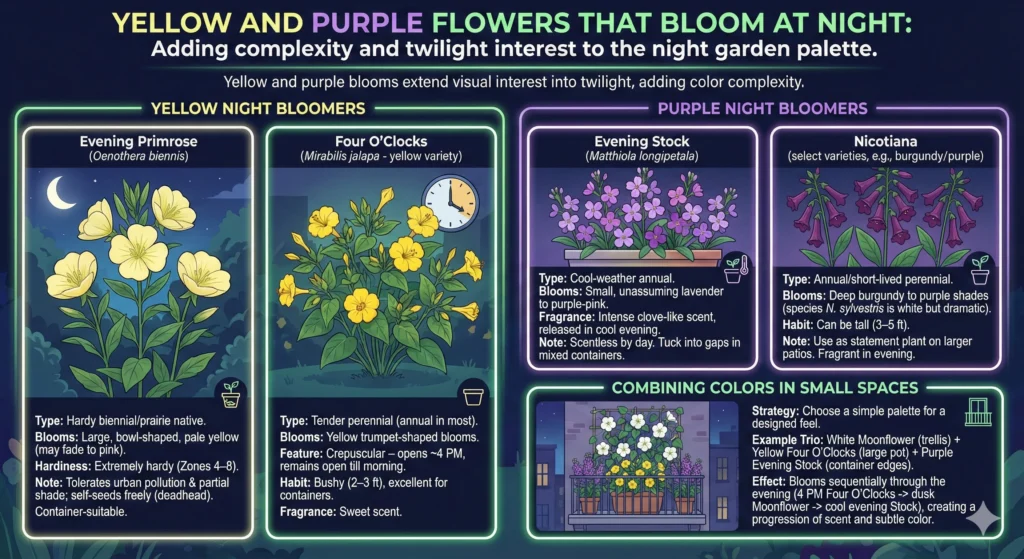
While white dominates the night garden palette, yellow and purple blooms add valuable complexity and extend the visual interest into twilight hours when some color is still perceptible.
Yellow Night Bloomers
Evening Primrose is the most accessible yellow option for northern climates. This prairie native opens pale yellow blooms (occasionally fading to pink by morning) that are large and bowl-shaped. While less fragrant than some night bloomers, it’s extremely hardy (zones 4–8) and unbothered by urban pollution. Grow it in well-drained soil or containers; it tolerates partial shade, useful on east-facing balconies. Be aware that evening primrose readily self-seeds—deadhead spent blooms if you’re working with very limited space.
Four O’Clocks come in a yellow variety (also magenta, pink, white, and even bicolors on the same plant). The common name is literal: flowers open around 4 p.m. and remain open until the following morning, making them technically crepuscular rather than strictly nocturnal. Their trumpet-shaped blooms and bushy habit (2–3 feet) make them excellent container specimens that provide structure as well as fragrance.
Purple Night Bloomers
Evening Stock produces small, four-petaled flowers in shades from pale lavender to deep purple-pink. The blossoms are unassuming by day (and scentless), but as temperatures drop in evening, they release an intense, clove-like fragrance. Evening stock is an annual that prefers cool weather—in hot summer climates, plant it for spring or fall bloom. In a small garden, tuck it into gaps in mixed containers where its fragrance will surprise visitors who can’t immediately locate the source.
Certain Nicotiana cultivars come in deep burgundy to purple shades, though white and pink are more common. The species Nicotiana sylvestris, while white-flowered, deserves mention here for its dramatic form: tall stalks (3–5 feet) topped with drooping clusters of long tubular flowers. It’s too large for truly tiny spaces but works on a larger patio as a statement plant.
Combining Colors in Small Spaces
In a limited area, resist the urge to collect one of everything. Instead, choose a simple palette: for example, combine white moonflower trained up a trellis with yellow four o’clocks in a large floor container and purple evening stock tucked into the edges. This trio blooms sequentially through the evening (four o’clocks opening first, moonflower at deep dusk, stock intensifying as night cools), creating a progression of scent and subtle color that makes your small space feel intentionally designed rather than randomly planted.
Night-Blooming Cactus and Cereus for Compact Spaces
Night-blooming cacti offer a dramatically different aesthetic—sculptural, water-wise, and perfect for gardeners with very limited time or space. The most commonly grown is Night-Blooming Cereus (Epiphyllum oxypetalum or Selenicereus species), a group of epiphytic cacti that produce enormous, intensely fragrant white flowers that open after dark and wilt by morning.
True night-blooming cereus is often grown as a houseplant that spends summers on a balcony or patio. The plant itself is ungainly—long, flat, leaf-like stems that sprawl or climb—but when it blooms (often erratically, a few nights per summer), the flowers are spectacular: pure white, up to 7 inches across, with a complex sweet-spicy fragrance. In zones 10–11, you can grow cereus outdoors year-round in containers. Elsewhere, treat it as a container specimen to bring inside before frost.
Care requirements are minimal: provide bright indirect light (morning sun is fine; harsh afternoon sun can scorch stems), water when the top inch of soil is dry, and use well-draining cactus mix in a hanging pot or one with a support stake. Epiphyllum oxypetalum is spineless, making it safe around children and pets. However, be aware that cereus blooming is unpredictable—plants may bloom multiple times in a season or not at all some years, typically in response to temperature fluctuations or dry periods.
Other night-blooming cacti include Peniocereus greggii (Desert Night-Blooming Cereus) and Hylocereus undatus (Dragon Fruit), both of which bloom at night. Dragon fruit, in particular, is becoming popular as an edible ornamental for warm-climate urban gardens; the large white flowers are pollinated by moths and bats, and successful pollination yields the familiar pink fruit.
Flowers That Bloom at Night and Die in the Morning
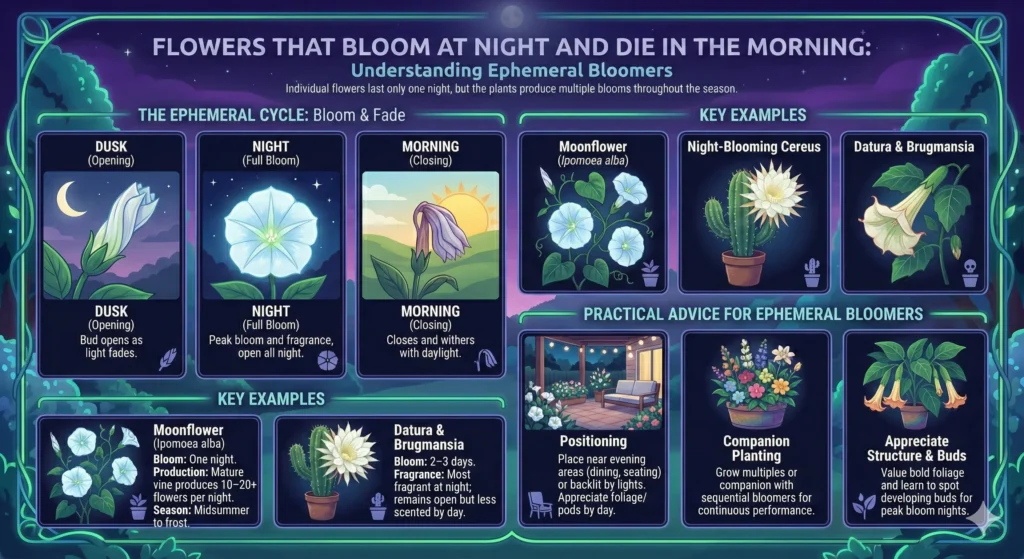
Several night bloomers are strictly ephemeral, meaning individual flowers last only one night. This characteristic puzzles some gardeners (“Why would I grow something that dies so quickly?”), but understanding the biology makes these plants more appealing.
Moonflower is the classic example. Each flower opens at dusk, remains open all night, then closes and withers as morning light strengthens. However, a mature vine produces 10–20+ flowers per night throughout its blooming season (midsummer through frost), so you’re never without blooms. The key is managing expectations: this isn’t a plant you’ll wake up to admire in daylight, but rather one you experience during your actual outdoor time—evening and night.
Most night-blooming cereus species also follow this pattern. A large, established cereus might produce five to ten flowers simultaneously on a single night, creating a spectacular but brief show. Growers often invite friends over for “cereus parties” when buds are swelling and clearly about to open.
Datura and Brugmansia (Angel’s Trumpet) have flowers that typically last two to three days, but they open in evening and are most fragrant at night, then remain open but less scented during the day before fading.
Practical advice for ephemeral bloomers:
- Position them where you naturally spend evening time—near outdoor dining areas, visible from where you sit with morning coffee (to appreciate the sculptural seed pods or foliage after blooms fade), or backlit by porch lights.
- If possible, grow multiples or companion them with sequential bloomers so something is always performing.
- Consider the foliage and structure, not just flowers. Brugmansia, for instance, offers bold tropical foliage all season even when not blooming.
- Learn to spot developing buds so you’re home to witness peak bloom nights.
Creating a Fragrant Evening Garden in a Small Space
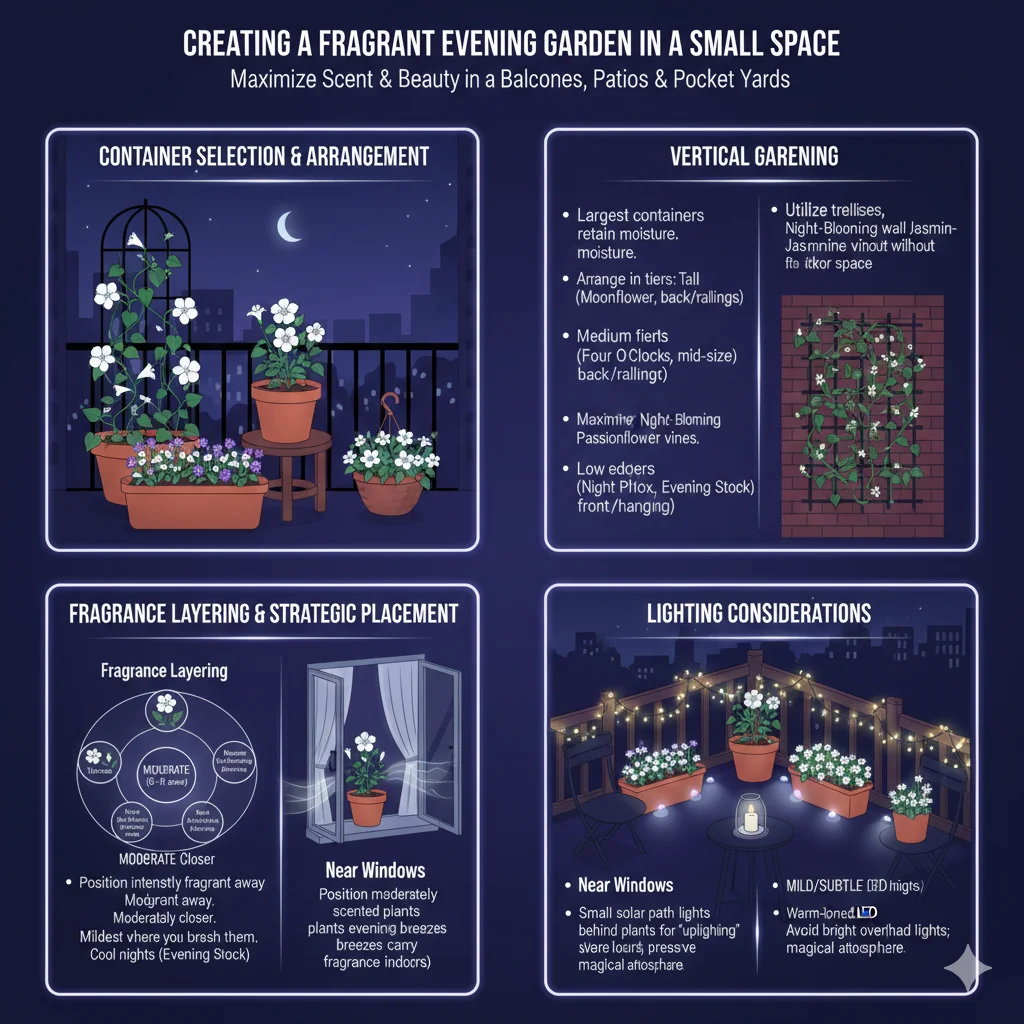
Designing a night garden in a balcony, patio, or pocket yard requires thinking differently than traditional ornamental gardening. Your priorities are fragrance, strategic placement, and maximizing limited square footage.
Container selection and arrangement: Use the largest containers your space and weight load allow. A 15-gallon pot permits deeper root development and retains moisture better than smaller pots—crucial for fragrant bloomers, which often need consistent watering to produce scent. Arrange pots in tiers if possible: tall plants (moonflower on a trellis, nicotiana) at the back or along railings, medium plants (four o’clocks, tuberose) in mid-size pots on plant stands or upturned nursery pots, and low edgers (night phlox, evening stock) in front or in hanging baskets at nose level.
Vertical gardening: In truly tiny spaces, go vertical. Train moonflower, night-blooming jasmine, or even passionflower vines (which have subtly fragrant night blooms in some species) up trellises, railings, or wall-mounted supports. This approach gives you abundant bloom without consuming precious floor space.
Fragrance layering: Instead of choosing only the most powerfully scented plants, create a progression. Position intensely fragrant species (tuberose, night-blooming jasmine) 8–10 feet from primary seating so they don’t overwhelm. Place moderately scented plants (moonflower, nicotiana) closer, and tuck mildly fragrant or subtly scented plants (evening primrose, certain four o’clocks) into intimate areas where you’ll brush against them or actively lean in to smell.
Different plants also release fragrance at different temperatures. Nicotiana and moonflower are most fragrant on warm nights (above 65°F), while evening stock intensifies as evening cools. By growing both types, you ensure fragrance across a wider range of conditions.
Strategic placement near windows and doors: If you have windows that open onto your balcony or patio, position moderately scented plants (not the overpowering ones) where evening breezes will carry fragrance indoors. This extends your garden’s sensory reach into your living space.
Lighting considerations: Night gardens don’t require elaborate lighting, but a bit of strategic illumination enhances the experience. Small solar path lights placed behind or under white-flowered plants create an uplighting effect that makes blooms glow. Avoid bright overhead lights, which diminish your night vision and reduce the magical quality of pale flowers in darkness. Warm-toned LED string lights or single candles are enough to find your way around while preserving the night-adapted atmosphere.
Attracting Pollinators with Night-Blooming Flowers
Night blooming flowers support an underappreciated community of pollinators that most gardeners never see: sphinx moths (also called hawk moths or hummingbird moths), smaller nocturnal moths, and in southwestern and southern regions, nectar-feeding bats.
Sphinx moths are particularly remarkable pollinators. These large moths have long proboscises that reach deep into tubular flowers like moonflower, nicotiana, and Brugmansia. They hover while feeding, much like hummingbirds, and are attracted to pale flowers with strong, sweet fragrances. By growing night bloomers, you’re providing essential nectar sources during moths’ active hours.
In urban environments, any support you offer to pollinators contributes meaningfully to local biodiversity. Cities are often “nectar deserts” after dark, so even a single balcony planted with moonflower and evening stock creates a refueling station for moths moving through the area.
Practical ways to support nocturnal pollinators:
- Avoid all pesticides, including organic ones like neem oil, which harm beneficial insects as readily as pests. Most night bloomers have few serious pest issues anyway.
- Provide water sources—a shallow dish with pebbles for insects to land on works well.
- Don’t deadhead too aggressively; some moths also feed on overripe fruit or tree sap, and spent flowers provide habitat for beneficial insects.
- If you live in zones 9–11, particularly in the Southwest (southern Arizona, New Mexico, Texas), consider plants specifically adapted to bat pollination, such as certain Agave species (which bloom after many years) or Night-Blooming Cereus species native to the region.
- Leave a few dried stems standing over winter to provide habitat for overwintering moth pupae.
Creating even a tiny night garden with attention to pollinators demonstrates that urban gardening can be about more than personal enjoyment—it’s also an act of ecological stewardship.
FAQs About Night-Blooming Flowers
Do night-blooming flowers need full sun?
Most night-blooming flowers prefer full sun (6+ hours of direct sunlight daily) to produce abundant blooms, though they perform the actual blooming after sunset. Exceptions include night-blooming jasmine and some Nicotiana varieties, which tolerate partial shade. In very hot climates (zones 9–11), afternoon shade can actually improve performance by preventing stress.
Can I grow night-blooming flowers in containers?
Yes—the majority of night bloomers adapt beautifully to containers, making them ideal for balconies and patios. Moonflower, four o’clocks, nicotiana, tuberose, night phlox, and evening stock all thrive in pots with good drainage and regular watering. Use containers at least 12 inches in diameter for most species; larger (15+ gallons) for vigorous vines or shrubs.
Why do my night-blooming flowers open during the day?
Some plants sold as “night bloomers” are actually crepuscular (opening in late afternoon and remaining open through morning). Four o’clocks are a prime example. True night-only bloomers like moonflower may occasionally fail to close if temperatures remain unusually cool or if they’re grown in deep shade—the environmental cues that trigger petal movement are disrupted.
Are night-blooming flowers safe around pets and children?
This varies significantly by species. Night phlox, moonflower, nicotiana, and four o’clocks have low to moderate toxicity (may cause mild stomach upset if ingested in quantity but aren’t typically dangerous). However, Datura and Brugmansia (Angel’s Trumpet) are highly toxic—all parts contain tropane alkaloids and should be avoided if you have curious children or pets that chew plants. Night-blooming jasmine is also toxic if ingested. Always research specific plants before introducing them to your space.
How do I get night-blooming cereus to bloom?
Cereus blooming is notoriously unpredictable, but you can encourage it by: (1) providing a cool winter rest period (50–55°F, reduced watering), (2) exposing plants to a slight dry period in late spring before resuming regular watering, (3) ensuring the plant is rootbound (they bloom better when slightly pot-stressed), and (4) giving bright indirect light. Some plants simply won’t bloom until they reach maturity at 3–5 years old.
What’s the strongest-smelling night-blooming flower?
Tuberose and night-blooming jasmine are generally considered the most intensely fragrant, with scents that can carry 20+ feet on still evenings. Both can be overwhelming in enclosed spaces or near bedroom windows. For strong but more pleasant fragrance, moonflower and nicotiana offer powerful scent without becoming cloying.
When do night-blooming flowers bloom during the season?
Most night bloomers are warm-season plants that flower from midsummer through fall. Moonflower typically starts blooming in July (after developing substantial vine growth) and continues until frost. Nicotiana, four o’clocks, and evening stock bloom continuously once established. Spring bulbs like night gladiolus bloom earlier (May–June in most zones). Cereus blooms sporadically, often in response to weather changes.
Can I grow these flowers in cold climates?
Many night bloomers are frost-tender perennials grown as annuals in cold climates (zones 3–7). Moonflower, nicotiana, four o’clocks, night phlox, and evening stock all grow successfully as annuals throughout the USA. Tuberose and Brugmansia can be overwintered indoors or by storing dormant bulbs/pots. Truly cold-hardy options include evening primrose (zones 4–8) and Casa Blanca lilies (zones 5–9).