Radiant Easter vs Christmas Cactus Care Guide
1. Introduction
“Holiday cacti” confuse a lot of people. The plant sold as a “Christmas cactus” might actually be a Thanksgiving cactus, and a plant flowering around Easter might be a true Easter cactus or just a Christmas cactus that missed its schedule. On top of that, they are tropical, epiphytic cacti, so classic “desert cactus” care often does more harm than good.
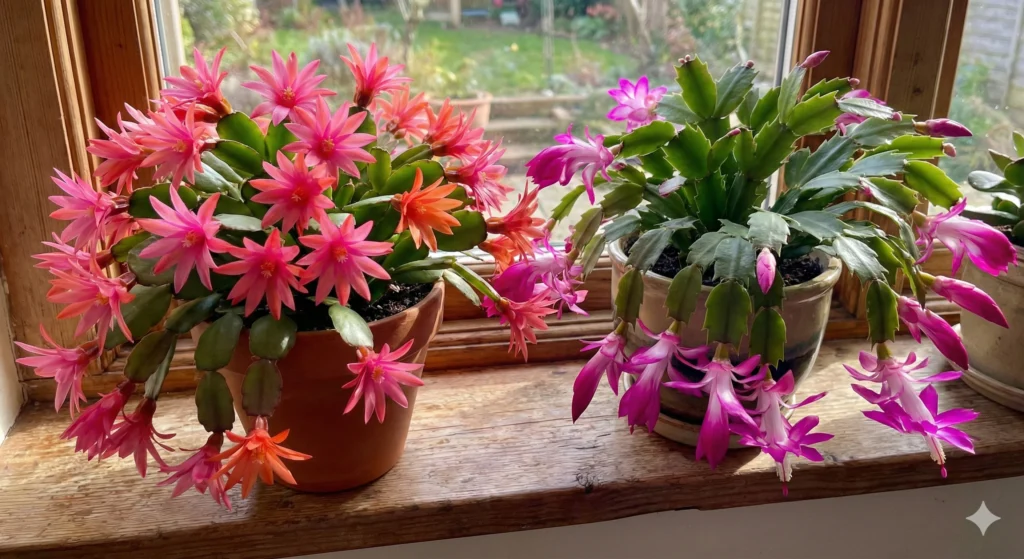
This guide focuses on Easter cactus vs Christmas cactus: how to identify which you have, how their needs differ, and how to give each plant the right light, water, soil, and temperature for reliable blooms. You will also find seasonal calendars, troubleshooting for “Easter cactus not blooming” and “Christmas cactus not blooming,” and a quick-print care cheat sheet at the end.
2. Quick Comparison: Easter Cactus vs Christmas Cactus
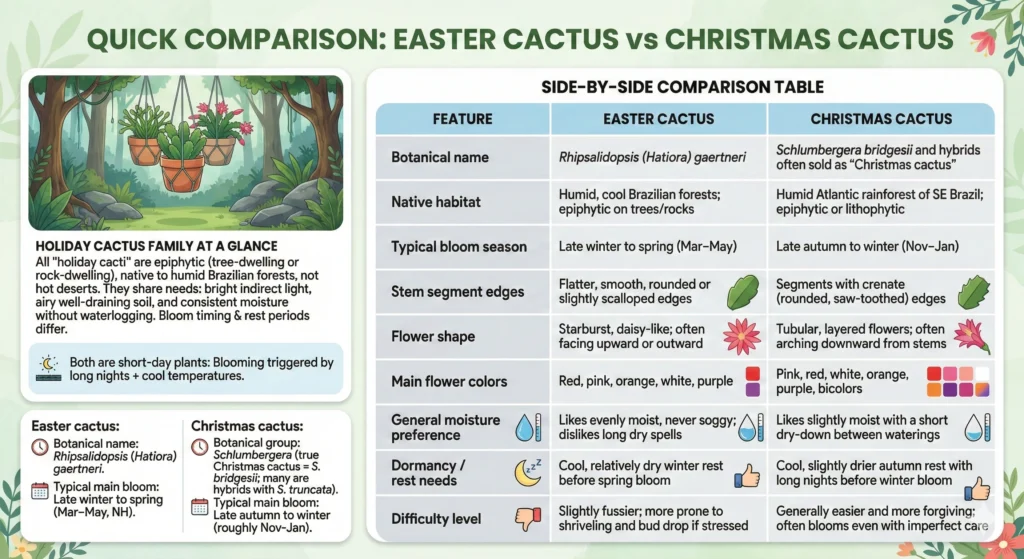
2.1 Holiday Cactus Family at a Glance
All the “holiday cacti” are epiphytic cacti (tree‑dwelling or rock‑dwelling), native to humid forests of Brazil, not hot deserts. They share many needs—bright indirect light, airy, well‑draining soil, and consistent moisture without waterlogging—but their bloom timing and rest periods differ.
- Easter cactus:
- Christmas cactus:
Both are short‑day plants: their blooming cycle is triggered by long nights plus cool temperatures.
2.2 Side‑by‑Side Comparison Table
3. How to Tell Easter Cactus from Christmas Cactus
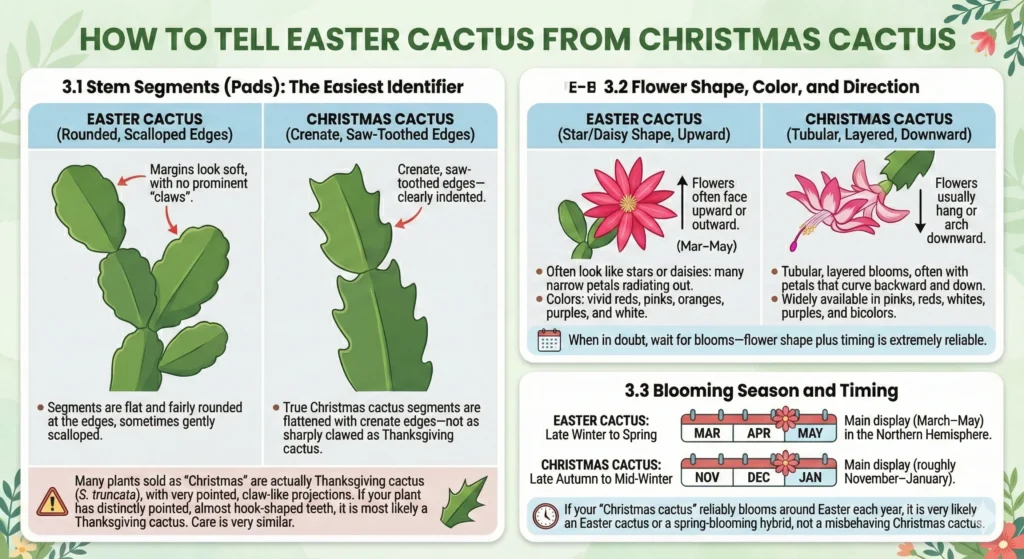
3.1 Stem Segments (Pads): The Easiest Identifier
Look closely at the “leaf” segments (they are actually flattened stems):
- Easter cactus
- Christmas cactus
If your plant has distinctly pointed, almost hook‑shaped teeth, it is most likely a Thanksgiving cactus, not a true Christmas cactus. That still counts as a “holiday cactus” and the care is very similar.
3.2 Flower Shape, Color, and Direction
- Easter cactus flowers
- Christmas cactus flowers
When in doubt, wait for blooms—flower shape plus timing is extremely reliable.
3.3 Blooming Season and Timing
- Easter cactus: main display is late winter to spring (March–May) in the Northern Hemisphere.
- Christmas cactus: main display is late autumn to mid‑winter (roughly November–January).
If your “Christmas cactus” reliably blooms around Easter each year, it is very likely an Easter cactus or a spring‑blooming hybrid, not a misbehaving Christmas cactus.
4. Native Habitat: Why These “Cacti” Don’t Like Desert Care
4.1 Rainforest Epiphytes, Not Desert Dwellers
In the wild, holiday cacti grow in the Atlantic rainforests of Brazil. They perch on mossy tree branches or nestle in rock crevices filled with decaying leaves, where they experience:
- Bright but filtered light under a forest canopy
- High humidity and frequent, gentle rainfall
- Cool to mild temperatures, not intense heat
- Constantly moist, but well‑aerated organic debris around their roots
This is very different from classic desert cacti. Treating them like desert plants—full sun, hot, and bone‑dry soil—leads to shriveled segments, sunburn, and root stress.
4.2 How Habitat Differences Shape Care
Because they are epiphytic cacti (epi = on, phyte = plant), they prefer:
- Bright indirect light or gentle morning sun
- Well‑draining potting mix that holds some moisture but never stays soggy
- Regular watering with a partial dry‑down, not long droughts
- Moderate to high humidity and good air movement
Keeping this rainforest origin in mind makes indoor plant care choices simple and intuitive.
5. Shared Care Basics (For Both Easter and Christmas Cactus)
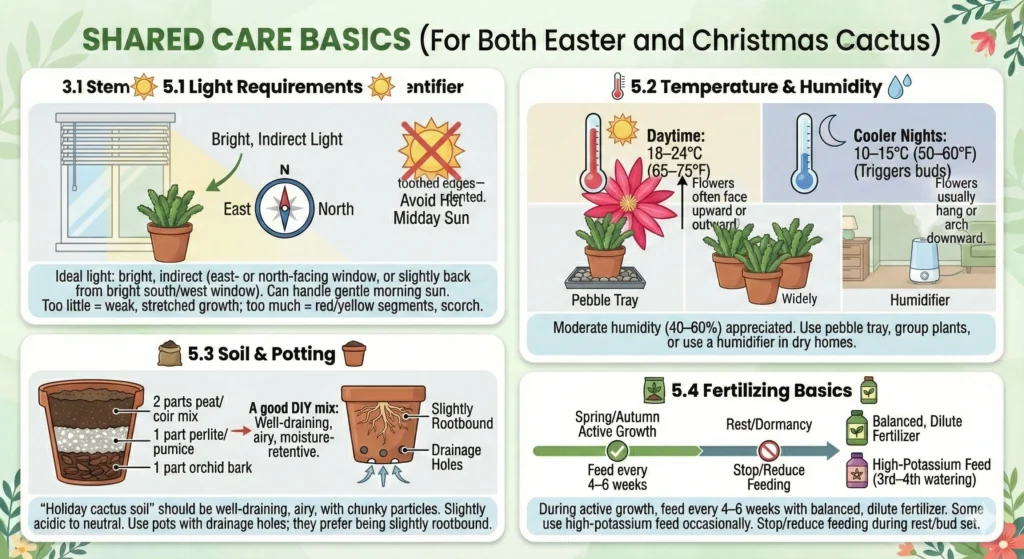
5.1 Light Requirements
- Ideal light is bright, indirect light—an east‑ or north‑facing window, or slightly back from a bright south or west window.
- They can handle a bit of gentle morning sun, especially Easter cactus, but avoid hot midday sun which can redden or scorch segments.
- Too little light leads to weak, stretched growth and fewer blooms; too much direct sun causes red or yellow segments and stress.
5.2 Temperature & Humidity
- Comfortable daytime temperatures: about 18–24°C (65–75°F) for most of the year.
- Cooler night temperatures (around 10–15°C / 50–60°F) help trigger buds during the bloom‑induction phase.
- They appreciate moderate humidity (around 40–60%). Use:
5.3 Soil & Potting
“Holiday cactus soil” should be:
- Well‑draining yet moisture‑retentive
- Airy, with chunky particles that prevent compaction
- Slightly acidic to neutral
A good DIY mix for both Easter and Christmas cactus:
- 2 parts high‑quality peat‑ or coir‑based potting mix
- 1 part perlite or pumice
- 1 part fine orchid bark or similar chunky material
Use pots with drainage holes. These plants prefer to be slightly rootbound, so do not overpot.
5.4 Fertilizing Basics
- During active growth (roughly late winter/spring through early autumn), feed every 4–6 weeks with a balanced, dilute fertilizer (e.g., all‑purpose or flowering houseplant feed at half strength).
- Some growers use a high‑potassium fertilizer (like tomato feed) every 3rd–4th watering in the growing season to support bud formation.
- Stop or reduce feeding during rest/dormancy phases and when plants are setting buds; resume lightly once they are actively growing again.
6. Easter Cactus Care: Detailed Guide
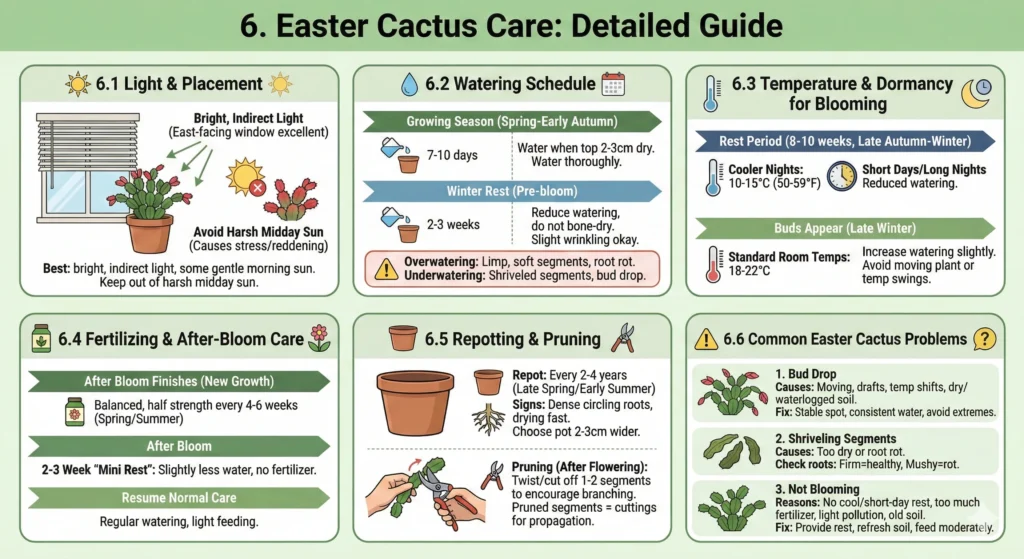
6.1 Light & Placement
- Best location: bright, indirect light with some gentle morning sun if possible.
- Keep out of harsh midday sun, which can cause segments to turn reddish and stressed.
- Indoors, an east‑facing window or bright spot a bit back from a south window is excellent.
6.2 Easter Cactus Watering Schedule
Easter cactus tends to be less drought‑tolerant than Christmas cactus. It dislikes completely dry soil for long periods.
- Growing season (roughly spring–early autumn):
- Winter rest (pre‑bloom) period:
Signs you are off balance:
- Overwatering: limp, soft segments and possibly black, mushy roots (root rot).
- Underwatering: segments become shriveled and stiff; buds dry and drop.
6.3 Easter Cactus Temperature & Dormancy for Blooming
To get a strong spring display and solve “Easter cactus not blooming”:
- Rest period: about 8–10 weeks in late autumn–winter with:
- Once buds appear in late winter:
Avoid big temperature swings or moving the plant once buds form—both can cause bud drop.
6.4 Fertilizing & After‑Bloom Care
- Start feeding shortly after flowering finishes, as new growth begins:
- After bloom:
- Give a 2–3 week “mini rest”: slightly less water, no fertilizer
- Then resume normal Easter cactus care with regular watering and light feeding
6.5 Repotting & Pruning
- When to repot: every 2–4 years, ideally in late spring or early summer after flowering.
- Signs it is time: roots circling densely, drying out very fast, or soil breaking down into fine, soggy particles.
- Choose a pot 2–3 cm (about 1 inch) wider than the old one; keep it on the snug side.
- Pruning:
- After flowering, you can twist or cut off the last one or two segments of stems to encourage branching.
- Pruned segments double as cuttings for propagation.
6.6 Common Easter Cactus Problems
1. Bud drop
- Causes: moving plant while budding, drafts, sudden temperature shifts, letting soil go very dry, or waterlogging.
- Fix: keep the plant in one stable spot during budding, water consistently, avoid extremes and cold/hot blasts of air.
2. Shriveling segments
- Usually a watering problem: either too dry for too long, or roots rotting from constant wetness.
- Check roots: firm and white/tan = healthy; brown/black and mushy = rot. Adjust watering and soil as needed.
3. Easter cactus not blooming
- Possible reasons:
- No cool, short‑day rest period in winter
- Too much fertilizer, especially late in the year
- Light pollution at night (strong artificial light near the plant)
- Very old, exhausted soil or potbound roots
- Fix:
7. Christmas Cactus Care: Detailed Guide
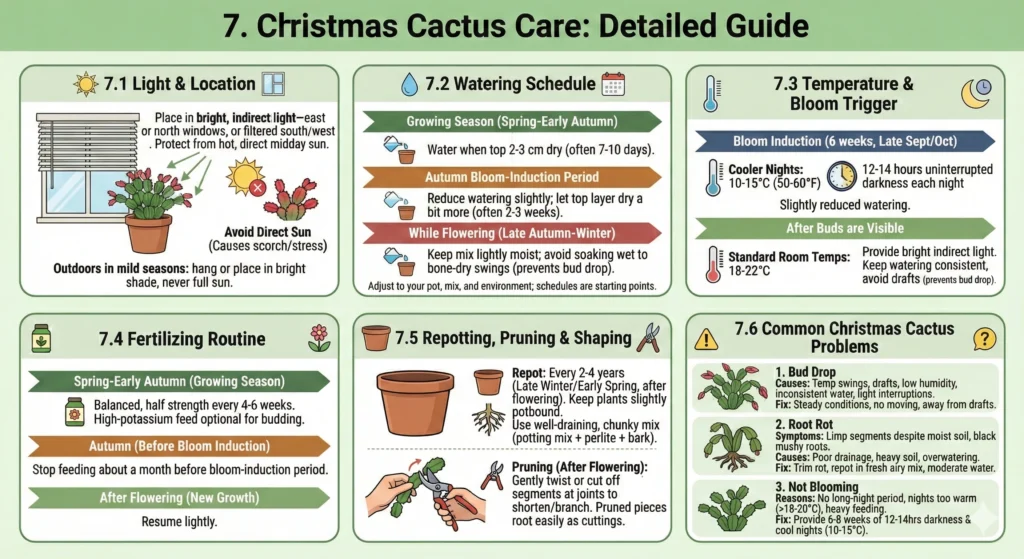
7.1 Light & Location
- Place in bright, indirect light—east or north windows, or filtered south/west light.
- Protect from hot, direct midday sun, especially through glass.
- Outdoors in mild seasons, hang or place in bright shade, never in full, burning sun.
7.2 Christmas Cactus Watering Schedule
Christmas cactus is slightly more tolerant of short dry periods than Easter cactus, but still dislikes sitting in soggy soil.
- Growing season (roughly spring–early autumn):
- Autumn bloom‑induction period:
- While flowering (late autumn–winter):
Always adjust to your pot, mix, and environment: water schedules from guides are starting points, not rigid rules.
7.3 Christmas Cactus Temperature & Bloom Trigger
To solve “Christmas cactus not blooming” and understand how to get Christmas cactus to bloom, focus on temperature plus darkness:
- About 6 weeks of:
This regime usually starts in late September or October for blooms around November–December, depending on your climate and whether you have a true Christmas vs Thanksgiving type.
After buds are visible:
- Move back to more typical room temperatures (18–23°C)
- Provide bright indirect light
- Keep watering consistent and avoid drafts to prevent bud drop
7.4 Fertilizing Routine
- From spring through early autumn, feed every 4–6 weeks with a balanced fertilizer at half strength.
- Some growers use a high‑potassium fertilizer (tomato feed) during the growing season to encourage heavy budding.
- Stop feeding about a month before starting the bloom‑induction period in autumn; resume lightly after flowering when new growth appears.
7.5 Repotting, Pruning & Shaping
- Repot every 2–4 years in late winter or early spring, once flowering has finished.
- Use a well‑draining, chunky mix similar to Easter cactus (potting mix + perlite + bark).
- Keep plants slightly potbound; large pots with excess wet soil raise the risk of root rot.
- For shaping:
- After flowering, gently twist or cut off segments at the joints to shorten overly long stems and encourage branching.
- These pruned pieces root easily as cuttings.
7.6 Common Christmas Cactus Problems
1. Bud drop
- Causes: sudden temperature swings, drafts, low humidity, inconsistent watering, or light interruptions at night during bud formation.
- Fix: keep conditions steady during budding; avoid moving the plant and keep it away from doors, vents, heaters.
2. Root rot
- Symptoms: limp, drooping segments despite moist soil; black, mushy roots when unpotted.
- Causes: poor drainage, heavy soil, overwatering.
- Fix: trim rotted roots, repot in fresh, airy mix, and adopt a moderate watering routine.
3. Christmas cactus not blooming
- Common reasons:
- Fix:
8. Blooming Mechanics: How to Get Reliable Flowers Every Year
8.1 Photoperiod (Day Length) & Darkness
These are short‑day plants, meaning they form flower buds when days are short and nights are long and uninterrupted. The term photoperiod refers to the ratio of light to dark in 24 hours.
- Most holiday cacti need about 12–14 hours of darkness each night for several weeks to initiate buds.
- Even a brief burst of bright light during the dark period can confuse the plant and delay or reduce budding.
8.2 Temperature Requirements Compared
Temperature interacts with photoperiod—this is sometimes called thermo‑photoperiodic behavior.
- Christmas cactus:
- Easter cactus:
Too‑warm nights (above about 18–20°C) can prevent blooming even if day length is correct.
8.3 Timing Your Bloom to the Holiday
To roughly time blooms:
- For Christmas cactus
- For Easter cactus
8.4 Troubleshooting Non‑Blooming Plants
If your plant is healthy but refuses to bloom:
- Confirm identification (Easter vs Christmas vs Thanksgiving). Their internal “clocks” differ by several weeks.
- Ensure:
- Enough darkness (12–14 hours nightly)
- Cool enough nights
- A rest period with reduced watering and feeding beforehand
- Check for stress: repotting too close to bloom time, severe pruning, pests, or root rot can all delay or stop budding.
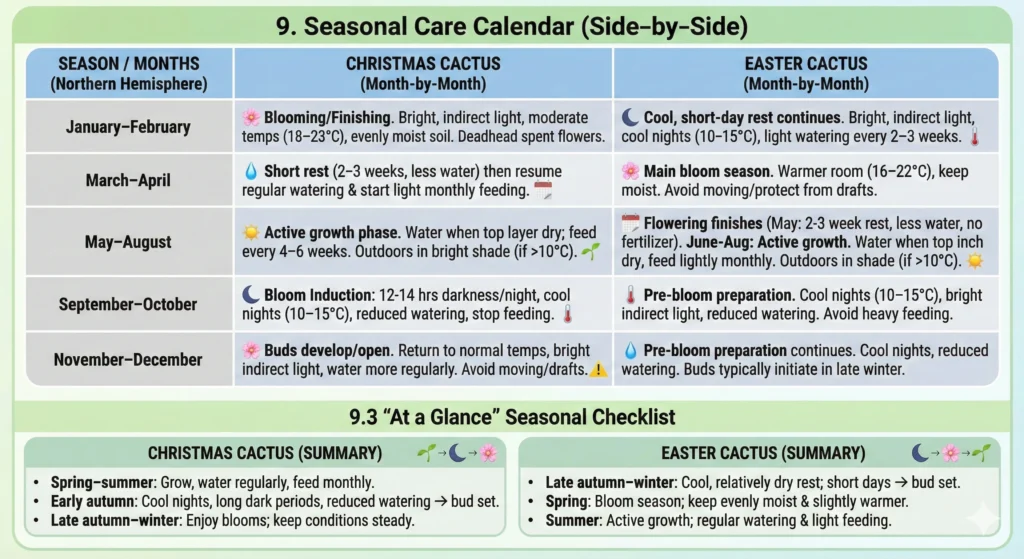
9. Seasonal Care Calendar (Side‑by‑Side)
9.1 Month‑by‑Month for Christmas Cactus
(Northern Hemisphere timing; in the Southern Hemisphere, shift by ~6 months.)
January–February
- Plant is usually still blooming or just finishing.
- Keep in bright, indirect light, moderate temps (18–23°C), and evenly moist soil. Deadhead spent flowers.
March–April
- Blooming ends; give a short rest: slightly less water for 2–3 weeks.
- Then resume regular watering and start light feeding monthly.
May–August
- Active growth phase.
- Water when the top layer is dry; feed every 4–6 weeks.
- Can go outdoors in bright shade if temps stay above about 10°C (50°F).
September–October
- Begin bloom induction for “how to get Christmas cactus to bloom”:
November–December
- Buds develop and open.
- Return to normal room temps, keep light bright but indirect, and water more regularly (but not soggy).
- Avoid moving the plant or exposing it to drafts to prevent bud drop.
9.2 Month‑by‑Month for Easter Cactus
January–February
- Cool, short‑day rest continues.
- Keep in bright, indirect light with cool nights (around 10–15°C).
- Water lightly every 2–3 weeks, just preventing complete dryness.
March–April
- Main bloom season for most cultivars.
- Move to a slightly warmer room (16–22°C), keep moist but not soggy.
- Avoid moving the plant; protect buds from drafts.
May
- Flowering finishes.
- Provide a 2–3 week rest with a bit less water and no fertilizer, then resume normal care.
June–August
- Active growth phase.
- Water when the top inch of soil is dry; feed lightly every 4–6 weeks.
- May be placed outdoors in shaded, frost‑free conditions (above ~10°C).
September–December
- Pre‑bloom preparation: late autumn into winter.
- Provide cooler nights (10–15°C), bright but indirect light, and reduced watering.
- Avoid heavy feeding and repotting during this period. Buds typically initiate in late winter.
9.3 “At a Glance” Seasonal Checklist
Christmas cactus (summary)
- Spring–summer: grow, water regularly, feed monthly.
- Early autumn: cool nights, long dark periods, reduced watering → bud set.
- Late autumn–winter: enjoy blooms; keep conditions steady.
Easter cactus (summary)
- Late autumn–winter: cool, relatively dry rest; short days → bud set.
- Spring: bloom season; keep evenly moist and slightly warmer.
- Summer: active growth; regular watering and light feeding.
10. Propagation, Repotting & Long‑Term Care
10.1 Propagating by Stem Cuttings (for both)
Propagation is simple and a good way to rejuvenate older plants.
Step‑by‑step:
- Timing: Best right after flowering, in late winter or spring.
- Take cuttings:
- Gently twist off or cut 2–4 segment pieces from healthy stems.
- Callus:
- Planting:
- Insert the callused end about 1–2 cm deep into a barely moist, well‑draining mix.
- Conditions:
- Keep in bright, indirect light with moderate humidity.
- Keep the mix only lightly moist—never wet.
- Rooting:
10.2 When and How to Repot Safely
- Repot only when needed, typically every 2–4 years.
- Best time: after flowering, in late winter–spring.
- Steps:
Avoid repotting just before or during bud formation—this often causes buds to abort.
10.3 Keeping Plants for Decades
With good care, holiday cacti can live for many decades, even over a century.
Key long‑term habits:
- Refresh soil periodically before it breaks down into fine, soggy particles.
- Avoid chronic overwatering or long droughts.
- Give them proper rest and light each year to keep the blooming cycle strong.
- Take cuttings occasionally to have “backup” plants and share with friends.
11. Pests, Diseases & Physiological Issues
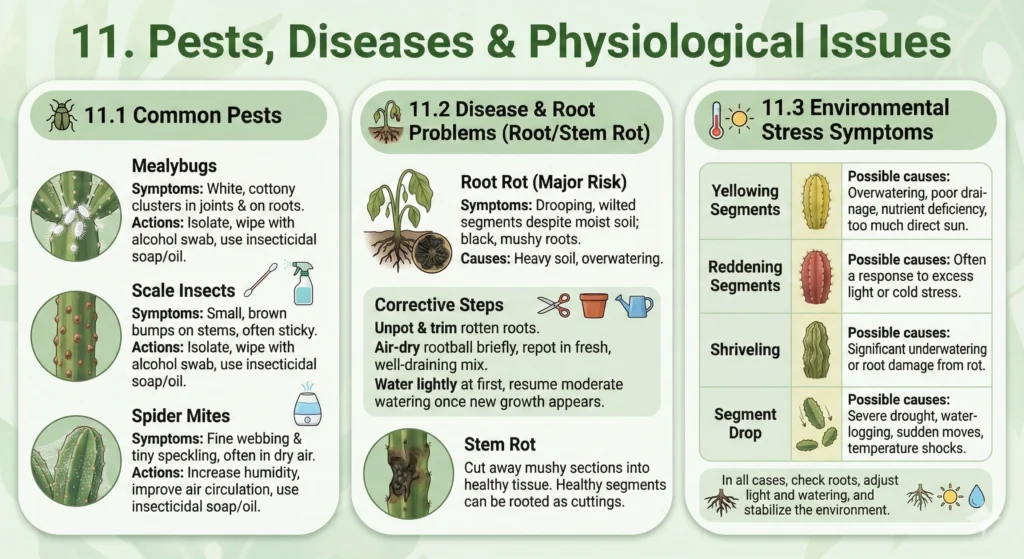
11.1 Common Pests
Typical indoor pests that may appear:
- Mealybugs: white, cottony clusters in joints and on roots.
- Scale insects: small, brown bumps on stems, often sticky.
- Spider mites: fine webbing and tiny speckling on segments, often in dry air.
Actions:
- Isolate the plant.
- Wipe pests with a cotton swab dipped in alcohol.
- Use insecticidal soap or a horticultural oil spray, following label directions.
- Increase humidity and improve air circulation to discourage spider mites.
11.2 Disease & Root Problems (Root/Stem Rot)
Root rot is a major risk if soil is heavy or stays wet. Symptoms:
Corrective steps:
- Unpot and trim all rotten roots.
- Let the rootball air‑dry briefly, then repot in fresh, well‑draining mix.
- Water lightly at first; then resume moderate watering once new growth appears.
Stem rot (blackened or mushy sections) should be cut away into healthy tissue. Healthy segments can be rooted as cuttings.
11.3 Environmental Stress Symptoms
- Yellowing segments:
- Possible causes: overwatering, poor drainage, nutrient deficiency, or too much direct sun.
- Reddening segments:
- Shriveling:
- Either significant underwatering or root damage from rot.
- Segment drop:
- Common after severe drought, waterlogging, sudden moves, or temperature shocks.
In all cases, check roots, adjust light and watering, and stabilize the environment.
12. Common Mistakes & Myths
12.1 Treating Them Like Desert Cacti
Myth: “They are cacti, so they need full sun and very little water.”
Reality: They are tropical, epiphytic cacti from cool, moist forests. Full sun and long droughts cause stress, shriveling, and poor flowering.
Correction: Bright indirect light, moderate watering, and some humidity are ideal.
12.2 Using the Same Routine for Both Easter and Christmas Cacti
Myth: “All holiday cacti need exactly the same care year‑round.”
Reality: Their rest periods and blooming windows differ, and Easter cactus is more sensitive to both drought and overwatering than Christmas cactus.
Correction: Give Easter cactus a cool, relatively dry winter rest and careful moisture in spring; give Christmas cactus a cool, dark autumn period for buds and slightly drier autumn soils.
12.3 Overwatering vs Underwatering
Myth: “If a holiday cactus looks limp, it always needs more water.”
Reality: Limp segments can signal overwatering and root rot or severe underwatering. Only checking the soil and roots tells you which.
Correction:
- If soil is wet and heavy, suspect rot and improve drainage.
- If soil is bone‑dry and segments are wrinkled, water thoroughly and adjust your schedule.
13. FAQs
Q: Why is my Christmas cactus blooming in spring?
- It may actually be an Easter cactus or a spring‑blooming hybrid; many are mislabeled.
- Alternatively, a Christmas cactus can rebloom out of season if it experiences an unplanned period of cool nights and shorter days in late winter or early spring. This is not harmful in moderation but can be stressful if repeated.
Q: Can I grow Easter and Christmas cactus in the same pot?
- Yes, but it is not ideal. Their exact rest and watering needs differ, so one may always be “slightly wronged.”
- If you combine them, aim for a compromise: bright indirect light, moderate watering, and careful attention to cool night induction for each in its season.
Q: How long do the blooms last, and how can I extend them?
- Individual flowers usually last several days, and the overall display can last 3–6 weeks.
- To extend bloom:
- Keep them in cooler rooms (around 15–20°C)
- Avoid hot sun on flowers
- Keep soil lightly moist, not soggy or bone‑dry
Q: Is bud drop normal and what causes it?
- A few buds dropping is normal, but heavy bud drop indicates stress:
Q: Can I keep them outdoors in summer?
- Yes, in many climates. Put them outside only when nights stay above about 10°C and:
14. Conclusion & Quick Care Cheat Sheet
14.1 Key Takeaways
- Both Easter and Christmas cacti are tropical, epiphytic cacti from Brazilian rainforests, not deserts.
- Identification hinges on stem edges and bloom timing:
- Easter cactus: rounded segments, star‑shaped spring flowers.
- Christmas cactus: crenate segments, tubular winter flowers.
- Both need bright indirect light, airy well‑draining soil, moderate watering, and regular but not heavy feeding.
- Reliable blooming depends on short days, long nights, and cool temperatures plus a clear rest period.
- Easter cactus is a bit fussier about moisture; Christmas cactus is generally more forgiving but still resents waterlogged soil.
14.2 Printable/Scannable Cheat Sheet
Identify Holiday Cactus
- Easter cactus:
- Rounded or softly scalloped segments
- Starburst, upward‑facing blooms
- Flowers March–May
- Christmas cactus:
- Segments with rounded, saw‑toothed edges
- Tubular, dangling blooms
- Flowers November–January
Shared Basics (Holiday Cactus Care)
- Light: Bright indirect, no harsh midday sun
- Soil: Well‑draining potting mix with perlite + bark
- Water: Thorough when top 2–3 cm are dry; never leave in standing water
- Humidity: Aim for 40–60%
- Fertilizer: Dilute balanced feed every 4–6 weeks in active growth
Easter Cactus Care (Quick)
- Light: Bright indirect; tolerates some gentle morning sun
- Watering: Keep slightly moist in growth and bloom; reduce in winter rest but do not allow long, complete dryness
- Temperature: 18–24°C in growth; 10–15°C nights in winter for buds
- Rest: Cool, shorter days and lighter watering in late autumn–winter
- Main problems: Shriveling and bud drop if over‑ or underwatered or if conditions swing too quickly
Christmas Cactus Care (Quick)
- Light: Bright indirect, protected from hot sun
- Watering: Let top layer dry slightly between waterings; reduce in autumn rest, moderate during bloom
- Temperature: 18–24°C most of year; 10–15°C nights for 6–8 weeks in autumn for buds
- Rest: Autumn—cool nights, long dark periods, slightly drier soil
- Main problems: Bud drop from drafts, light at night, or erratic watering; root rot from heavy, wet soil
If you match the plant you have with its natural rhythm—Easter cactus for spring, Christmas cactus for winter—and follow these clear light, water, soil, and temperature guidelines, you can expect these “holiday” cacti to reward you with reliable, abundant blooms year after year.