Complete Guide to Growing Grape Vines at Home
Growing grape vines at home is one of the most rewarding long-term investments a gardener can make. A well-maintained grape vine can produce fruit for 50 to 100 years, providing decades of fresh eating grapes, juice, wine, or shade on an arbor. Unlike annual vegetables, grape vines are perennial woody plants that improve with age, developing deeper root systems and more productive canes each year.
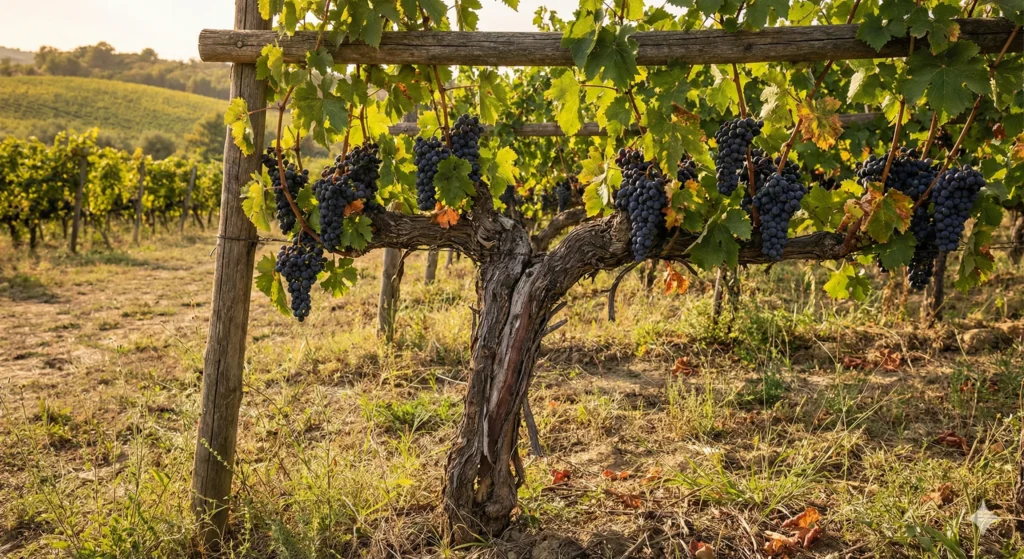
The reality of growing grape vines requires patience. While you’ll plant a small dormant stick in year one, you won’t harvest meaningful quantities of fruit until year three or four. This timeline isn’t a failure of technique—it’s the biology of how grape vines mature. Understanding this from the start prevents disappointment and helps you make better decisions during the critical establishment phase.
Grape vine biology is surprisingly simple once you grasp the basic principle: grapes form on current-season green shoots that grow from buds on last year’s wood. This means the canes you allow to grow this summer will become next year’s fruiting wood after winter dormancy. Everything about grape vine care—pruning, training, fertilizing—stems from managing this annual cycle of vegetative growth and fruit production.
Planning Your Grape Planting
Understanding Climate and Growing Zones
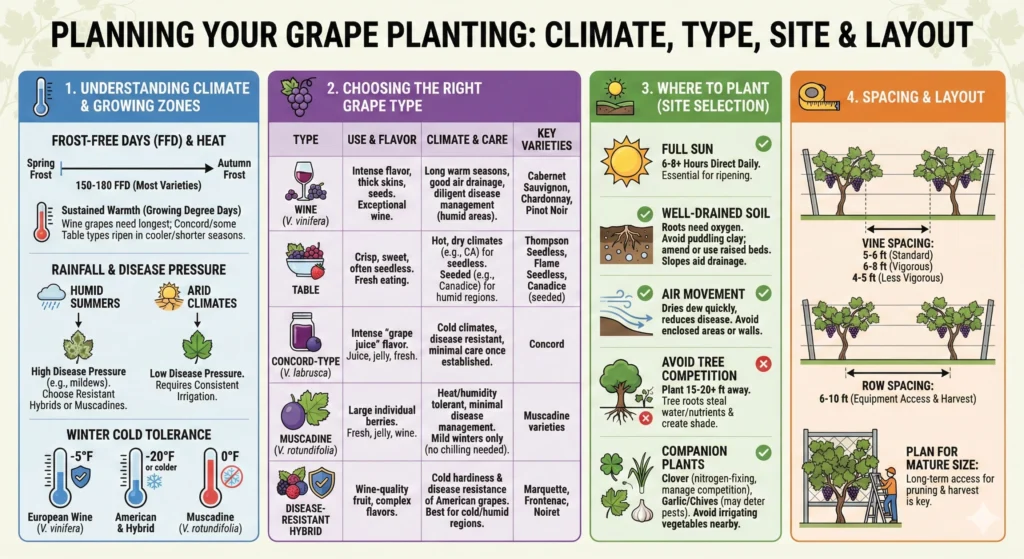
Successful grape growing starts with matching varieties to your climate. Grapes require a specific combination of warmth, sunlight, and dormancy that varies by type.
Most grape varieties need 150 to 180 frost-free days to ripen fruit properly. Wine grapes typically require the longest seasons, while some table grapes and Concord-type grapes can ripen in cooler climates with shorter summers. Heat accumulation matters more than maximum temperatures—grapes need sustained warmth during the growing season, measured in growing degree days.
Rainfall patterns significantly affect variety selection and disease pressure. Regions with humid summers create ideal conditions for fungal diseases like powdery mildew and downy mildew, making disease-resistant hybrids or muscadine grape vines better choices than European wine grapes. Arid climates reduce disease pressure but require consistent irrigation during fruit development.
Winter cold tolerance varies dramatically. European wine grapes (Vitis vinifera) survive to about -5°F with protection, while American and hybrid grapes withstand -20°F or colder. Muscadine grapes, native to the southeastern United States, require mild winters and struggle where temperatures drop below 0°F.
Choosing the Right Grape Type
The grape world divides into several distinct categories, each suited to different uses and climates.
Wine grapes (Vitis vinifera) include varieties like Cabernet Sauvignon, Chardonnay, and Pinot Noir. These produce small, intensely flavored fruit with thick skins and prominent seeds. They require long warm seasons, good air drainage to prevent frost, and diligent disease management in humid climates. The reward is fruit that makes exceptional wine and interesting fresh eating for those who enjoy complex flavors.
Table grapes prioritize fresh eating quality—crisp texture, sweet flavor, and often seedlessness. Thompson Seedless, Flame Seedless, and Crimson Seedless dominate commercial production but require hot, dry climates like California’s Central Valley. In humid regions, seeded table grapes like Canadice or Reliance perform better and offer good disease resistance.
Concord-type grapes produce the intensely flavored “grape juice” taste familiar from commercial products. These American grapes (Vitis labrusca) thrive in cold climates, resist most diseases, and require minimal care once established. They make excellent juice, jelly, and fresh eating if you enjoy their distinctive flavor.
Muscadine grape vines represent a separate species (Vitis rotundifolia) native to the Southeast. They produce large individual berries rather than tight clusters, require minimal disease management, and tolerate heat and humidity that would devastate other types. Muscadines need a different trellis system than bunch grapes and don’t require winter chilling like other grape types.
Disease-resistant hybrid grapes combine traits from multiple species. Varieties like Marquette, Frontenac, and Noiret offer wine-quality fruit with the cold hardiness and disease resistance of American grapes. These represent the best choice for cold climates or humid regions where European grapes struggle.
Where to Plant Grape Vines
Site selection determines success or failure before you dig the first hole. Grape vines have specific requirements that cannot be compromised.
Full sun means six to eight hours minimum of direct sunlight daily, though eight to ten hours produces better fruit. Grapes will grow in partial shade but produce weak, sparse growth and fail to ripen fruit properly. The chlorophyll in leaves powers ripening—inadequate sunlight means green, sour grapes regardless of how long you wait.
Well-drained soil is non-negotiable. Grape roots need oxygen and will rot in waterlogged soil. Clay soils that puddle after rain require amendment or raised beds. Sandy or loamy soils work well, though they may need irrigation more frequently. Slopes provide natural drainage and cold air drainage, reducing frost damage to emerging shoots in spring.
Air movement prevents disease by drying morning dew quickly and reducing humidity around clusters. Avoid planting in enclosed courtyards, valleys where cold air settles, or immediately against walls that block airflow. Gentle slopes or open areas with good air circulation create healthier vines that require less fungicide intervention.
Competition from trees kills young grape vines. Tree roots extend far beyond the drip line and will dominate the soil, stealing water and nutrients. Tree shade creates weak growth and poor fruit. Plant grapes at least 15 to 20 feet from established trees, or preferably in an open area entirely.
Companion plants for grape vines serve specific purposes. Clover or other nitrogen-fixing cover crops between rows can improve soil, though they must be managed to prevent competition with young vines. Garlic or chives planted nearby may deter some pests, though evidence is mostly anecdotal. Avoid planting vegetables or flowers that require irrigation or cultivation close to established vines, as this disturbs roots and alters water availability.
Spacing and Layout
Proper spacing between vines prevents overcrowding and ensures adequate sunlight and air circulation for each plant.
Standard spacing places vines five to six feet apart in the row. This distance allows mature vines to fill their trellis space without creating dense tangles that trap humidity and shade interior growth. Vigorous varieties or very fertile soils may justify six to eight feet, while less vigorous vines can succeed at four to five feet.
Row spacing of six to ten feet provides room for equipment access, spraying, and comfortable harvest. Home gardeners can work with six-foot rows if growing only one or two rows, but ten-foot spacing makes sense for larger plantings or if you’ll use a lawn mower or tractor between rows.
Planning for long-term access matters more than saving space in year one. A young vine fits in a two-foot circle, but a mature vine fills a trellis panel six feet wide and seven feet tall. Leave enough room to prune comfortably from both sides and to move a ladder if needed for harvest or training.
Soil Preparation Before Planting
Investing time in soil preparation before planting pays dividends for decades. Grape vines develop deep root systems—up to 20 feet or more in ideal conditions—and correcting soil problems after planting becomes difficult or impossible.
Soil testing reveals pH and nutrient levels before you plant. Grapes prefer slightly acidic to neutral soil, with a pH between 5.5 and 7.0. Most grape varieties perform best around 6.0 to 6.5. Soils below 5.5 may need lime, while soils above 7.5 may require sulfur amendments to lower pH. Avoid making drastic pH changes—adjust gradually over time if needed.
Improving drainage in heavy clay soils requires physical modification. Tilling or digging in coarse sand, perlite, or pine bark improves structure, but avoid creating a “bathtub effect” where you amend only the planting hole. Water draining into an amended hole surrounded by clay has nowhere to go, potentially drowning roots. Instead, amend broadly across the planting area or use raised beds in extremely heavy soils.
Deep loosening to 24 to 36 inches, if your soil allows, encourages downward root growth and improves long-term drought tolerance. A broadfork or similar tool can fracture compacted subsoil without inverting layers. This step isn’t always possible in rocky or extremely heavy soils, but where feasible, it benefits vines for years.
Organic matter improves soil structure and water retention, but use restraint. A two to three inch layer of compost worked into the top 12 inches of soil is sufficient. Excessive organic matter, especially if poorly decomposed, can create water retention problems and stimulate excessive nitrogen availability.
Weed control before planting prevents years of competition. Perennial weeds like bindweed, bermudagrass, or Canada thistle are nearly impossible to eliminate once vines are established. Solarizing with clear plastic during summer heat, repeated cultivation, or targeted herbicide use in the year before planting eliminates many problem weeds.
Avoiding excessive nitrogen at planting encourages root development over shoot growth. Grapes don’t require rich, heavily fertilized soil—in fact, overly fertile soil produces excessive vegetative growth at the expense of fruit quality. If your soil test shows adequate phosphorus and potassium, you may need no fertilizer at planting.
Selecting Planting Material
Quality planting stock establishes faster and produces healthy, productive vines. Poor stock wastes years of waiting only to reveal virus infections, weak growth, or wrong varieties.
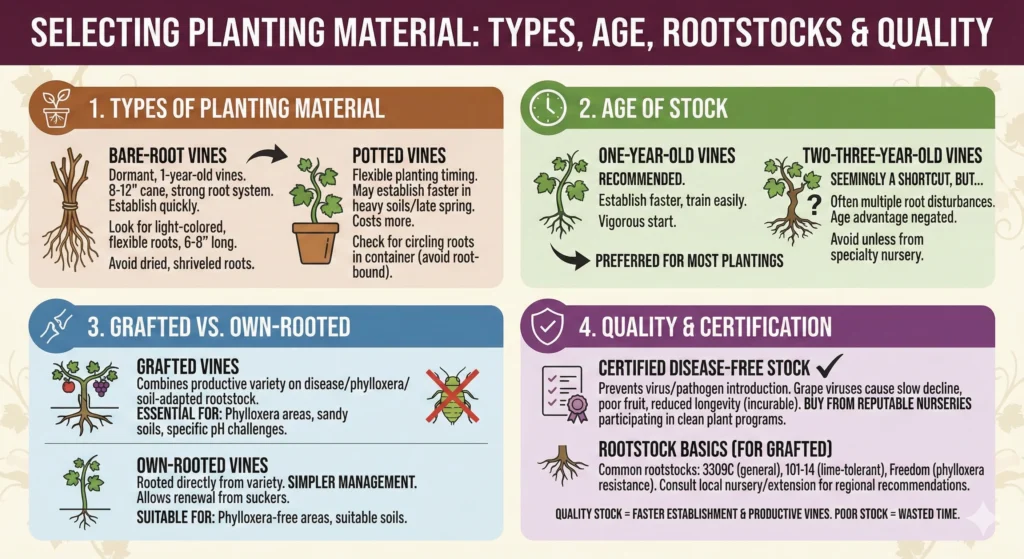
Bare-root vines dominate commercial grape planting and home garden centers. Dormant one-year-old vines with 8 to 12 inches of cane and a strong root system establish quickly when planted at the right time. Look for roots that are light-colored, flexible, and at least 6 to 8 inches long with multiple branches. Avoid dried, shriveled roots or canes—these indicate poor handling or storage.
Potted vines offer flexibility in planting timing and may establish slightly faster in heavy soils or if you’re planting later in spring. However, potted vines cost more and may have circling roots if grown in containers too long. If buying potted stock, check that roots haven’t completely filled the container or started wrapping around the root ball.
One-year-old vines establish faster and train more easily than older material. Two or three-year-old vines seem like a shortcut to production, but they’ve often been dug and potted multiple times, creating root disturbance that negates their age advantage. Start with young, vigorous one-year stock unless you’re buying from a specialty nursery that has carefully container-grown older vines.
Grafted versus own-rooted vines depends on your soil and variety choice. Grafted vines combine a productive fruiting variety on top with a rootstock selected for disease resistance, phylloxera resistance, or soil adaptation. In areas with phylloxera (a root-feeding insect), sandy soils, or specific soil pH challenges, grafted vines are essential. In phylloxera-free areas with suitable soil, own-rooted vines simplify management and allow renewal from suckers if needed.
Certified disease-free stock from reputable nurseries ensures you’re not introducing viruses or other pathogens. Grape viruses cause slow decline, poor fruit quality, and reduced longevity. Once infected, vines cannot be cured and will eventually need replacement. Buy from nurseries that certify their stock or participate in clean plant programs.
Rootstock basics matter primarily for grafted vines. Common rootstocks include 3309C for general use, 101-14 for lime-tolerant situations, and Freedom for phylloxera resistance. Most home gardeners can succeed with standard rootstocks unless dealing with extreme soil conditions. Your local nursery or extension office can recommend appropriate rootstocks for your region.
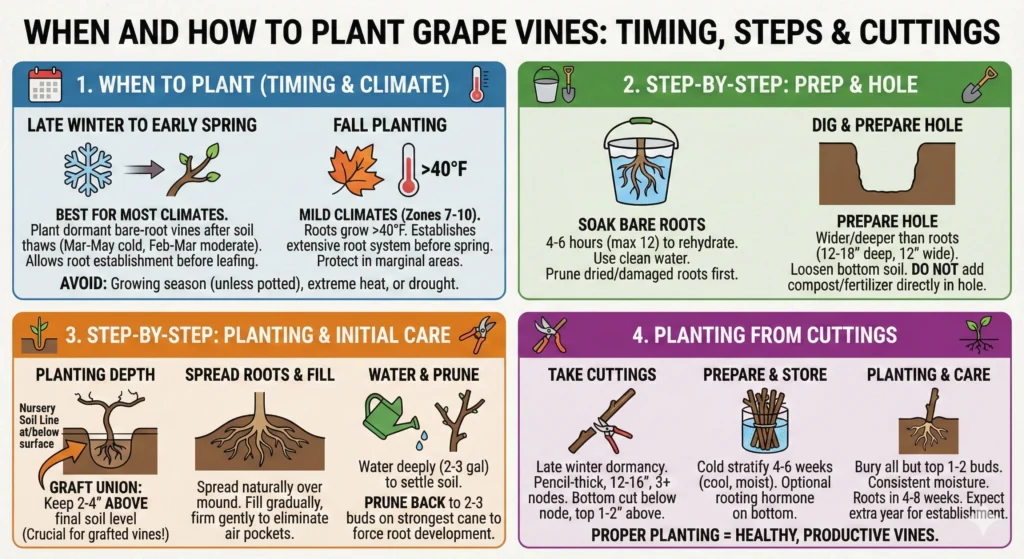
When and How to Plant Grape Vines
When to Plant Grape Vines
Timing grape planting to match your climate and stock type minimizes stress and maximizes establishment success.
Late winter to early spring planting works best in most climates. Plant bare-root vines while fully dormant but after the worst winter weather has passed and soil has thawed enough to dig. This typically means March through early May in cold climates, February through March in moderate climates. Planting dormant vines allows root establishment before leaves emerge and create water demand.
Fall planting in mild climates (USDA zones 7-10) allows root growth during cool, moist fall and winter months. Roots grow whenever soil temperatures exceed 40°F, even when canes are dormant. Fall-planted vines establish more extensive root systems before their first growing season, though they need protection from extreme cold if planted in marginal areas.
Avoid planting during the growing season unless using actively growing potted vines, and even then, expect some shock and slower establishment. Never plant during extreme heat or drought.
Step-by-Step Planting Guide
Proper planting technique ensures good root-to-soil contact and appropriate depth for long-term health.
Soaking bare roots for four to six hours before planting rehydrates tissue and makes roots more pliable. Use clean water at room temperature. Avoid soaking longer than 12 hours, as this can damage roots. If roots appear dried or damaged, prune back to healthy white tissue before soaking.
Digging holes slightly wider and deeper than the root system allows roots to spread naturally. A hole 12 to 18 inches deep and 12 inches wide suits most one-year vines. Loosen soil at the bottom of the hole to encourage downward root growth, but don’t add compost or fertilizer directly in the hole.
Planting depth places the original nursery soil line at or slightly below your soil surface. Look for the color change on the trunk where roots transition to cane. For own-rooted vines, this depth isn’t critical, but for grafted vines, keep the graft union two to four inches above the final soil level. Burying the graft allows the fruiting variety to root, negating the rootstock’s benefits.
Spreading roots in a natural pattern prevents circling or crossing that can girdle roots later. Create a small mound in the center of the hole, drape roots over it, and adjust the vine’s depth until the planting line is correct. Fill the hole gradually, firming soil gently to eliminate air pockets without compacting.
Watering deeply after planting settles soil around roots and eliminates remaining air pockets. Apply two to three gallons slowly, allowing it to soak in rather than run off. Avoid creating a moat or basin that holds standing water—water should infiltrate and drain.
Initial pruning back to two or three buds on the strongest cane forces energy into root development and establishes a single trunk. Remove all canes except the straightest, strongest one, then cut that cane back to 6 to 8 inches with two or three visible buds. This severe pruning seems counterintuitive but produces stronger vines than leaving more cane.
Planting Grape Vines from Cuttings
How to grow a grape vine from a cutting offers an economical way to propagate your own vines or share varieties with friends.
Taking cuttings during dormancy, typically late winter, provides wood at the right physiological state for rooting. Select pencil-thick wood from the previous season’s growth—it will be tan or reddish, not green. Cut 12 to 16 inch sections with at least three nodes (buds). Make the bottom cut just below a node and the top cut 1 to 2 inches above a node.
Preparing cuttings involves keeping the bottom end moist and the top end protected from drying. Some growers dip the bottom inch in rooting hormone, though many grape varieties root readily without it. Bundle cuttings with the top ends aligned and store in slightly moist sawdust, perlite, or sand in a cool location for four to six weeks of cold stratification.
Planting cuttings in spring involves burying all but the top one or two buds in well-drained soil or a container mix. Water consistently to keep soil moist but not waterlogged. Roots typically develop within four to eight weeks, though shoots may emerge first.
How to plant grape vine cuttings differs from planting rooted vines primarily in the first-year expectations. Cuttings need consistent moisture throughout their first season and may not develop as extensive a root system as nursery-grown vines. Expect to wait an extra year before training and fruiting compared to purchased stock.
Grape Vine Trellis Systems and Training
Understanding why grape vines on a trellis are essential prevents the common mistake of trying to grow grapes as unsupported bushes. Grape vines are climbing plants that evolved to grow up trees using tendrils. Without support, canes sprawl on the ground, creating disease problems, pest issues, and irregular ripening. A trellis provides structural support, improves sun exposure, enhances air circulation, and makes pruning and harvest manageable.
A simple home trellis system suitable for most table and juice grapes consists of sturdy end posts (4×4 treated lumber or metal posts set 24 to 30 inches deep) with line posts every 15 to 20 feet. High-tensile wire or heavy-gauge wire (9 to 11 gauge) runs between posts at specific heights depending on training system.
Vertical Shoot Positioning (VSP) represents the most common home system and works well for most grape types except muscadines. This system uses a top wire at 5 to 6 feet and often a lower wire at 30 to 36 inches. The vine’s permanent trunk grows to the top wire, where horizontal cordons (arms) extend in both directions along the wire. Shoots grow upward from these cordons each spring, held in place by catch wires or manual tucking.
Arbors and pergolas provide shade and ornamental value but complicate pruning and reduce fruit quality compared to open trellis systems. Grapes grown on arbors produce more vegetative growth and shade, less air circulation, and more disease pressure. If growing grapes primarily for fruit rather than shade, use a standard trellis. If appearance matters more than maximum production, understand that arbor-grown grapes require more aggressive pruning and disease management.
Trellis wire heights vary by system but generally include a fruiting wire at 5 to 6 feet for VSP systems or dual wires at 30 and 60 inches for other systems. Spacing wires properly during installation saves retrofitting later. Use smooth, high-tensile wire tightened to about 200 to 250 pounds of tension—tight enough to support crop weight without sagging but not so tight it bows posts.
Training the first-year trunk involves selecting the strongest shoot to become the permanent trunk and tying it loosely to a training stake or temporary wire. Remove competing shoots but allow leaves to remain on the main shoot to power root growth. The goal in year one is reaching the fruiting wire with a straight, strong trunk—not producing fruit.
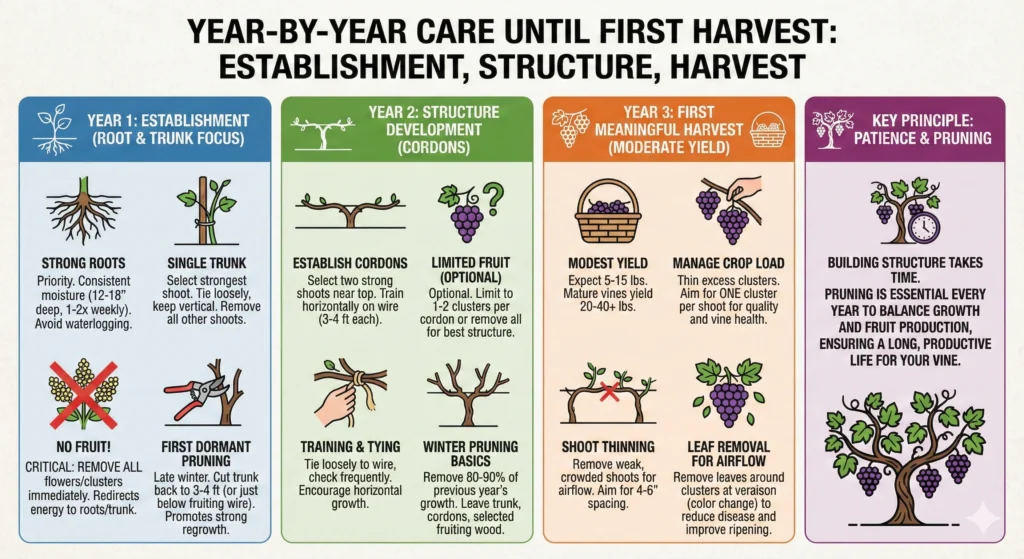
Year-by-Year Care Until First Harvest
Year 1: Establishment
The first year focuses entirely on root development and establishing a single strong trunk. Ignore any temptation to allow fruiting—removing flowers and clusters redirects carbohydrates to roots and vegetative structure.
Building a strong root system determines the vine’s productive potential for decades. Roots grow faster than shoots early in the season, especially in cool spring weather. Adequate soil moisture during this phase encourages deep root exploration while avoiding waterlogged conditions that limit oxygen.
Selecting the trunk shoot happens naturally if you prune at planting to two or three buds. The strongest shoot becomes your trunk. Tie it loosely to a stake every 8 to 12 inches as it grows, keeping it vertical and straight. Remove other shoots entirely—don’t just cut them back, as this encourages regrowth.
Watering young vines requires attention but not obsession. Newly planted vines need consistent moisture in the top 12 inches of soil while roots establish. This typically means deep watering once or twice weekly in the absence of rain, applying enough water to moisten soil 12 to 18 inches deep. Avoid daily shallow watering, which encourages shallow roots and disease.
Light fertilization, if any, waits until shoots show 6 to 12 inches of growth. A light application of balanced fertilizer (10-10-10) at one quarter to one half the normal rate provides nutrients without forcing excessive shoot growth. Many vines need no fertilizer in year one if planted in adequately prepared soil.
Removing flowers prevents the common mistake of allowing a newly planted vine to fruit. Any flower clusters that form must be removed as soon as visible. Fruiting in year one produces tiny, poor-quality clusters while severely stunting root and trunk development.
The first dormant pruning, done in late winter of the first dormant season, involves cutting the trunk back to about 3 to 4 feet if it hasn’t reached the fruiting wire, or just below the fruiting wire if it has. This seems severe after a year of growth, but it promotes stronger regrowth and better structure in year two.
Year 2: Structure Development
Year two focuses on establishing permanent cordons (horizontal arms) along the fruiting wire and beginning the pattern of annual growth and pruning.
Establishing cordons begins when shoots emerge in spring. Select two strong shoots near the top of the trunk that can be trained horizontally along the fruiting wire in opposite directions. Remove other shoots. Tie these cordon shoots loosely to the wire as they grow, encouraging horizontal growth. Each cordon should extend 3 to 4 feet from the trunk, creating a total span of 6 to 8 feet for the vine.
Limited fruit production in year two is possible but optional. Most experts recommend removing all or most clusters to maintain focus on structural development. If you allow fruiting, limit it to one or two small clusters per cordon and remove them if the vine shows stress or slow growth.
Training along the wire involves frequent tying and shoot positioning during the growing season. Check ties every few weeks to ensure they’re not constricting growth. Use soft ties or stretchy tape rather than wire or rigid materials.
Winter pruning basics become critical in year two and every year afterward. During dormancy, remove all growth except the permanent trunk and cordons plus selected fruiting wood. The exact amount of wood to leave depends on your pruning system (cane or spur), but the principle is removing 80 to 90 percent of the previous year’s growth annually.
Year 3: First Meaningful Harvest
When do grape vines produce fruit in meaningful quantities? Year three typically delivers the first harvest worth processing or eating, though quantities remain modest compared to mature vines. A three-year-old vine might produce 5 to 15 pounds of fruit, while a mature vine can yield 20 to 40 pounds or more.
Managing crop load in year three prevents overcropping that weakens the vine. If clusters appear excessive—more than one cluster per shoot or shoots with multiple clusters—remove the smaller, weaker clusters early in the season. Thinning to one cluster per shoot on most shoots produces better quality fruit and maintains vine health.
Shoot thinning in late spring removes weak, poorly positioned, or excessive shoots to improve air circulation and concentrate resources. Remove shoots growing from the trunk below the cordons, shoots growing downward, and crowded shoots that shade each other. Aim for shoots spaced 4 to 6 inches apart along the cordons.
Leaf removal for airflow around clusters reduces disease and improves ripening. Remove leaves immediately surrounding clusters around veraison (when berries begin changing color), creating an open area that allows air movement and some direct sun. Avoid removing so many leaves that you stress the vine or sunburn fruit—remove only the leaves touching or immediately shading clusters.
How to Prune Grape Vines
Understanding why pruning grape vines is critical changes how you approach this annual task. Grapes fruit on current-season shoots growing from buds on last year’s wood. Without pruning, vines produce dozens or hundreds of weak shoots with small, poorly ripening clusters. Proper pruning limits shoot numbers, concentrates resources, and maintains manageable vine size while maximizing fruit quality.
Cane versus spur pruning represents two different approaches to selecting fruiting wood. Cane pruning involves selecting specific one-year-old canes during dormancy, cutting them back to 8 to 15 buds each, and removing all other wood. The buds on these canes produce this year’s fruiting shoots. Spur pruning leaves permanent older wood (cordons) and cuts all one-year canes back to short spurs of 2 to 3 buds each. These spurs produce fruiting shoots annually.
Most home gardeners succeed with spur pruning on a bilateral cordon system. This method creates a simple, consistent framework that’s easy to understand and maintain. Cane pruning produces slightly higher quality in some wine grapes but requires more skill and understanding.
When can you prune grape vines? Dormant pruning happens anytime from leaf fall to just before budbreak in spring, typically December through March depending on climate. Many growers prefer late winter (February to early March) because wounds heal faster as sap begins rising. Avoid pruning during extreme cold below 20°F, which can damage wood.
When can you trim grape vines during the growing season? Summer pruning or trimming focuses on managing excessive vegetative growth, not removing fruiting wood. Light trimming to remove water sprouts, laterals growing from shoot tips, or shoots growing into walkways can happen throughout summer. Avoid heavy summer pruning after veraison, as this removes leaves needed to ripen fruit.
A step-by-step beginner pruning method for spur-pruned vines:
First, identify the permanent wood—the trunk and two horizontal cordons running along the wire. This wood is usually thicker, darker, and obviously older than one-year canes.
Second, identify one-year-old canes—these are the wood that grew last summer, typically lighter colored, smooth, and about pencil thickness. These canes grow from the cordons.
Third, select canes to become spurs by choosing those spaced every 6 to 8 inches along each cordon. Each selected cane should arise from the top or sides of the cordon (not hanging down) and be healthy and straight.
Fourth, cut selected canes back to 2 to 3 buds (about 2 to 4 inches long), creating spurs. Make cuts just beyond the bud you’re keeping, angled slightly.
Fifth, remove all other one-year growth completely, cutting flush with the cordon. This includes removing 90 percent or more of last year’s growth.
Sixth, remove any shoots growing from the trunk below the cordons, any damaged or diseased wood, and any thin weak growth.
Common pruning mistakes include leaving too much wood (weak shoots, poor fruit), fear of cutting (grapes tolerate severe pruning better than too little), cutting into permanent cordons (removes fruiting positions), and inconsistent annual pruning (creates structural problems).
Watering, Fertilizing, and Mulching
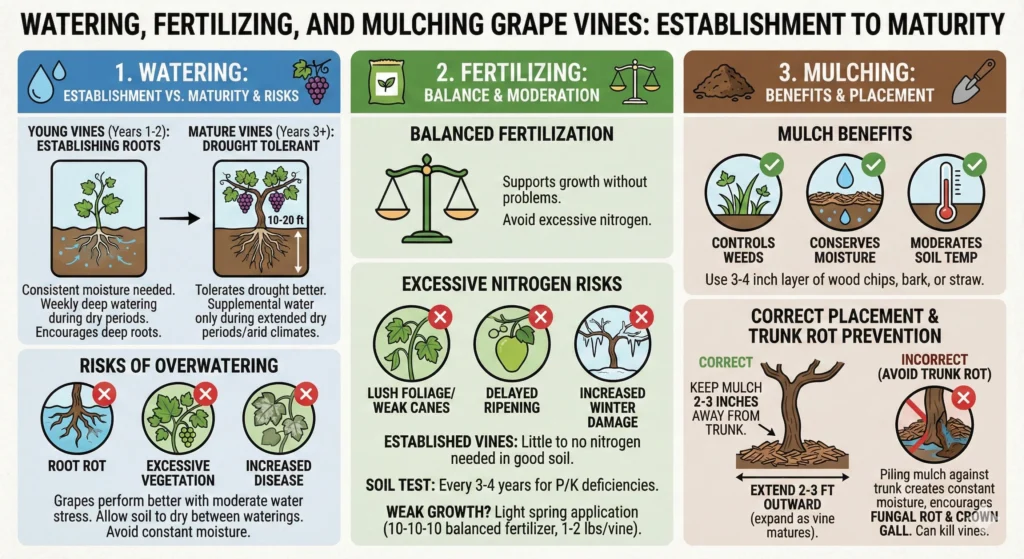
Water needs during establishment versus mature vines differ significantly. Young vines require consistent moisture in the root zone during their first two years to establish deep roots. This typically means weekly deep watering during dry periods. Mature vines develop roots 10 to 20 feet deep and tolerate drought much better, often needing supplemental water only during extended dry periods or in naturally arid climates.
Risks of overwatering include root rot, excessive vegetative growth at the expense of fruit, and increased disease pressure. Grapes evolved in Mediterranean climates with dry summers. They perform better with moderate water stress than excessive irrigation. Soil should dry somewhat between waterings rather than remaining constantly moist.
Balanced fertilization supports growth without creating problems. Excessive nitrogen produces lush foliage, weak canes, delayed fruit ripening, and increased winter damage. Most established grape vines need little to no nitrogen fertilizer if growing in reasonable soil. A soil test every three to four years identifies any phosphorus or potassium deficiencies. If growth seems weak and soil is poor, a light spring application of balanced fertilizer (10-10-10 or similar) at one to two pounds per vine suffices.
Mulch placement around vines controls weeds, moderates soil temperature, and conserves moisture. A 3 to 4 inch layer of wood chips, bark, or straw works well. Keep mulch several inches away from the trunk to prevent rot and rodent damage. Extend mulch outward 2 to 3 feet around young vines, expanding the mulched area as the vine matures.
Avoiding trunk rot requires keeping the bark dry where the trunk meets soil. Piling mulch against the trunk creates constant moisture that encourages fungal rot and crown gall. This damage can kill vines years after the mulch is removed.
Common Pests and Diseases
Powdery mildew appears as white or gray powder on leaves, shoots, and clusters. It thrives in warm, dry conditions with poor air circulation. Preventive measures include proper pruning for air flow, avoiding excessive nitrogen, and selecting resistant varieties. Sulfur-based sprays applied before infection occurs provide organic control.
Downy mildew causes yellowish spots on upper leaf surfaces and white fuzzy growth underneath. It requires wet conditions and free moisture on leaves. Improve air circulation, avoid overhead watering, and remove infected leaves. Copper-based sprays offer organic prevention.
Botrytis bunch rot affects ripening fruit during wet weather. Gray fuzzy mold develops on berries, spreading rapidly through clusters. Prevent botrytis through cluster zone leaf removal for air circulation, avoiding excessive vine vigor, and removing infected clusters immediately.
Birds and wasps become serious pests as fruit ripens. Birds can destroy an entire crop in days. Netting provides the most reliable protection, installed before berries begin coloring. Wasps prefer damaged or split berries. Removing damaged fruit and maintaining healthy vines reduces wasp attraction.
Preventive cultural practices matter more than reactive spraying. Proper site selection, appropriate variety choice, adequate spacing, correct pruning, and balanced nutrition create conditions where pests and diseases cause minimal damage. Many home grape growers succeed with little or no pesticide use through cultural practices alone.
Basic organic control involves sulfur for powdery mildew, copper for downy mildew, Bacillus thuringiensis for certain caterpillars, and physical barriers for birds. Always follow label directions and observe pre-harvest intervals before eating fruit.
Recognizing Ripeness and Harvest
Grape development follows distinct growth stages from flowering through ripeness. Understanding this progression helps you anticipate harvest timing and recognize problems.
Flowering occurs in spring, typically May through June depending on climate. Small inconspicuous flowers appear in clusters. Pollination happens through wind and gravity—grapes are self-fertile and don’t require insects. Poor pollination or cold, wet weather during bloom causes “shatter” where many flowers fail to set fruit.
Fruit set follows successful pollination. Fertilized flowers develop into tiny green berries. Many small berries may drop naturally during this phase—up to 30 percent drop is normal and actually improves final cluster quality.
Berry development involves cell division and expansion. Berries grow rapidly and remain hard, green, and very acidic. This phase lasts 6 to 8 weeks depending on variety and temperature.
Veraison marks the transition to ripening. Berries begin changing color—red varieties shift from green to pink or red, white varieties from green to golden or translucent. Berries begin softening and accumulating sugar while acids decline. Veraison happens over several days within a cluster and over 1 to 2 weeks across the vineyard.
Ripeness develops over the 4 to 8 weeks following veraison. Sugars increase, acids decrease, flavors develop, and seeds turn from green to brown. The exact timing from veraison to harvest is typically 6 to 8 weeks for table grapes, 8 to 10 weeks for wine grapes, though weather and variety create significant variation.
Taste testing remains the most reliable ripeness indicator for home growers. Sample berries from different clusters and different areas of the vine—sun-exposed versus shaded clusters ripen at different rates. Ripe grapes taste sweet with balanced acidity, not mouth-puckering sour.
Seed color provides a secondary indicator. Ripe grape seeds turn from green to tan or brown. Check seeds from several berries. Some seedless varieties produce small, soft seed traces that never harden, making this test less useful.
Can grapes ripen off the vine? Unlike some fruits that continue ripening after harvest (tomatoes, bananas), grapes do not ripen further once picked. Sugar content, acid levels, and flavor are fixed at harvest. This makes timing critical—picking too early guarantees sour grapes, while waiting too long risks bird damage, splitting, or overripeness.
Harvesting properly involves cutting clusters with sharp shears, handling gently to avoid crushing berries, and removing damaged or diseased berries from clusters. Harvest in cool morning temperatures if possible to preserve quality. For wine grapes, handle carefully to avoid breaking skins before crushing.
What to expect from the first harvest in year three: 5 to 15 pounds of fruit is typical, distributed across perhaps 10 to 25 small to medium clusters. Quality may not match mature vines—berries might be slightly smaller or flavor slightly less developed. This is normal. Production increases significantly in years four through seven as the vine reaches full maturity.
Post-Harvest and Winter Preparation
Watering after harvest supports the vine’s preparation for dormancy and next year’s crop. Leaves continue photosynthesizing for weeks after harvest, building carbohydrate reserves in the trunk, cordons, and roots. These reserves power budbreak and early growth next spring. Maintain adequate soil moisture through fall unless you’re in a naturally wet climate.
Hardening off happens naturally as temperatures cool and day length shortens. Avoid late-season fertilization or excessive irrigation that encourages tender new growth vulnerable to early freezes. Vines should enter dormancy gradually with fully mature wood.
Winter protection becomes necessary where minimum temperatures drop below the variety’s hardiness level. Trunk and cordon protection for marginally hardy varieties can involve mounding soil over the graft union or wrapping trunks with insulating material. In severe climates, some growers remove canes from wires and bury the entire vine under soil or mulch, though this requires specialized training systems.
Planning next season begins before the current year ends. Reflect on what worked—did you prune heavily enough? Was disease pressure manageable? Did clusters ripen evenly? Order any needed supplies, plan pruning strategy, and note observations while they’re fresh.
Common Problems and Troubleshooting
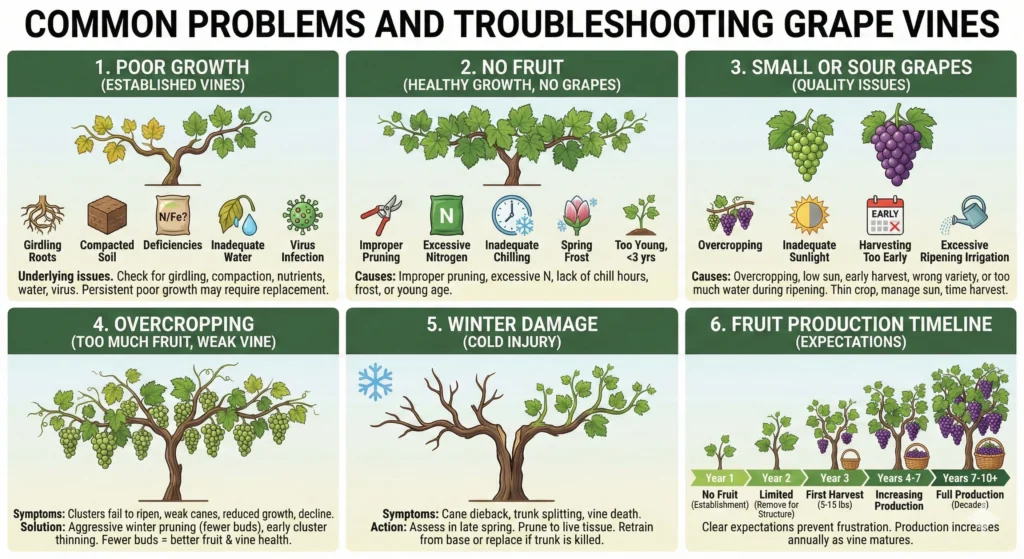
Poor growth in established vines signals underlying problems. Check for girdling roots, compacted soil, nutrient deficiencies (especially nitrogen or iron), inadequate water, or virus infection. Vines that grow poorly despite good care for multiple years may harbor viruses and require replacement.
No fruit production despite healthy growth indicates improper pruning (removing all fruiting wood), excessive nitrogen creating all-vegetative growth, inadequate chilling hours for the variety, spring frost killing emerging flower clusters, or a vine too young to bear (less than three years old).
Small or sour grapes result from overcropping, inadequate sunlight, harvesting too early, variety poorly suited to your climate, or excessive irrigation during ripening. Proper crop thinning, sun exposure management, and harvest timing usually resolve these issues.
Overcropping shows as clusters failing to ripen, vines with thin weak canes, reduced growth, and general vine decline. The solution is more aggressive winter pruning, leaving fewer buds, and cluster thinning earlier in the season. Many home growers err by leaving too much fruiting wood, thinking more buds equal more fruit—in reality, fewer buds produce larger, higher-quality clusters and healthier vines.
Winter damage appears as cane dieback, trunk splitting, or vine death after severe cold. Assess damage in late spring after new growth reveals what survived. Prune dead wood back to live tissue. If only canes died but cordons or trunk survived, the vine can recover. If winter kill extends into the trunk, you may need to retrain from a basal shoot or replace the vine.
How long do grape vines take to produce fruit? Clear expectations prevent frustration. First year: no fruit, focus on establishment. Second year: limited fruit possible but better removed for structure development. Third year: first meaningful harvest of 5 to 15 pounds. Fourth through seventh years: production increases annually as the vine matures. Full production around year 7 to 10, continuing for decades with proper care.
Summary and Key Takeaways
Growing grape vines from planting to first harvest requires patience through the first two years while the vine establishes roots and structure. This investment pays exponential dividends over the decades that follow.
Proper pruning represents the single most important skill for grape growing success. Annual dormant pruning that removes 80 to 90 percent of last year’s growth feels counterintuitive but creates productive, manageable vines with quality fruit. Master this skill and you’ll master grape growing.
Sunlight and airflow cannot be compromised. Site selection, pruning technique, and training systems all serve these requirements. Grapes tolerate poor soil better than shade or stagnant air.
Long-term rewards for patient, diligent grape growers include decades of fruit from long-lived vines, deepening understanding of vine behavior, connection to seasonal rhythms, and the satisfaction of transforming dormant sticks into productive plants through thoughtful care.