Master Fig Tree Care: California’s Central Valley Guide
California’s Central Valley is prime fig territory. Hot summers, mild winters, and Mediterranean-style climate create ideal conditions for growing Ficus carica—the edible fig tree. Whether you’re planting in your backyard or growing in containers, understanding proper fig tree care transforms your efforts into decades of reliable fruit production.
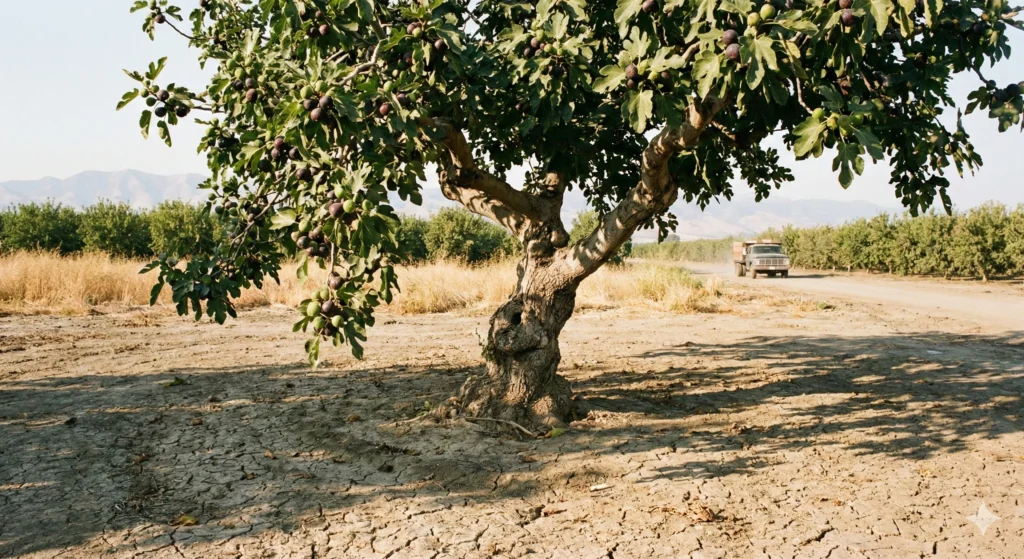
This guide covers everything from selecting the right variety to harvest techniques, with specific focus on Central Valley conditions in USDA zones 8-9. You’ll learn outdoor planting, container growing, indoor fig tree care, seasonal maintenance schedules, and integrated pest management. Both beginners and experienced gardeners will find actionable strategies for successful edible fig tree care in our unique climate.
Understanding Fig Trees & Central Valley Climate
Ficus carica is a deciduous fruit tree that thrives for 50-100+ years with proper care. Unlike many fruit trees, figs produce on previous year’s wood, meaning pruning decisions directly impact next season’s harvest (University of California Agriculture and Natural Resources, 2023). Most home gardeners grow common figs, which are self-fruitful and parthenocarpic—producing seedless fruit without pollination (UC Davis Postharvest Technology Center, 2022).
The Central Valley occupies USDA hardiness zones 8-9, with summer temperatures regularly exceeding 90-100°F and mild winters that rarely drop below 20°F (USDA Plant Hardiness Zone Map, 2023). These conditions mirror the Mediterranean regions where figs originated. Hot, dry summers promote fruit sweetness while winter chill triggers proper dormancy for spring growth.
Understanding crop types helps manage expectations. The breba crop develops on last year’s wood and ripens in early summer (June-July), while the main crop forms on current season’s growth and ripens late summer through fall (August-October) (California Rare Fruit Growers, 2023). Most varieties produce both crops, though heat-stressed trees may drop breba figs during extreme conditions.
Common figs dominate home gardens because they don’t require pollination. Smyrna figs need specific wasps for pollination, while San Pedro types produce breba crops without pollination but need wasps for main crops. Stick with common figs for reliable care fig tree production in home settings (UC ANR Publication 8367, 2022).
Choosing the Right Fig Variety for Central Valley
Variety selection determines your success more than any other factor. Central Valley growers have tested dozens of cultivars over decades of commercial and home production.
| Variety | Fruit Type | Size | Best For | Cold Hardiness | Heat Tolerance |
|---|---|---|---|---|---|
| Brown Turkey | Medium-large, brown-purple | 15-25 ft | Fresh eating, reliable production | Zone 7-10, 10°F | Excellent (105°F+) |
| Black Mission | Medium, dark purple-black | 15-30 ft | Drying, fresh, preserves | Zone 8-10, 15°F | Excellent (105°F+) |
| Celeste | Small-medium, light brown | 10-15 ft | Containers, fresh eating | Zone 7-9, 5°F | Very good (100°F) |
| Chicago Hardy | Medium, purplish-brown | 12-20 ft | Cold pockets, insurance variety | Zone 5-10, -10°F | Good (95°F) |
| Kadota | Medium, green-yellow | 15-25 ft | Preserves, canning | Zone 8-10, 15°F | Excellent (105°F+) |
| LSU Purple | Large, purple | 12-18 ft | Fresh eating, hot climates | Zone 7-10, 10°F | Outstanding (110°F+) |
| Desert King | Large, green | 15-20 ft | Breba specialist | Zone 7-10, 10°F | Moderate (lighter crops in extreme heat) |
Brown Turkey remains the most popular choice for brown turkey fig tree care because it tolerates beginner mistakes while producing abundantly. Fruit ripens reliably even during 105°F heat waves, and trees recover quickly from stress (California Fig Advisory Board, 2023).
Black Mission represents California’s heritage fig industry. These trees produce the classic dried figs sold commercially, with intensely sweet flavor and dark purple skin. They’re vigorous growers requiring more space but rewarding patient gardeners with massive crops (Sunset Western Garden Book, 2023).
Celeste, often called Sugar Fig, excels in containers due to compact size and closed eye that resists insect invasion. Small, intensely sweet figs make celeste fig tree care ideal for patio growing and small yards (Dave Wilson Nursery, 2023).
Chicago Hardy serves as insurance in cooler Valley microclimates near Sacramento or in frost pockets. While other varieties handle typical Central Valley winters, Chicago Hardy survives unexpected cold snaps. Focus chicago fig tree care on locations with winter temperature uncertainty (Missouri Botanical Garden, 2023).
Kadota dominated commercial production for decades and still produces honey-sweet green figs perfect for preserves. Trees tolerate heat exceptionally well and crop heavily without special attention (UC ANR, 2022).
LSU Purple from Louisiana State University breeding programs specifically targets hot, humid climates. In Central Valley’s dry heat, these trees excel with large, flavorful fruit throughout summer (LSU AgCenter, 2023).
Desert King focuses energy on spring breba crops rather than main crops. In extreme Valley heat, main crop production diminishes, but early summer harvest provides abundant fruit when others are still developing (Territorial Seed Company, 2023).
Select varieties based on intended use (fresh, dried, or preserves), available space, container versus in-ground planting, and microclimate variations within the Central Valley.
Outdoor Fig Tree Planting in Central Valley
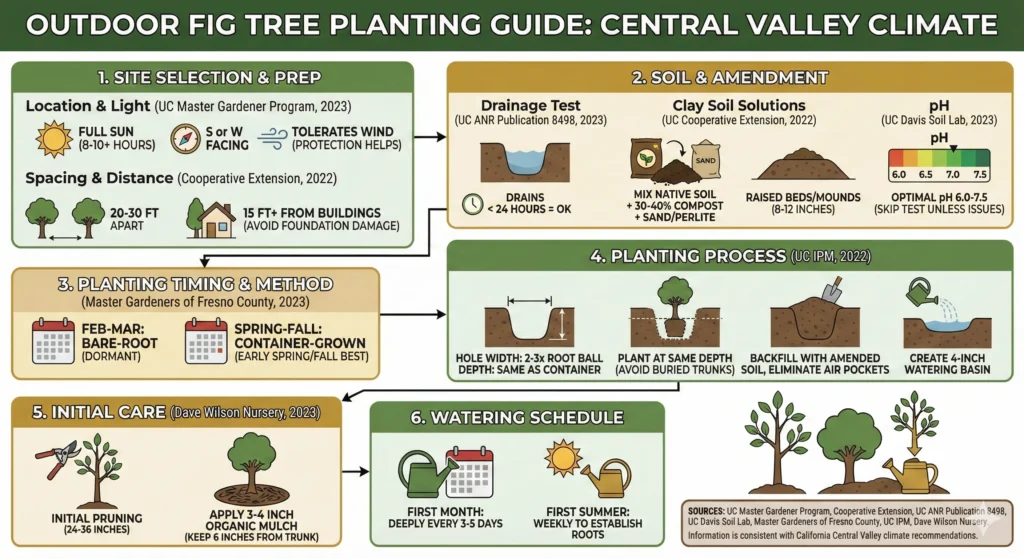
Site selection determines long-term success. Figs demand full sun—minimum 8 hours daily, preferably 10+ hours for optimal fruit production (UC Master Gardener Program, 2023). South or west-facing locations maximize light exposure. Wind protection prevents branch breakage and reduces water stress, though figs tolerate Valley winds better than other fruit trees.
Space trees 20-30 feet apart for mature specimens, though controlled pruning maintains smaller sizes. Avoid planting within 15 feet of buildings, as aggressive roots crack foundations over decades (Cooperative Extension, 2022). Soil drainage matters more than fertility. Figs tolerate poor soils but cannot survive waterlogged roots.
Central Valley clay soils require amendment for proper fig tree plant care. Test drainage by digging a 12-inch deep hole, filling with water, and observing drainage time. Water should drain within 24 hours (UC ANR Publication 8498, 2023). Heavy clay needs substantial organic matter additions.
Amend planting areas by mixing native soil with 30-40% compost, adding coarse sand or perlite to improve structure. Work amendments into a 3-foot diameter area, 18 inches deep (UC Cooperative Extension, 2022). For extremely heavy clay, consider raised beds or mounded planting sites elevated 8-12 inches above grade.
Soil pH between 6.0-7.5 suits figs well, and Central Valley soils typically fall within this range. Skip pH testing unless growing struggles suggest problems (UC Davis Soil Lab, 2023).
Plant bare-root trees in late winter (February-March) while dormant. Container-grown trees transplant successfully spring through fall, though early spring planting allows root establishment before summer heat. Fall planting (October-November) works well, giving roots months to develop before growth resumes (Master Gardeners of Fresno County, 2023).
Dig holes 2-3 times wider than root balls but no deeper. Plant at the same depth trees grew in nursery containers—burying trunks promotes rot (UC IPM, 2022). Position trees, backfill with amended soil, and water thoroughly to eliminate air pockets. Create a 4-inch high watering basin around the trunk.
Initial pruning to 24-36 inches encourages low branching and sturdy framework. Cut just above a bud, and remove any damaged roots before planting (Dave Wilson Nursery, 2023).
Apply 3-4 inches of organic mulch after planting, keeping material 6 inches away from trunks. Water deeply every 3-5 days for the first month, then weekly through the first summer to establish roots.
Watering, Mulching & Fertilizing Outdoor Figs
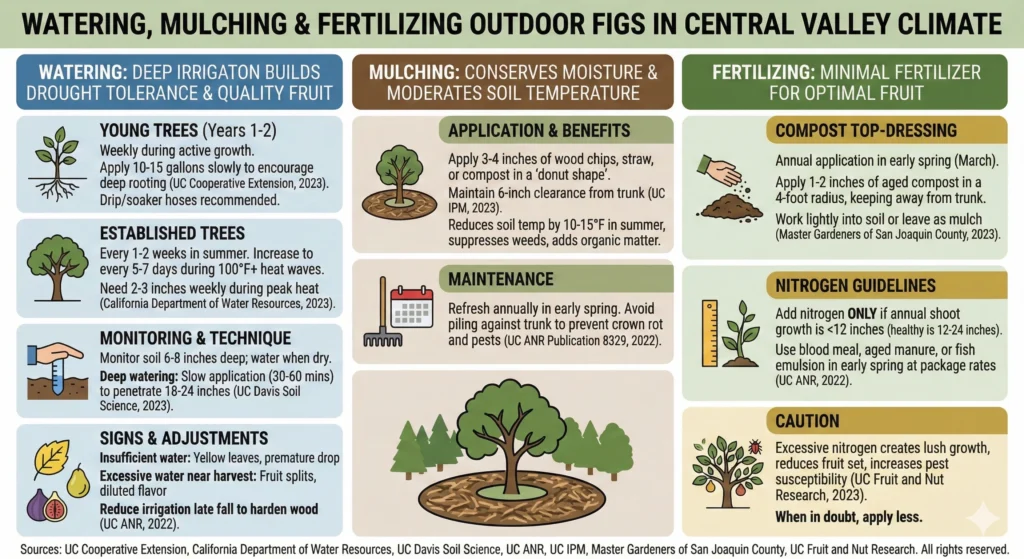
Deep watering builds drought tolerance while promoting fruit quality. Young trees (years 1-2) need weekly irrigation during active growth, applying 10-15 gallons slowly to encourage deep rooting (UC Cooperative Extension, 2023). Drip irrigation or soaker hoses deliver water efficiently without wetting foliage.
Established trees require water every 1-2 weeks during summer, increasing frequency during 100°F+ heat waves to every 5-7 days. Mature trees need 2-3 inches of water weekly during peak heat (California Department of Water Resources, 2023). Monitor soil moisture 6-8 inches deep—water when soil feels dry at this depth.
Insufficient water causes yellowing leaves, premature fruit drop, and leaf loss during summer. However, excessive watering near harvest splits fruit and dilutes flavor. Reduce irrigation in late fall (after harvest) to harden wood for winter dormancy (UC ANR, 2022).
Deep watering technique involves slow application over 30-60 minutes, allowing water to penetrate 18-24 inches deep. This encourages roots to grow downward rather than spreading near the surface where they’re vulnerable to heat stress (UC Davis Soil Science, 2023).
Mulching conserves moisture critical for how to take care of a fig tree in Central Valley’s dry heat. Apply 3-4 inches of wood chips, straw, or compost in a donut shape around trees, maintaining 6 inches clearance from trunks (UC IPM, 2023). Mulch reduces soil temperature by 10-15°F during summer, suppresses weeds, and gradually adds organic matter as it decomposes.
Refresh mulch annually in early spring as previous applications decompose. Avoid piling mulch against trunks—constant moisture promotes crown rot and provides pest habitat (UC ANR Publication 8329, 2022).
Figs thrive with minimal fertilizer. Excessive nitrogen creates lush growth at the expense of fruit production and increases pest susceptibility (UC Fruit and Nut Research, 2023). Annual compost top-dressing in early spring (March) provides sufficient nutrients for established trees.
Apply 1-2 inches of aged compost in a 4-foot radius around trees, keeping material away from trunks. Work compost lightly into soil surface or leave as mulch layer (Master Gardeners of San Joaquin County, 2023).
Add nitrogen only if annual shoot growth measures less than 12 inches—healthy trees produce 12-24 inches of new growth yearly. Blood meal, aged manure, or fish emulsion provide organic nitrogen when needed, applied in early spring at package rates (UC ANR, 2022).
Over-fertilizing causes excessive vegetative growth, reduces fruit set, and attracts aphids and other pests. When in doubt about fig tree care fertility needs, apply less rather than more.
Pruning & Training Outdoor Figs
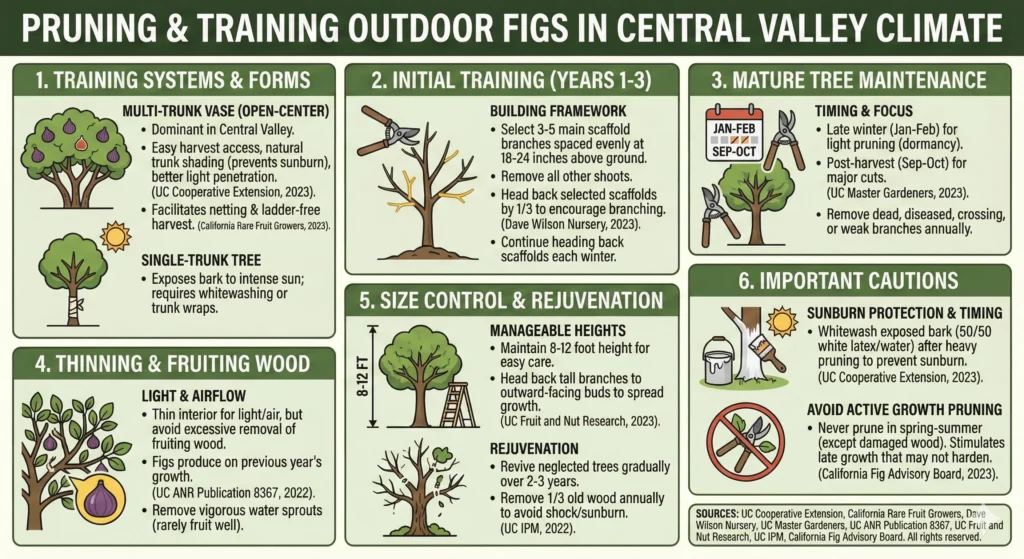
Training systems shape trees for decades of productive growth. The multi-trunk vase or open-center shrub form dominates Central Valley for good reasons: easy harvest access, natural trunk shading preventing sunburn, and better light penetration for fruit development (UC Cooperative Extension, 2023).
Single-trunk tree forms work but expose bark to intense Valley sun, requiring whitewashing or trunk wraps. Low, bushy vase shapes also facilitate netting against birds and make harvest possible without ladders (California Rare Fruit Growers, 2023).
During years 1-3, select 3-5 main scaffold branches spaced evenly around the trunk at 18-24 inches above ground. Remove all other shoots and head back selected scaffolds by one-third to encourage branching (Dave Wilson Nursery, 2023). Each winter, continue heading back scaffold branches to build framework.
Mature tree pruning focuses on maintenance rather than heavy cutting. Late winter dormancy (January-February) suits light pruning, while post-harvest (September-October) works for major cuts (UC Master Gardeners, 2023). Remove dead, diseased, crossing, or weak branches annually.
Thin interior growth to improve light penetration and air circulation, but avoid removing excessive fruiting wood—figs produce on previous year’s growth, so cutting too much eliminates next season’s crop (UC ANR Publication 8367, 2022). Water sprouts (vigorous vertical shoots) rarely fruit well and should be removed.
Size control maintains trees at manageable 8-12 foot heights for care for fig trees without ladders. Head back tall branches to outward-facing buds, spreading growth horizontally (UC Fruit and Nut Research, 2023).
Rejuvenation pruning revives neglected trees gradually over 2-3 years. Remove one-third of old wood annually, allowing new growth to replace it. Sudden, heavy pruning shocks trees and exposes bark to sunburn (UC IPM, 2022).
After heavy pruning, whitewash exposed bark with 50/50 white latex paint and water to prevent sunburn on trunks and main branches. Central Valley’s intense sun damages newly exposed bark quickly (UC Cooperative Extension, 2023).
Never prune during active growth (spring-summer) except to remove damaged wood. Pruning stimulates new growth that won’t harden before winter (California Fig Advisory Board, 2023).
Container Fig Growing in Central Valley
Container growing solves multiple challenges: poor soil, nematode infestations, limited space, renting situations, and mobility needs. Root restriction in pots actually encourages fruiting rather than excessive vegetative growth (UC Master Gardener Program, 2023).
Start with 15-18 inch diameter containers (5-7 gallons) for young trees, sizing up to 20-24 inch pots (15-20 gallons) for mature specimens. Larger containers reduce watering frequency and provide root stability, but mobility becomes challenging (Fine Gardening, 2023).
Terra cotta pots breathe well, preventing waterlogged roots, but dry quickly requiring frequent watering. Plastic containers retain moisture longer and weigh less but need careful watering to prevent saturation. Fabric grow bags provide excellent drainage and air pruning of roots (Container Gardening Research, 2023).
Drainage holes are non-negotiable—at least 4-6 holes per container. Elevate pots on feet or pot caddies to ensure water escapes freely and allow air circulation underneath (UC Cooperative Extension, 2023).
Quality potting mix for potted fig tree care should drain rapidly while retaining some moisture. Garden soil compacts in containers, suffocating roots. Mix 50% commercial potting soil + 30% perlite or pumice + 20% compost for ideal structure (Master Gardeners, 2023). Maintain pH 6.0-7.0 for optimal nutrient availability.
Container figs need daily watering checks during summer heat. Water when the top 2 inches feel dry, applying until water drains freely from bottom holes (UC ANR, 2022). Multiple daily waterings may be necessary during 100°F+ heat waves.
Mulch container surfaces with 1-2 inches organic material to slow evaporation and moderate root temperature. Empty saucers after watering to prevent root rot—standing water suffocates roots within days (UC IPM, 2023).
Fertilize container-grown figs every 3-4 weeks from spring through mid-summer with balanced fertilizer (5-5-5 or 10-10-10) or slightly nitrogen-reduced formulas. Containers leach nutrients faster than ground soil, requiring supplemental feeding (Container Gardening Research, 2023).
Stop fertilizing by August to allow wood hardening before dormancy. Organic options include compost tea, fish emulsion, or slow-release organic pellets at package rates (UC Organic Agriculture, 2023).
Repot every 2-3 years in early spring before growth begins. Slide trees from pots, loosen circling roots, trim one-third of root mass, and replant in fresh mix. Root pruning maintains manageable sizes while rejuvenating growth (Fine Gardening, 2023).
After repotting, water thoroughly, place in partial shade for one week, then gradually return to full sun. Avoid fertilizing for 4-6 weeks to prevent burning trimmed roots (Master Gardeners of Kern County, 2023).
Best varieties for indoor fig tree care and containers include compact growers: Celeste reaches 10-12 feet maximum, Petite Negra (dwarf variety) stays 4-6 feet, Chicago Hardy maintains moderate size, and Brown Turkey responds well to container pruning (Dave Wilson Nursery, 2023).
Indoor & Semi-Indoor Fig Growing
Indoor fig tree care in Central Valley faces an important reality: figs are outdoor trees in our climate. True indoor growing produces primarily ornamental plants with minimal fruiting (UC Master Gardeners, 2023). Most “indoor” scenarios involve overwintering container figs in protected spaces during occasional hard freezes.
Attempting year-round houseplant fig tree care requires brightest possible indoor locations—south or west-facing windows receiving minimum 6 hours direct sunlight. Even optimal windows provide less light than outdoor shade, limiting photosynthesis and fruit development (Sunset Western Garden Book, 2023).
Supplement natural light with full-spectrum LED grow lights positioned 6-12 inches above foliage, operating 12-14 hours daily. Expect reduced growth and sparse fruiting compared to outdoor trees (Container Gardening Research, 2023).
Indoor temperatures between 60-75°F suit fig tree care indoor needs. Avoid heat vents and cold drafts. Humidity should reach 40-60%—dry Central Valley homes may need misting or pebble trays filled with water beneath pots (UC Cooperative Extension, 2023).
Reduce watering frequency indoors due to lower light and evaporation. Overwatering kills more indoor figs than underwatering—check soil moisture before watering (Fine Gardening, 2023). Provide air circulation with gentle fans to prevent fungal problems.
Transitioning container figs between indoor and outdoor locations requires gradual acclimation over 1-2 weeks. Start with 1-2 hours morning sun, increasing exposure daily. Sudden full sun scorches leaves adapted to indoor light (Master Gardeners, 2023).
Watch for leaf yellowing or browning indicating excessive light exposure. Pull back to partial shade if stress appears, then resume gradual acclimation (UC IPM, 2022).
Overwintering strategies make more sense than year-round indoor growing in Central Valley. Unheated garages or sheds maintaining temperatures above 20°F protect dormant trees from rare hard freezes (UC ANR, 2023). Deciduous figs don’t need light during dormancy.
Water dormant container figs monthly—just enough to prevent complete drying. Never fertilize dormant trees. Bring containers outside in March-April as temperatures warm and growth resumes (California Rare Fruit Growers, 2023).
Seasonal Care Calendar for Central Valley
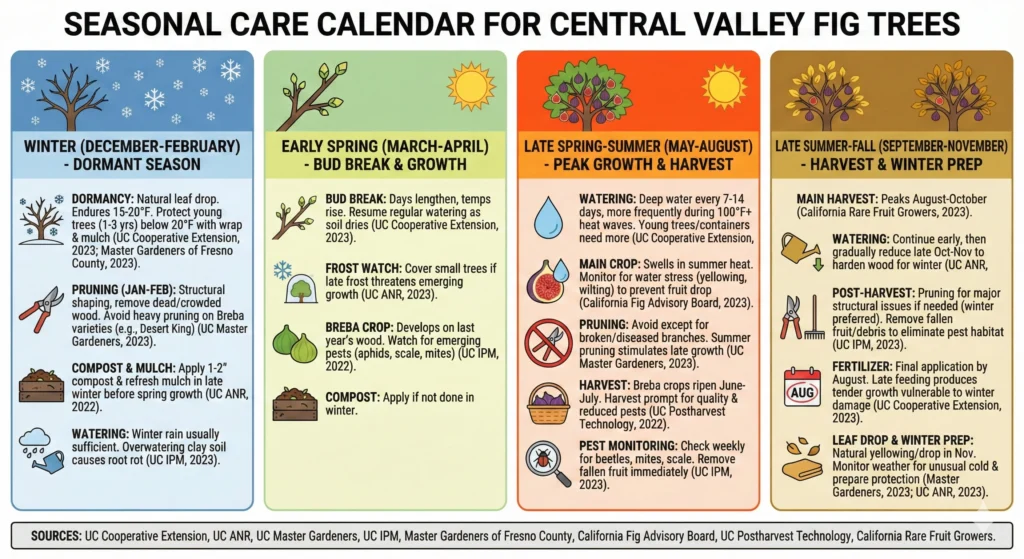
Winter (December-February) brings dormancy as trees drop leaves—a natural response to short days and cool temperatures. Trees endure temperatures to 15-20°F without damage, though young trees benefit from root zone mulching during rare cold snaps (UC Cooperative Extension, 2023).
Structural pruning during late winter (January-February) shapes trees while dormant. Remove dead or damaged wood, thin crowded branches, and maintain desired size and form (UC Master Gardeners, 2023). Avoid heavy pruning on varieties like Desert King that produce primarily on last year’s wood.
Apply 1-2 inches of compost and refresh mulch layers in late winter before spring growth. This timing allows nutrients to incorporate before active growth demands resources (UC ANR, 2022).
Winter rainfall usually provides adequate moisture—supplemental watering is rarely needed unless drought conditions persist. Overwatering dormant trees in clay soil causes root rot (UC IPM, 2023).
Protect trunks of young trees (years 1-3) if temperatures below 20°F are forecast. Wrap trunks with burlap or tree wrap, and mound mulch around root zones. Remove protection when temperatures moderate (Master Gardeners of Fresno County, 2023).
Early spring (March-April) starts with bud break as days lengthen and temperatures rise. Resume regular watering as soil dries, transitioning from winter dormancy to active growth (UC Cooperative Extension, 2023). Apply compost if not completed in winter.
Monitor for late frost events—while rare in Central Valley, unexpected cold can damage emerging growth. Cover small trees with frost cloth if late frost threatens (UC ANR, 2023).
Breba crops develop on last year’s wood during early spring. Watch for emerging pests—aphids, scale, and spider mites become active as trees leaf out (UC IPM, 2022).
Late spring to summer (May-August) brings peak growth and fruit development. Deep water every 7-14 days, increasing frequency during heat waves exceeding 100°F. Young trees and containers need more frequent irrigation (UC Cooperative Extension, 2023).
Main crop figs swell during summer heat. Monitor fruit set and watch for water stress indicators: leaf yellowing, wilting, or fruit drop. Consistent moisture prevents these issues without overwatering (California Fig Advisory Board, 2023).
Avoid pruning except to remove broken or diseased branches. Summer pruning stimulates growth that won’t harden before winter (UC Master Gardeners, 2023).
Breba crops ripen June-July depending on variety. Harvest promptly as fruit reaches peak ripeness to maximize quality and reduce pest pressure (UC Postharvest Technology, 2022).
Pest monitoring intensifies during summer. Check weekly for fig beetles, spider mites, scale insects, and bird damage. Remove fallen fruit immediately to reduce beetle populations (UC IPM, 2023).
Late summer to fall (September-November) peaks with main harvest season. Most Central Valley figs ripen August through October depending on variety and weather (California Rare Fruit Growers, 2023).
Continue regular watering early in this period, gradually reducing irrigation in late October and November to prepare trees for dormancy. Late season watering reduction hardens wood for winter (UC ANR, 2022).
Post-harvest pruning addresses major structural issues if needed, though winter pruning is preferred. Remove fallen fruit and debris to eliminate overwintering pest habitat (UC IPM, 2023).
Final fertilizer applications should occur no later than August—late feeding produces tender growth vulnerable to winter damage (UC Cooperative Extension, 2023).
November brings natural leaf drop as trees enter dormancy. Yellow leaves falling in November are normal, not a care problem (Master Gardeners, 2023).
Monitor fig tree winter care needs as temperatures drop. Watch weather forecasts for unusual cold and prepare protection if necessary, especially for young or tender varieties (UC ANR, 2023).
Harvesting Your Figs
Recognizing ripeness requires observation as color and feel vary by variety. Brown Turkey shifts from green to brown-purple, Black Mission turns deep purple-black, while Kadota remains greenish-yellow even when ripe (UC Postharvest Technology Center, 2022).
Ripe figs droop slightly on stems rather than pointing upward. Gently squeeze fruit—slight softness without mushiness indicates readiness. Small cracks often appear near stem ends, and sweet fragrance becomes noticeable (California Fig Advisory Board, 2023).
Harvest gently to avoid skin damage and latex leakage from stems. Twist and pull fruit from branches or use pruners for clean cuts. Some gardeners wear gloves—fig latex irritates sensitive skin (UC Master Gardeners, 2023).
Peak production requires daily harvest checks. Figs ripen quickly during summer heat, and overripe fruit splits, ferments, or attracts insects within hours (UC IPM, 2022).
Morning harvest before heat stress and when fruit is coolest preserves quality. Use shallow containers—stacked figs bruise easily even with gentle handling (UC Postharvest Technology, 2022).
Fresh figs have extremely short shelf life—2-3 days at room temperature before fermentation begins. Refrigerate immediately in perforated containers or paper bags for 5-7 days maximum storage (California Fig Industry, 2023).
Handle refrigerated figs carefully as cold fruit bruises more easily than room temperature. Don’t wash until ready to eat—moisture accelerates decay (UC Postharvest Technology, 2022).
Preservation extends Central Valley’s abundant harvests. Drying concentrates sugars and creates shelf-stable fruit—the traditional Central Valley method. Sun-dry halved figs on screens in direct sunlight for 3-5 days, bringing inside overnight to prevent dew exposure (UC ANR, 2022).
Freeze whole or halved figs on trays, then transfer to freezer bags for 8-12 months storage. Frozen figs work excellently for baking and smoothies (Master Gardeners of Stanislaus County, 2023).
Make jams, preserves, chutneys, or fig paste for year-round use. High sugar content and natural pectin make figs excellent for preserving (UC ANR Publication 8102, 2023).
Pests, Diseases & Problems in Central Valley
Birds and squirrels pose the greatest harvest threat. Ripening figs attract crows, scrub jays, mockingbirds, and numerous other species. Netting over trees or individual branches provides effective protection (UC IPM, 2023).
Install netting before fruit colors to prevent birds from discovering crops. Harvest timing also helps—picking slightly early at color break yields less sweet but still usable fruit that birds haven’t damaged (California Rare Fruit Growers, 2023).
Fig beetles (green fruit beetles) emerge mid-summer, targeting ripe and damaged fruit. Adult beetles bore into figs, causing rapid fermentation. Remove fallen fruit daily and harvest promptly to reduce populations. Beetle traps using fermenting fruit bait capture many adults (UC IPM, 2022).
Avoid chemical controls for beetles—harvest management and sanitation work better without risking beneficial insects (UC Organic Agriculture, 2023).
Gophers devastate young trees by destroying root systems. Install 1/2-inch hardware cloth baskets at planting, extending 18-24 inches deep and 12 inches above ground (UC IPM, 2023). Trapping controls established populations.
Spider mites increase during hot, dry conditions—typical Central Valley summers. Fine webbing on leaf undersides and stippled yellowing foliage indicate infestations. Spray foliage forcefully with water to dislodge mites, or apply insecticidal soap or horticultural oil (UC IPM, 2022).
Scale insects (particularly black scale) colonize branches, appearing as brown bumps. Heavy infestations weaken trees and produce honeydew attracting ants. Dormant season horticultural oil applications (December-January) suffocate overwintering scales (UC IPM, 2023).
Fig rust, a fungal disease, appears as rust-colored spots on leaves, eventually causing defoliation. More common with overhead watering or unusual humidity, rust rarely kills trees but reduces vigor (UC Plant Pathology, 2023).
Improve air circulation through thinning pruning, avoid overhead watering, and rake fallen leaves to reduce spore populations. Copper-based fungicides provide control if needed (UC IPM, 2022).
Fig mosaic virus affects many Central Valley trees, causing mottled, distorted leaves. No cure exists, but most infected trees remain productive for decades (UC Plant Pathology, 2023). Severe infections reducing productivity warrant tree removal and replacement.
Root rot from Phytophthora or Armillaria fungi devastates trees in waterlogged soil. Prevention is critical—ensure drainage before planting. Infected trees show yellowing foliage, decline, and eventual death. No chemical cure exists (UC IPM, 2023).
Fruit drop during summer typically results from irregular watering, heat stress, or over-fertilization. Maintain consistent watering schedules and avoid excessive nitrogen (UC Cooperative Extension, 2023).
Fruit split occurs when sudden heavy watering follows drought, or late season rain saturates ripening fruit. Maintain steady moisture throughout ripening, and harvest slightly early if rain threatens (California Fig Advisory Board, 2023).
Sour fruit results from incomplete ripening or excessive water near harvest. Allow fruit to fully ripen on trees and reduce irrigation as fruit colors (UC Postharvest Technology, 2022).
Sunburn on branches follows heavy pruning that suddenly exposes bark. Whitewash newly exposed wood with diluted white latex paint (50/50 with water) immediately after pruning (UC Cooperative Extension, 2023).
Yellow leaves indicate multiple possible causes: underwatering (most common in Central Valley), overwatering, salt buildup from hard water or over-fertilizing, nematode damage, or natural late-season leaf drop. Diagnose by checking soil moisture, watering history, and timing (UC Master Gardeners, 2023).
Nematodes (microscopic root-feeding worms) pervade many Central Valley soils, particularly in areas with previous vegetable or fruit production. Symptoms include stunted growth, yellowing, poor fruit set, and general decline despite good care (UC Nematology, 2023).
Container growing eliminates nematode exposure. For in-ground planting in infested soil, consider raised beds with imported clean soil, or soil solarization: cover moistened soil with clear plastic for 4-6 weeks during peak summer heat (June-August) to kill nematodes (UC IPM, 2022).
Nematode-resistant rootstocks exist but limited availability restricts home gardener access. Container culture remains the most practical solution (UC ANR, 2023).
Integrated Pest Management (IPM) prioritizes monitoring, prevention, and least-toxic controls. Inspect trees weekly during growing season, watching for pest buildup before populations explode (UC IPM, 2023).
Cultural controls—proper watering, sanitation, pruning for air circulation—prevent most problems. Physical barriers like netting and trunk wraps provide non-toxic protection. Encourage beneficial insects through diverse plantings and avoiding broad-spectrum pesticides (UC Organic Agriculture, 2023).
Apply pesticides only as last resort, choosing least-toxic options: insecticidal soap, horticultural oil, Bacillus thuringiensis (Bt), or botanical pyrethrins. Follow label directions carefully (UC IPM, 2022).
Troubleshooting Common Problems
“My fig tree won’t produce fruit” frustrates many growers, but usual causes are correctable. Young trees typically require 3-5 years before significant production begins—patience is essential (UC Cooperative Extension, 2023).
Excessive nitrogen fertilizer diverts energy to foliage rather than fruiting. Reduce or eliminate fertilizer and allow trees to focus on reproduction (UC Fruit and Nut Research, 2023).
Insufficient sun (less than 8 hours daily) limits photosynthesis and fruit development. Relocate container trees or prune surrounding vegetation shading in-ground specimens (UC Master Gardeners, 2023).
Wrong variety types requiring pollination don’t produce in home gardens without specific wasps. Common figs eliminate this concern—verify variety selection (California Rare Fruit Growers, 2023).
Heavy winter pruning removes fruiting wood since figs produce on previous year’s growth. Limit winter cuts to structural and maintenance work, preserving last year’s branches (UC ANR, 2022).
“Leaves turning yellow and dropping” during growing season indicates problems, though late-fall yellowing is normal. Underwatering causes most Central Valley yellowing—check soil moisture and increase irrigation frequency (UC Cooperative Extension, 2023).
Conversely, overwatering in clay soils suffocates roots and triggers yellowing. Verify drainage and reduce watering if soil stays saturated (UC IPM, 2023).
Salt buildup from hard Central Valley water or over-fertilizing shows as leaf margin yellowing or browning. Leach salts with deep watering and reduce fertilizer applications (UC Master Gardeners, 2023).
Nematode damage causes gradual yellowing and decline. Consider container growing if in-ground trees continue struggling despite good care (UC Nematology, 2023).
“Figs splitting on the tree” results primarily from irregular watering—periods of drought followed by heavy irrigation or rain. Maintain consistent watering schedules throughout ripening (California Fig Advisory Board, 2023).
Late season rain causes splitting in fruit approaching ripeness. Harvest slightly early if rain threatens, allowing figs to soften indoors (UC Postharvest Technology, 2022).
“Tree growing too large” requires pruning to control size. Post-harvest pruning (September-October) or dormant season cuts (January-February) reduce height and spread. Head back tall branches annually to maintain manageable sizes (UC Cooperative Extension, 2023).
Root prune container trees every 2-3 years to limit size. Remove tree from pot, trim outer roots, and replant in same container (Fine Gardening, 2023).
Choose compact varieties like Celeste for small spaces rather than fighting vigorous varieties (Dave Wilson Nursery, 2023).
“Frost damage concerns” primarily affect young trees (years 1-3). Mature trees tolerate Central Valley winters, but unexpected cold below 20°F threatens tender growth (UC ANR, 2023).
Mulch root zones heavily (6-8 inches) for care for fig tree in winter during cold snaps. Wrap young trunks with burlap or commercial tree wrap if severe cold threatens. Remove protection when temperatures moderate (Master Gardeners, 2023).
Prune frost-damaged wood in spring after final frost risk passes. Trees often recover vigorously from cold damage (UC Cooperative Extension, 2023).
“Poor fruit quality or flavor” stems from multiple factors. Insufficient sun reduces sugar development—ensure 8+ hours direct sunlight (UC Master Gardeners, 2023).
Overwatering near harvest dilutes flavor and causes sogginess. Reduce irrigation as fruit colors to concentrate sugars (California Fig Advisory Board, 2023).
Picking underripe fruit before full color development and softening yields bland figs. Allow complete ripening on trees (UC Postharvest Technology, 2022).
Heat stress during ripening occasionally reduces quality during extreme heat waves (110°F+), though Central Valley varieties typically handle normal 100-105°F temperatures well (UC Fruit and Nut Research, 2023).
Long-Term Fig Tree Care & Maintenance
Annual maintenance preserves productive life for decades. Prune annually during dormancy to maintain structure, remove problematic wood, and control size (UC Cooperative Extension, 2023).
Refresh mulch layers each spring as previous applications decompose, maintaining 3-4 inch depth around trees (UC Master Gardeners, 2023).
Soil testing every 3-5 years monitors pH and nutrient levels, though figs tolerate wide conditions. Test if growth or production declines without obvious cause (UC Davis Analytical Lab, 2023).
Track pest and disease patterns year-to-year to predict and prevent future problems. Heavy scale infestations one winter suggest dormant oil treatments next year (UC IPM, 2023).
Repot container trees every 2-3 years to refresh soil and root prune for size maintenance. Skip repotting schedule if trees show stress or poor growth that year (Fine Gardening, 2023).
Proper pruning maintains vigor as trees age. Thinning cuts remove entire branches at their origin, opening canopies and stimulating new fruiting wood. Heading cuts shorten branches, encouraging lateral growth (UC Fruit and Nut Research, 2023).
Consistent care prevents stress that shortens productive life. Avoid extreme drought, overwatering, excessive fertilizer, and severe pruning (UC Cooperative Extension, 2023).
Disease management through sanitation and cultural practices extends tree longevity. Remove diseased wood promptly, rake fallen leaves, and destroy infected material (UC Plant Pathology, 2023).
Adequate but not excessive fertility—annual compost applications without nitrogen supplements—provides balanced nutrition supporting decades of growth (UC ANR, 2022).
Central Valley figs producing for 50+ years are common with consistent care and favorable conditions. Heritage trees over 100 years still fruit productively (California Rare Fruit Growers, 2023).
Consider replacement when severe disease like fig mosaic virus significantly reduces production despite good care. Root rot usually kills trees beyond recovery (UC IPM, 2023).
Repeated winter damage in cold pockets may indicate variety/location mismatch. Replace with cold-hardy varieties like Chicago Hardy (Missouri Botanical Garden, 2023).
Poor production despite proper care for 3+ years suggests nematode damage or unsuitable soil. Container growing or relocation often solves the issue better than persisting with struggling trees (UC Nematology, 2023).
Trees becoming unmanageable size despite regular pruning may exceed available space. Replace with compact varieties or relocate larger trees if possible (UC Cooperative Extension, 2023).
Conclusion
Fig trees rank among California Central Valley’s most reliable, low-maintenance fruit producers. Hot summers mirror Mediterranean conditions where figs originated, while mild winters provide necessary dormancy without damaging cold. Success hinges on several key factors: selecting appropriate varieties for your specific use and space, providing adequate water without overwatering, avoiding excessive fertilizer that prioritizes leaves over fruit, and annual pruning that maintains manageable size while preserving fruiting wood.
Beginners should start with Brown Turkey—this variety tolerates mistakes while producing abundantly under Central Valley conditions. Container growing succeeds as well as in-ground planting, with both methods yielding quality fruit for 50+ years when properly maintained.
The reward for proper edible fig tree care is decades of reliable harvest, often with 100+ pounds of fruit annually from mature trees. Few fruit trees match figs’ combination of heat tolerance, drought resilience, pest resistance, and production longevity. Your homegrown Central Valley figs will outshine grocery store specimens in freshness and flavor—a testament to proper care and our region’s ideal growing conditions.