Creeping Myrtle Success: Fast-Growing Groundcover
1. Introduction
Creeping myrtle, Vinca minor, is a fast‑growing, evergreen, mat‑forming perennial often used as a carpet‑like ground cover in home gardens and designed landscapes. It goes by several common names, including creeping myrtle, periwinkle, lesser periwinkle, dwarf periwinkle, and simply “myrtle” in many parts of North America.
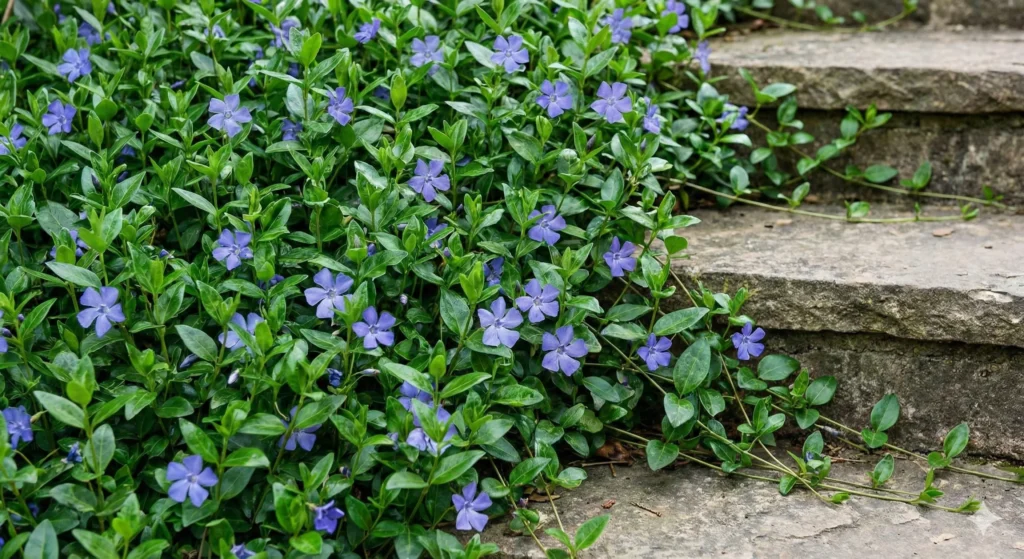
Gardeners prize this periwinkle ground cover for its glossy evergreen foliage, small violet‑blue (or sometimes white) flowers, and its ability to knit together a living mulch in shade where turf and many perennials struggle. It is widely used for erosion control on slopes, to suppress weeds under trees and shrubs, and as a low‑maintenance shade ground cover around foundations and in problem areas.
This guide offers a complete, practical overview of creeping myrtle ground cover: plant profile and selection, site preparation, planting step‑by‑step, Vinca minor care and maintenance, control of spread, propagation, design uses, troubleshooting, toxicity, regional considerations, and alternatives where it behaves as an invasive ground cover plant.
2. Plant Profile: What Is Creeping Myrtle (Vinca minor)?
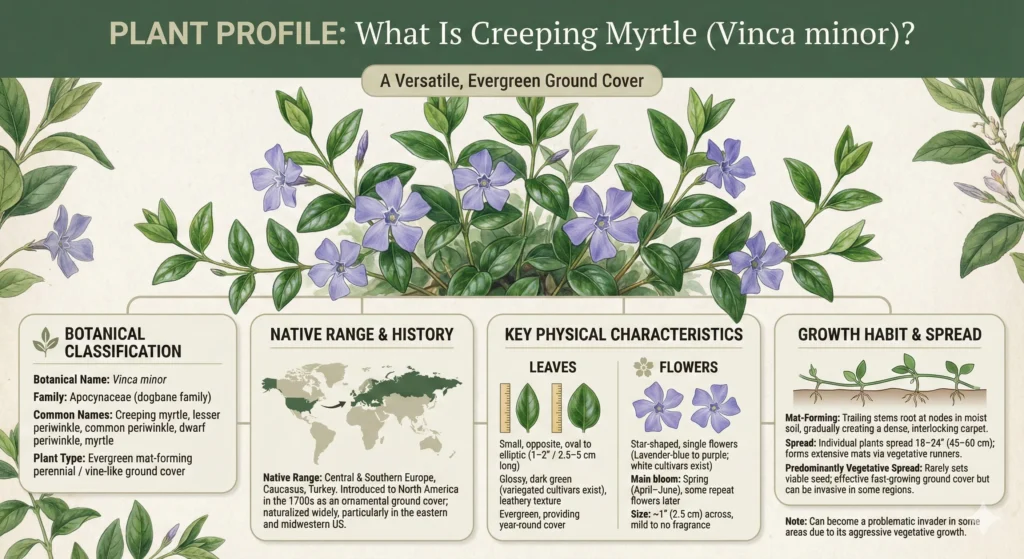
Botanical classification
- Botanical name: Vinca minor
- Family: Apocynaceae (dogbane family)
- Common names: Creeping myrtle, lesser periwinkle, common periwinkle, dwarf periwinkle, myrtle
- Plant type: Evergreen mat‑forming perennial / vine‑like ground cover
Native range and history
Vinca minor is native to central and southern Europe, from Portugal and France north to the Netherlands and the Baltic states, and east to the Caucasus and Turkey. It was introduced to North America as an ornamental ground cover in the 1700s and has since naturalized widely, particularly in the eastern and midwestern United States.
Key physical characteristics
- Height: Typically 3–6 inches (7.5–15 cm) tall.
- Spread: Individual plants can spread 18–24 inches (45–60 cm) via trailing stems; as a colony, it forms extensive mats.
- Habit: Long, slender, arching to trailing stems that root where nodes (the points where leaves attach) touch moist soil, gradually creating a dense, interlocking mat.
Leaves:
- Small, opposite, oval to elliptic leaves, generally 1–2 inches (2.5–5 cm) long.
- Glossy, dark green in the species, with a leathery texture; some cultivars have variegated or chartreuse foliage.
- Evergreen in most climates where it is hardy, providing year‑round cover.
Flowers:
- Star‑shaped, single flowers, usually in shades of lavender‑blue to purple; white and other tones are available in cultivars.
- Main bloom in spring (roughly April–June), with scattered repeat flowers later in the season in favorable conditions.
- Individual flowers are about 1 inch (2.5 cm) across, borne singly along the stems. Fragrance is generally mild to none.
Growth habit
Creeping myrtle is an evergreen mat‑forming perennial with trailing stems that root at the nodes as they travel along the ground. Over time, this creates a dense, weed‑smothering carpet. It rarely sets viable seed in many regions; spread is predominantly vegetative by runners, which is why it is both a superb fast‑growing ground cover plant and, in some regions, a problematic invader.
3. Pros and Cons: Is Creeping Myrtle Right for Your Garden?
Advantages
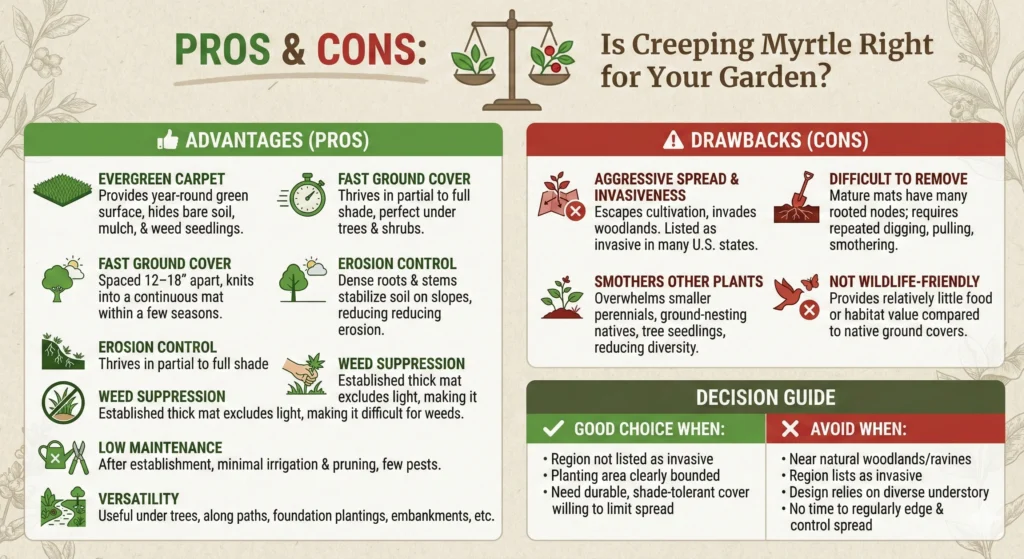
- Evergreen carpet: Provides a year‑round green surface that hides bare soil, mulch, and weed seedlings.
- Fast ground cover: Classified as a fast‑growing groundcover; plants spaced 12–18 inches apart typically knit into a continuous mat within a few seasons.
- Shade tolerance: Thrives from partial shade to full shade, making it a classic low‑maintenance shade ground cover under trees and shrubs.
- Erosion control: Dense roots and stems help stabilize soil on slopes and banks, reducing erosion.
- Weed suppression: Once established, the thick evergreen mat excludes light and makes it difficult for most weeds to establish.
- Low maintenance: After establishment, it typically needs minimal irrigation and pruning, with few serious pest problems.
- Versatility: Useful under trees, along paths, in foundation plantings, on embankments, and in formal or naturalistic designs.
Drawbacks
- Aggressive spread and invasiveness: In many regions, especially where winters are mild and soils are moist, Vinca minor escapes cultivation and invades woodlands and natural areas. It is listed as invasive or of concern in multiple U.S. states across the Pacific Northwest, West Coast, South, and much of the Midwest and Northeast.
- Difficult to remove: Mature mats have many rooted nodes; removing them often requires repeated digging, pulling, and smothering over several seasons.
- Smothers other plants: Its dense growth can overwhelm smaller perennials, ground‑nesting native plants, and tree seedlings, reducing plant diversity.
- Not wildlife‑friendly: Compared with native ground covers, creeping myrtle provides relatively little food or habitat value to local wildlife.
When it is a good choice
Consider creeping myrtle when:
- You are in a region where it is not listed as invasive or restricted, and you have confirmed this with local extension or invasive‑species lists.
- The planting area is clearly bounded by paths, walls, lawn, or hardscape that make regular edging easy.
- You need a durable, evergreen, shade‑tolerant ground cover under established trees, on slopes, or in difficult shaded corners, and are willing to limit it to that area.
When to avoid it
Avoid or strongly reconsider creeping myrtle if:
- You garden near natural woodlands, ravines, or conservation areas, where escape into native habitats is likely.
- You live in a region where Vinca minor is officially classed as an invasive ground cover plant or is discouraged by extension services.
- Your design relies on a diverse understory of native or ornamental perennials, spring ephemerals, or self‑sowing wildflowers that creeping myrtle would smother.
- You do not have the time or inclination to regularly edge and control its spread.
4. Ideal Growing Conditions
Climate and hardiness
- USDA hardiness zones: Generally hardy in zones 4–9.
- Performs very well in cool‑temperate climates; in hotter climates, it benefits from afternoon shade and reliable soil moisture.
- In the coldest parts of its range, foliage may discolor or burn in winter but typically greens up again in spring.
Light requirements
- Partial shade to full shade is ideal for lush foliage and good flowering.
- Tolerates full sun in cooler climates if soil moisture is adequate.
- In hot climates, full sun can cause leaf scorch and thinning; deep shade may slightly reduce flowering but the evergreen mat remains effective.
Trade‑offs:
- More light (morning sun or light dappled shade) generally means more flowers and denser growth, but also slightly more irrigation needs.
- Deeper shade favors foliage over flowers; this is often acceptable when the primary goal is a green carpet.
Soil preferences
- Prefers well‑drained, moist but not waterlogged soils.
- Adaptable to clay, loam, or sandy soils once established, provided drainage is reasonable.
- Tolerates a wide pH range, from slightly acidic to neutral, and often into mildly alkaline soils.
Moisture needs
- During establishment (first season): Needs consistent moisture—a deep watering once or twice a week in dry weather, allowing the surface to dry slightly between waterings.
- Once established: Moderately drought tolerant; in many climates it can get by on rainfall alone, especially in shade.
- Prolonged saturation or heavy, poorly drained clay predisposes the planting to root and stem rots (Phytophthora, Rhizoctonia, Phoma stem blight)..
5. Choosing Plants and Varieties
Planting material options
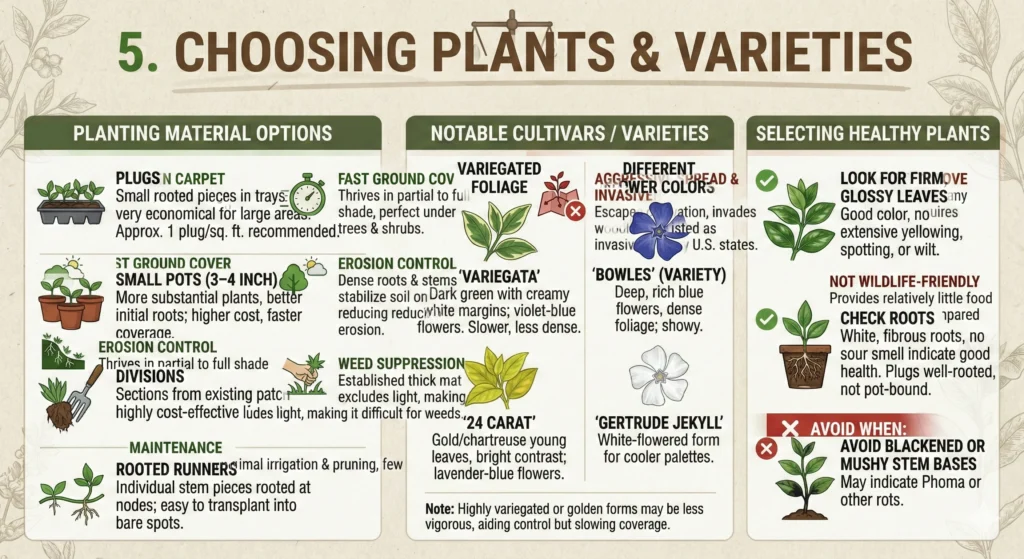
- Plugs: Small rooted pieces in trays or small cells; very economical for large areas. Garden centers often recommend about one plug per square foot for reasonably fast coverage.
- Small pots (3–4 inch): More substantial plants with better initial root systems; cost per plant is higher but coverage begins sooner.
- Divisions: Sections lifted from an existing patch and replanted elsewhere; highly cost‑effective if you or a neighbor already has creeping myrtle.
- Rooted runners: Individual stem pieces already rooted at nodes; easy to transplant into bare spots to speed fill‑in.
Notable cultivars / varieties
Many cultivars provide variation in foliage and flower color.
- Variegated foliage:
- Different flower colors:
- Leaf color variants:
When choosing cultivars, note that highly variegated or golden forms may be slightly less vigorous, which can be an advantage for control but may mean a bit slower coverage.
Selecting healthy plants
When buying plugs or pots:
- Look for firm, glossy leaves with good color and no extensive yellowing, spotting, or wilt.
- Turn pots over and check drainage holes; white, fibrous roots with no sour smell indicate good health.
- Avoid plants with blackened or mushy stem bases, which may indicate Phoma or other rots.
- For plugs, choose trays with well‑rooted but not pot‑bound cells—roots should hold the soil together but not be circling heavily.
6. Site Assessment and Preparation
Evaluating light and exposure
- Observe sun and shade patterns at several times of day and, if possible, different seasons (leaf‑on vs leaf‑off for deciduous trees).
- Creeping myrtle is especially well suited to east‑facing slopes, north sides of buildings, and under deciduous or evergreen canopies where it will see dappled or indirect light.
Competition from tree roots
- Vinca minor can grow under tree roots better than many plants, but:
- Avoid severely compacted or extremely dry root zones.
- Do minimal digging under established trees—plant between major roots and keep added soil depth modest (a few centimeters).
Existing vegetation and weeds
- Remove perennial weeds (quackgrass, bindweed, ivy, brambles) thoroughly before planting; they are difficult to remove once intertwined with the vinca mat.
- Scalp or remove turf if present. Either:
- Spray existing weeds/turf with an appropriate non‑selective herbicide (following all label and local regulations), wait, then remove dead material; or
- Use sheet mulching (layers of cardboard or paper plus mulch) where appropriate, then cut planting holes.
Soil preparation
- Check drainage:
- Dig a test hole about 30 cm deep, fill with water, and time how long it takes to drain.
- If water still stands after 24 hours, consider raised berms, amending with coarse material, or choosing a more moisture‑tolerant alternative.
- Assess and adjust soil:
- Surface preparation:
- Rake to a smooth, friable surface.
- For slopes, shape shallow terraces or contour ridges to slow runoff and help new plants root.
7. How to Plant Creeping Myrtle (Step‑by‑Step)
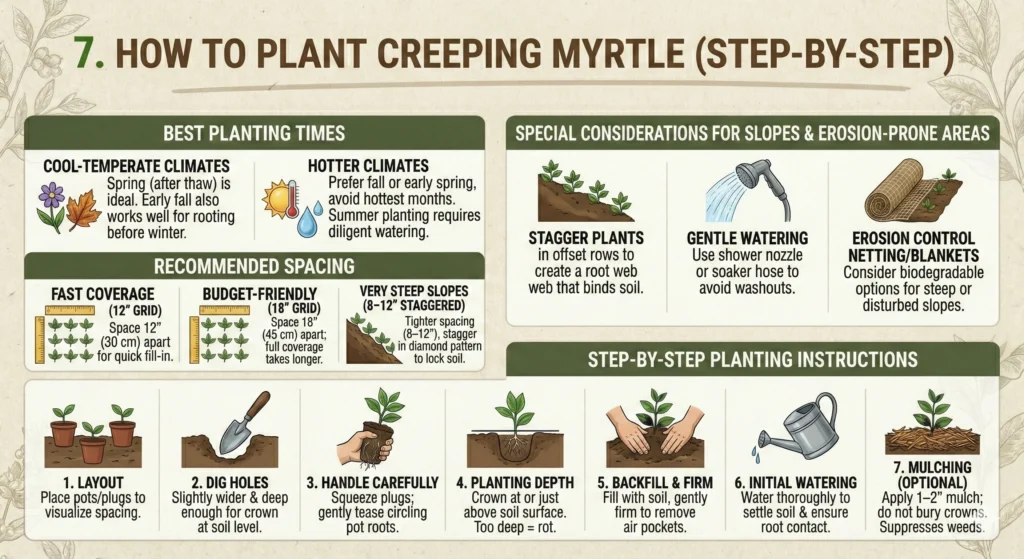
Best planting times
- Cool‑temperate climates:
- Spring (after soil is workable) is ideal, giving a full season for roots to establish.
- Early fall also works well, allowing rooting before winter.
- Hotter climates:
- Prefer fall or early spring, avoiding the hottest months. Summer planting is possible with diligent watering.
Recommended spacing
- Fast coverage:
- Budget‑friendly slower coverage:
- Space 18 inches (45 cm) apart, acknowledging that full coverage may take an extra season or two.
- Very steep slopes:
- Use tighter spacing (8–12 inches) and stagger plants in a diamond pattern to lock soil more quickly.
Step‑by‑step planting instructions
- Layout:
- Place pots or plugs on the soil surface at the desired spacing to visualize coverage and adjust before digging.
- Dig holes:
- Holes should be just slightly wider and deep enough so the crown (where stems meet roots) sits at or just above soil level.
- Handle plants carefully:
- For plugs: Squeeze or tap cells to remove with minimal root damage.
- For pots: Slide plant out, and if roots are circling, gently tease them apart.
- Planting depth:
- Set each plant so the existing soil surface on the plug matches the surrounding soil level. Planting too deep encourages rot.
- Backfill and firm:
- Backfill with loosened soil (amended with compost if needed), gently firming around the roots to remove air pockets.
- Initial watering:
- Mulching (optional):
- Apply a thin mulch (1–2 inches) of leaf mold, shredded bark, or compost between plants. Do not bury crowns. Mulch suppresses weeds until vinca fills in.
Special considerations for slopes and erosion‑prone areas
- Stagger plants in offset rows to create a web of roots that binds soil.
- Water in gently using a shower‑type nozzle or soaker hoses to avoid washouts.
- On very steep or freshly disturbed slopes, consider:
- Biodegradable erosion control netting over the soil with plants inserted through; or
- Temporary straw or fiber blankets pinned down between rows.
8. Routine Care and Maintenance
Watering schedules
- Establishment phase (first growing season):
- Mature plantings:
Signs of water stress:
- Too little water: Wilting, dull or rolling leaves, browning at tips, and slowed spread.
- Too much water: Yellowing leaves, blackened stems at soil line, dieback in patches—often associated with root and stem rots.
Fertilization
- In typical garden soils with added compost, no routine fertilizer is necessary for healthy Vinca minor care.
- If growth is weak and soil tests show nutrient deficiency:
- Apply a balanced, slow‑release fertilizer at a modest rate in spring only, avoiding heavy nitrogen that can promote disease in lush, crowded growth.
Trimming and pruning
- Light shearing after flowering (late spring to early summer) can encourage branching and a thicker mat.
- Edge regularly where mats meet lawns, paths, or beds:
- Use a half‑moon edger or spade to slice back runners.
- In more formal settings, hedge shears or a string trimmer can be used carefully to maintain a crisp line.
Seasonal care
- Spring:
- Summer:
- Monitor moisture during hot spells; spot‑water as needed.
- Watch for any yellowing or thinning that might indicate disease or root issues.
- Autumn:
- Light cleanup of fallen leaves (especially thick mats of large leaves) to maintain airflow.
- Winter:
9. Controlling Spread and Preventing Invasiveness
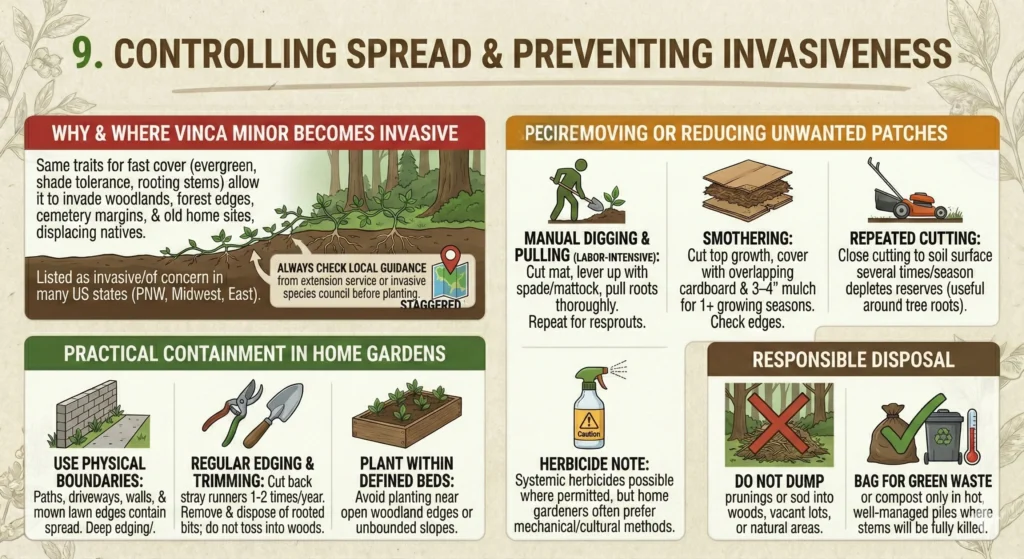
Why and where Vinca minor becomes invasive
The same traits that make creeping myrtle an excellent fast‑spreading groundcover—evergreen foliage, tolerance of shade, rapid vegetative spread by rooting stems—allow it to invade woodlands, forest edges, cemetery margins, and old home sites when it escapes gardens. It forms mats that displace native herbs, ferns, and seedlings.
State and regional invasive plant councils list Vinca minor as invasive or of concern in many U.S. states from the Pacific Northwest through the Midwest and much of the East.
Always check local guidance from your extension service or invasive species council before planting.
Practical containment in home gardens
- Use physical boundaries:
- Paths, driveways, walls, and regularly mown lawn edges all help contain spread.
- Deep edging strips or root barriers (installed 6–8 inches deep) can block stolons from creeping under fences or into beds.
- Regular edging and trimming:
- Once or twice a year, cut back runners that stray into unwanted areas.
- Remove and dispose of rooted bits; do not toss them into adjacent woods.
- Plant within defined beds:
- Avoid planting creeping myrtle in open woodland edges or unbounded slopes that transition directly into natural areas.
Removing or reducing unwanted patches
Removal is possible but generally labor‑intensive:
- Manual digging and pulling:
- Smothering:
- After initial cutting and raking off top growth, cover area with overlapping layers of cardboard plus 3–4 inches of mulch for one or more growing seasons.
- Check edges regularly for runners escaping beyond the smothered zone.
- Repeated cutting:
- In areas where digging is difficult (around tree roots), repeated close cutting to the soil surface several times per season depletes stored reserves over time.
Where herbicides are permitted and appropriate, some land managers use systemic herbicides in combination with mechanical methods, but home gardeners often prefer mechanical and cultural approaches, especially near desirable trees or in sensitive sites.
Responsible disposal
- Do not dump creeping myrtle prunings or sod into nearby woods, vacant lots, or natural areas—many invasions begin this way.
- Bag plant material for municipal green waste where accepted, or compost only in hot, well‑managed piles where you are confident stems will be fully killed.
10. Propagation Methods
Natural spread via runners
Creeping myrtle’s main method of spread is by trailing stems that root at their nodes. Gardeners can redirect this natural behavior:
- Gently lift rooted nodes at the edge of the mat, cut the connecting stem behind the rooted section, and transplant these small rooted pieces into bare areas.
- Water well until established.
Division of mature mats
Dividing established patches is the quickest way to create new plantings:
- In early spring or early fall, select a healthy area.
- Use a sharp spade to cut out clumps several inches thick, including roots.
- Lift the clump, trim away excessive trailing stems, and replant divisions immediately at the same depth in the new location.
- Water thoroughly until re‑rooted.
Stem cuttings
Stem cuttings are an efficient way to produce many plants:
- Best time: Late spring through summer when stems are actively growing.
- How to:
- Take 3–5 inch (8–12 cm) non‑flowering stem tips with at least three sets of leaves.
- Remove leaves from the lower half.
- Insert cut ends into a moist, well‑drained rooting mix such as equal parts peat moss and perlite or sand.
- Keep in bright shade with high humidity (a clear plastic cover that doesn’t touch leaves works well).
- Roots typically form in about 4–6 weeks under suitable conditions.
Seed propagation
Vinca minor rarely sets significant viable seed in many garden situations, and commercial production relies almost entirely on vegetative propagation. Seed propagation is generally impractical and unnecessary for home gardeners.
11. Design Ideas and Landscape Uses
Classic landscape uses
- Under trees and shrubs:
- Along paths and around foundations:
- Creates a tidy, low edging that softens hardscape while remaining low enough not to block views or vents.
- On slopes and embankments:
Companion planting ideas
Because creeping myrtle forms a low, even evergreen mat, it pairs well with taller or clumping plants that rise above it, such as:
- Spring bulbs (daffodils, narcissus) that emerge through the foliage.
- Upright woodland perennials like hostas, ferns, hellebores, and astilbes in regions where invasiveness is not a concern.
- Shrubs such as azaleas, rhododendrons, yews, and hydrangeas, where the vinca covers bare soil under their canopies.
In ecologically sensitive areas or where wildlife value is a priority, consider native companions instead of vinca itself, using similar design logic but with more diverse, wildlife‑supporting species.
Small‑space and container uses
- In large shade containers, creeping myrtle can cascade over the edges, acting as a living mulch under small trees or shrubs in pots.
- In courtyard or walled gardens, it can define planting pockets and soften stonework, provided its spread is monitored and occasionally trimmed.
Situations to avoid
- Adjacent to natural woodlands, ravines, or conservation areas, especially in regions where it is already escaping into wild habitats.
- Mixed perennial beds where you rely on small, low, or slowly spreading species, as creeping myrtle may eventually smother them.
12. Pests, Diseases, and Common Problems
Diseases
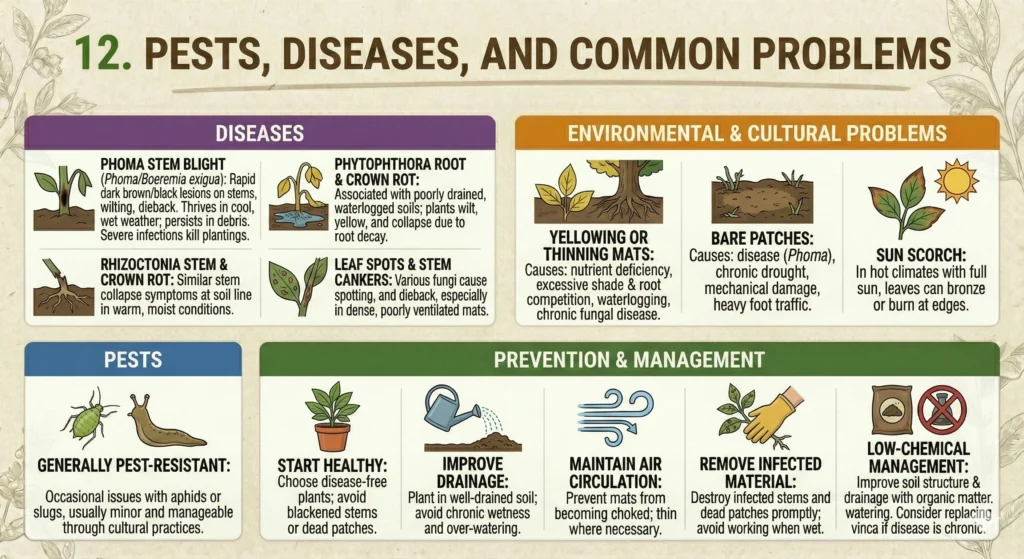
While generally resilient, Vinca minor can suffer from several fungal diseases in cool, wet conditions:
- Phoma stem blight (Phoma/Boeremia exigua):
- Phytophthora root and crown rot:
- Rhizoctonia stem and crown rot:
- Leaf spots and stem cankers:
Prevention and management:
- Start with healthy, disease‑free plants; avoid stock with blackened stems or dead patches.
- Plant in well‑drained soil; avoid chronic wetness and over‑watering.
- Maintain air circulation by not letting mats become choked with leaves and debris; thin where necessary.
- Remove and destroy infected stems and dead patches promptly; avoid working in the bed when foliage is wet to limit spore spread.
Pests
Vinca minor is generally resistant to serious insect pests and is often described as pest‑resistant. Occasional issues may include aphids or slugs, but these are usually minor and manageable through cultural practices or localized treatment.
Environmental and cultural problems
- Yellowing or thinning mats:
- Possible causes include nutrient deficiency, excessive shade combined with competition from tree roots, waterlogging, or chronic fungal disease.
- Bare patches:
- Sun scorch:
- In hot climates with full sun, leaves can bronze or burn at edges.
Low‑chemical management:
- Improve soil structure and drainage with organic matter.
- Adjust watering to prevent both drought stress and saturation.
- Where disease is chronic and severe, consider replacing vinca with a non‑susceptible ground cover rather than repeated fungicide use.
13. Troubleshooting Guide (Quick Reference)
14. Safe Handling, Pets, and Toxicity
Toxicity to humans and pets
Periwinkle species, including Vinca minor, contain vinca alkaloids such as vincamine and related compounds, which have pharmacological activity and can be harmful if ingested in quantity. Toxicity is generally considered mild to moderate compared with the much more poisonous Catharanthus roseus (Madagascar periwinkle), but caution is still warranted.
- Reported or potential symptoms in pets and humans from ingestion include:
- Poison center data suggest that small accidental ingestions of Vinca minor leaves or flowers often result in no or mild symptoms, but medical guidance is still recommended.
Practical safety advice
- Treat creeping myrtle as potentially toxic if eaten:
- Avoid planting it where toddlers or pets routinely graze on plants.
- If pets are known plant‑chewers, consider a non‑toxic alternative ground cover.
- Use gloves when planting or pruning, especially if you have sensitive skin, and wash hands afterwards.
- If a child or pet ingests plant material:

15. Regional Notes and Alternatives
Performance in cool‑temperate climates
In cool‑temperate regions within zones 4–7, creeping myrtle often performs near its best:
- Evergreen foliage, vigorous spread, and reliable flowering in spring into early summer.
- Winter damage is generally minimal, with quick recovery in spring.
Performance in hot or very dry climates
In hotter or arid regions:
- Needs shade and supplemental moisture; full sun and drought lead to scorching and thinning.
- Deep organic mulches and irrigation during peak heat help it persist, but some gardeners prefer more heat‑adapted ground covers.
Recommended alternatives where Vinca minor is invasive or unsuitable
For regions where creeping myrtle is invasive, or for gardeners seeking wildlife‑friendly or native options, consider these alternatives:
For shade (native or wildlife‑friendly):
- Wild ginger (Asarum canadense): Low, shade‑loving, colony‑forming perennial with heart‑shaped leaves; excellent in woodland shade.
- Barren strawberry (Waldsteinia fragarioides): Evergreen or semi‑evergreen, strawberry‑like foliage with yellow spring flowers; good in part shade and tolerates some sun.
- Native sedges (Carex spp., e.g., Carex pensylvanica): Fine‑textured, deer‑resistant, shade‑tolerant ground covers that stabilize soil and support insects.
- Allegheny pachysandra (Pachysandra procumbens): A native alternative to Japanese pachysandra, evergreen to semi‑evergreen, excellent for shade groundcover.
For erosion control on slopes:
- Pennsylvania sedge (Carex pensylvanica) and other woodland sedges – bind soil, tolerate shade, and are good erosion control plants.
- Native ferns (e.g., hay‑scented fern, Christmas fern) – taller but effective ground shields on shady slopes.
For sunny or mixed sites:
- Creeping phlox (Phlox subulata or Phlox divaricata in partial shade): Low, flowering mats in sun or part shade, high wildlife value.
- Creeping junipers (Juniperus spp.) – evergreen conifers for sunny slopes with strong erosion control where woody groundcovers are acceptable.
Extension and conservation resources specifically recommend replacing invasive ground covers such as English ivy, Japanese pachysandra, and periwinkle with a mix of native groundcovers to improve biodiversity and ecological function.
16. Frequently Asked Questions (FAQ)
How fast does creeping myrtle spread, and how long to full coverage?
Vinca minor is classified as a fast‑growth‑rate ground cover. When planted about 12 inches apart in suitable soil and light, it often forms a visually continuous evergreen mat within 2–3 growing seasons. Tighter spacing and good moisture during establishment speed up coverage.
Can I plant it under mature trees?
Yes—this is one of its classic uses. Creeping myrtle tolerates root competition and shade, making it suitable under many trees. Avoid excessive disturbance of major roots, amend lightly with compost, and ensure adequate initial watering during establishment.
Will it tolerate deep shade?
It can persist in deep shade and is widely used as a shade‑tolerant ground cover; foliage remains acceptable, though flowering may be reduced. In extremely dark or dry spots, spread may slow and mats may thin unless soil is improved and watered during dry spells.
How do I remove it if I regret planting it?
Expect a multi‑season effort: cut and lift mats in sections, remove as many roots and stolons as possible, then repeatedly pull resprouts. Smothering with cardboard and mulch after initial removal accelerates control. In heavily infested woodlands, professional guidance may be helpful.
Is it safe around pets and kids?
Vinca minor contains vinca alkaloids; ingestion of significant amounts can cause gastrointestinal upset and, at higher doses, more serious symptoms. Most accidental small ingestions are mild, but the plant is considered toxic to pets and humans if eaten. Avoid planting in play areas for nibbling‑prone children or pets, and consult a poison center or vet promptly if ingestion occurs.
How often should I prune or shear it?
In many gardens, once or twice per year is enough: a light shear or trim after spring flowering to tidy and thicken the mat, and edging along paths and lawns as needed to prevent encroachment. More frequent trimming may be needed where it borders delicate beds.
17. Conclusion
Creeping myrtle (Vinca minor) is a robust, evergreen mat‑forming perennial that, in the right place, provides a fast‑growing, attractive periwinkle ground cover with minimal ongoing effort. It thrives in partial to full shade, stabilizes slopes, suppresses weeds, and brings a soft carpet of green and spring flowers where few other plants are willing to grow.
At the same time, its vigor and capacity to root at every node make it a serious concern as an invasive ground cover plant in many regions, especially near woodlands and natural areas. Once established, it can be difficult and time‑consuming to remove. Thoughtful site selection, strong physical boundaries, and regular edging are essential for responsible use.
For gardeners in regions where creeping myrtle is appropriate and non‑invasive, it can be an excellent low‑maintenance shade ground cover and erosion control plant when combined with well‑chosen shrubs, trees, and taller perennials. Where it is invasive or ecologically unsuitable, a wide range of native ground covers—wild ginger, sedges, barren strawberry, native pachysandra, ferns, and others—can provide similar functional benefits with greater wildlife value and fewer ecological risks.
Approach Vinca minor as a powerful tool: highly effective when used thoughtfully in the right context, but best avoided in sensitive landscapes or where regional guidelines flag it as a threat.