Stunning Hybrid Houseplants: Hype or Hero?
Introduction: Why Hybrids Are Everywhere
Walk into any plant shop today and you’ll encounter names like Philodendron ‘Pink Princess’, Begonia ‘Autumn Ember’, or Anthurium ‘Ace of Spades’—all meticulously crafted hybrid houseplants that didn’t exist in nature a generation ago. The surge in named hybrids over the past decade has transformed our living spaces into showcases of botanical innovation, with breeders delivering velvety leaves in impossible colors, compact growth habits perfect for apartments, and foliage patterns that look hand-painted. But here’s the question keeping collectors and casual plant parents alike awake at night: are these hybrids genuinely superior performers worth their premium prices, or just horticultural hype cleverly marketed to our Instagram feeds?
A hybrid, in simplest terms, is a plant created by crossing two different parent plants—whether different species, cultivars, or even genera—to combine desirable traits from both lineages into offspring that nature would rarely produce on its own. This isn’t genetic modification in a lab; it’s controlled pollination guided by human hands, the same fundamental technique that gave us seedless watermelons and disease-resistant tomatoes. The difference is that with houseplants, we’re often chasing aesthetics—that perfect leaf texture, that rare coloration, that architectural form—rather than agricultural yield.
What Is a Hybrid Houseplant?
Understanding hybrid houseplants starts with grasping a few botanical terms that breeders use daily. A species is a naturally occurring plant type, like Philodendron hederaceum or Begonia maculata, that reproduces true to type in the wild. A cultivar (short for “cultivated variety”) is a plant selected and maintained by humans for specific characteristics, designated by single quotes around its name, such as Anthurium ‘Clarinervium’. When breeders deliberately cross-pollinate two different parent plants—whether distinct species, cultivars, or a combination—the resulting offspring are hybrids.
An F1 hybrid refers to the first filial generation, the immediate offspring from crossing two pure-breeding parent lines. F1 hybrids often display what geneticists call “hybrid vigor” or heterosis: enhanced growth rate, larger leaves, stronger stems, or better disease resistance compared to either parent. However, if you collect seeds from an F1 hybrid and grow them, the F2 generation typically shows enormous variation—some plants resembling one grandparent, others the other, and many falling somewhere unpredictable in between. This genetic lottery is why most desirable hybrids are propagated vegetatively (through cuttings or division) rather than from seed, ensuring every new plant is a genetic clone of the original.
Complex hybrids take this further, involving three or more species in their ancestry across multiple generations of breeding. Many modern Begonia hybrids fall into this category, with parentage so tangled that even the breeder may not remember every ancestor. These complex hybrids can exhibit trait combinations impossible in simpler crosses, but they also introduce unpredictability—a velvety leaf texture might suddenly disappear in tissue culture propagation if the genetic combination isn’t stable.
It’s critical to distinguish hybrids from two phenomena often confused with them: clonal variations and variegation. When you buy a Monstera deliciosa ‘Thai Constellation’, you’re purchasing a clone—a genetically identical copy produced through tissue culture propagation—not a hybrid. The white variegation resulted from a genetic mutation, not from crossing two parent plants. Similarly, the Philodendron ‘Brasil’ with its yellow stripes is a sport (spontaneous mutation) of P. hederaceum, not a philodendron hybrid. Understanding this distinction helps you set realistic expectations: clonal variegated plants will produce identical cuttings, while seeds from hybrids will likely disappoint.
How Breeders Create New Philodendron, Begonia, and Anthurium
Creating a commercial-quality hybrid houseplant is not a weekend hobby—it’s a multi-year commitment requiring greenhouse space, detailed record-keeping, and patience that would test a saint. Let me walk you through the process as I’ve executed it hundreds of times with aroid hybrids and begonias.
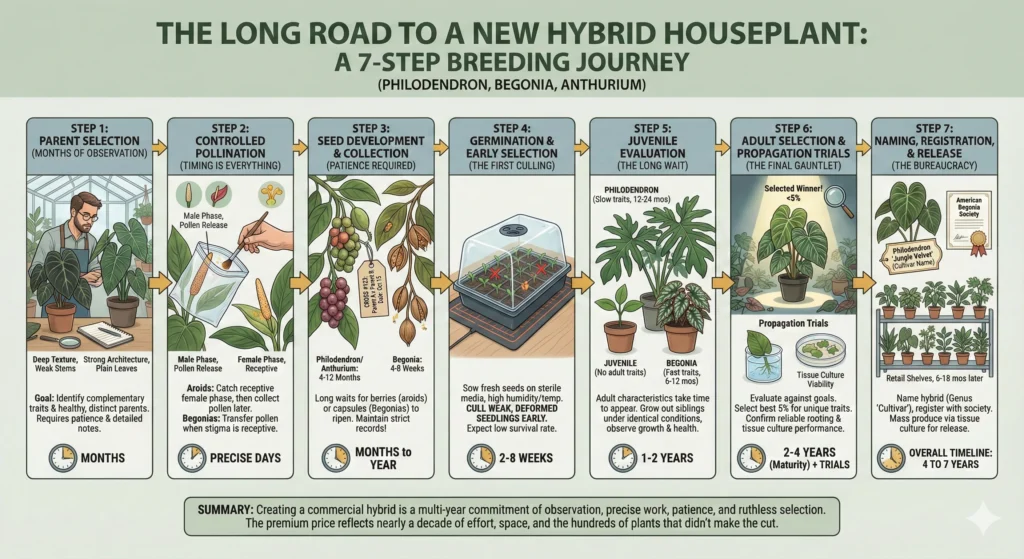
Step 1: Parent Selection (Months of Observation)
Successful hybridization begins not with pollination but with obsessive observation of potential parents. I might spend an entire growing season evaluating which Philodendron species show the deepest velvety leaf texture, which Begonia cultivars maintain their foliage patterns under lower light, or which Anthurium species demonstrate genuine resistance to bacterial blight. The goal is identifying complementary traits: perhaps one parent has spectacular coloration but weak stems, while the other has architectural strength but unremarkable leaves. Parent plants must be healthy, mature enough to flower reliably, and ideally unrelated to maximize genetic diversity in offspring.
Step 2: Controlled Pollination (Timing Is Everything)
For aroids like Philodendron and Anthurium, pollination requires catching the spathe and spadix at precisely the right moment. The spadix (the actual flower structure) goes through distinct phases: female receptivity first, then male pollen release days later—nature’s mechanism to prevent self-pollination. I collect pollen from the male parent using a small brush when the spadix is releasing (you’ll see it dusting onto the spathe), store it in a labeled vial, and apply it to the female parent’s spadix when her flowers are receptive, indicated by a sticky, glistening surface. Begonias are comparatively straightforward since their flowers are more accessible, though timing remains crucial—transferring pollen from one flower’s stamens to another flower’s stigma when she’s receptive, usually indicated by a slightly curved and sticky stigma surface.
Step 3: Seed Development and Collection (Patience Required)
After successful pollination, Philodendron and Anthurium develop berries containing seeds, a process taking anywhere from 4 to 12 months depending on species—yes, you read that correctly. Begonias are faster, producing seed capsules in 4 to 8 weeks. Throughout this period, I maintain detailed labels because in a production greenhouse with hundreds of crosses happening simultaneously, losing track of parentage means losing years of work. Seeds must be harvested at peak ripeness: Anthurium berries should be soft and often change color, while Begonia capsules dry and split open naturally.
Step 4: Germination and Early Selection (The First Culling)
Aroid seeds remain viable for only weeks and must be sown immediately on sterile media—I use a mix of fine peat and perlite, maintaining 75–85°F temperatures and high humidity. Germination takes 2 to 8 weeks for most aroids, faster for Begonias. This is where reality hits: from 100 seeds, perhaps 60 germinate, and of those, maybe 40 survive to the seedling stage. Even at this early point, I’m culling, removing any seedlings showing obvious weakness, deformities, or growth habits that won’t work commercially.
Step 5: Juvenile Evaluation (The Long Wait)
Here’s where breeding houseplants tests your resolve: juvenile plants rarely display their adult characteristics. That Philodendron seedling won’t show its mature velvety leaf texture for 12 to 24 months. Begonias reveal their foliage patterns faster, often within 6 to 12 months, which is one reason they’re favorites for hobbyist breeders. During this phase, I’m growing out dozens or hundreds of siblings under identical conditions, taking notes on growth rate, pest susceptibility, and any early indicators of the traits I’m selecting for.
Step 6: Adult Selection and Propagation Trials (The Final Gauntlet)
When seedlings reach maturity—often 2 to 4 years post-pollination for Philodendrons and Anthuriums—I evaluate them ruthlessly against the original breeding goals. Does this plant actually improve on what’s already available commercially? If I’m selecting for disease resistance, I might deliberately expose candidates to common pathogens. If aesthetics are the goal, I’m looking for that one-in-a-hundred seedling whose leaf texture, color intensity, and pattern surpass both parents and existing cultivars. The winners—typically fewer than 5% of the original cross—enter propagation trials to confirm they root reliably from cuttings or perform well in tissue culture propagation, a non-negotiable requirement for commercial viability.
Step 7: Naming, Registration, and Release (The Bureaucracy)
Before release, standout hybrids receive a cultivar name following International Code of Nomenclature rules: Latin name (genus, maybe species if clearly dominant) followed by the cultivar name in single quotes, such as Begonia ‘Autumn Ember’. For complex hybrids where parentage is unclear, we might simply write Begonia ‘Cultivar Name’ without species designation. Some breeders register their cultivars with organizations like the American Begonia Society, establishing official records of parentage and characteristics. Finally, the hybrid enters tissue culture for mass production or is distributed to propagators who’ll grow it from cuttings—a process adding another 6 to 18 months before plants reach retail shelves.
From initial pollination to plants in your local nursery, the timeline for a philodendron hybrid typically spans 4 to 7 years. This investment explains why genuinely novel hybrids command premium prices: you’re paying for nearly a decade of greenhouse space, expert selection, and the hundreds of siblings that didn’t make the cut.
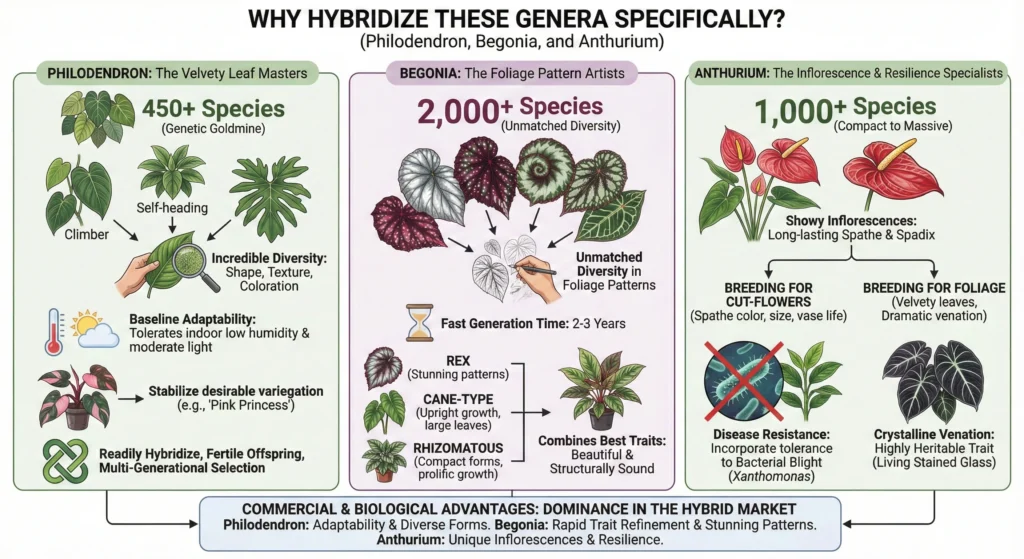
Why Hybridize These Genera Specifically?
Not all houseplant genera receive equal breeding attention, and there are solid biological and commercial reasons why Philodendron, Begonia, and Anthurium dominate the hybrid houseplant market.
Philodendron: The Velvety Leaf Masters
Philodendrons offer breeders a genetic goldmine of around 450 species with incredible diversity in leaf shape, texture, and coloration. The genus includes climbers, self-heading types, and everything between, providing endless recombination possibilities. What makes philodendron hybrids particularly appealing is their baseline adaptability to indoor conditions: most tolerate the low humidity and moderate light levels found in homes far better than, say, tropical orchids or ferns. Breeders have successfully combined the velvety leaf texture of species like P. melanochrysum with the compact growth habit of P. verrucosum, creating hybrids that deliver that touchable, light-catching surface in apartment-friendly sizes. The famous Philodendron ‘Pink Princess’ (a hybrid of P. erubescens) demonstrates how crossing within species can stabilize desirable variegation patterns that appear sporadically in nature. Additionally, many Philodendron species hybridize readily with each other, producing fertile offspring that allow for multi-generational selection—a breeder’s dream.
Begonia: The Foliage Pattern Artists
With over 2,000 species, Begonia presents unmatched diversity in foliage patterns, from metallic silver overlays to deep burgundy undersides to spots, spirals, and geometric designs that seem impossible. Begonia hybrids have been cultivated since Victorian times, resulting in an enormous pool of complex hybrids whose ancestry includes species from different continents. What attracts breeders is Begonia’s relatively fast generation time compared to aroids—you can produce, evaluate, and select a new begonia hybrid in 2 to 3 years rather than 5 to 7—allowing for more rapid trait refinement. Different Begonia groups (Rex, cane-type, rhizomatous, shrub-like) offer distinct advantages: rex begonias contribute stunning leaf patterns, cane types contribute upright growth habits and larger leaves, while rhizomatous types contribute compact forms and prolific growth. Modern breeders have created begonia hybrids combining the painted foliage of rex types with the robust stems and upright habit of cane begonias, producing plants that are both beautiful and structurally sound for commercial production.
Anthurium: The Inflorescence and Resilience Specialists
While Philodendrons and Begonias focus primarily on foliage, Anthurium offers the bonus of showy inflorescences—that colorful spathe and spadix combination that can persist for months. The genus includes roughly 1,000 species ranging from compact dwarfs to massive specimens with 3-foot leaves. Anthurium hybridization has two main tracks: breeding for cut-flower production (focusing on spathe color, size, and vase life) and breeding for foliage (emphasizing the velvety leaves and dramatic venation found in species like A. crystallinum and A. clarinervium). For houseplant breeders specifically, anthurium hybrids offer opportunities to combine the disease resistance of certain species with the aesthetic appeal of others. Bacterial blight, caused by Xanthomonas, devastates many Anthurium collections, but some species show genuine tolerance; incorporating this trait into otherwise susceptible but beautiful hybrids is a major breeding goal. The crystalline venation pattern—those bright white or colored veins contrasting against dark velvety leaves—is another highly heritable trait that breeders can reliably transfer to hybrids, creating plants that are essentially living stained glass.
Types of Hybrids You’ll See
The hybrid houseplant market uses terminology that can confuse newcomers, particularly the distinction between botanical accuracy and trade convenience.
Intra-Generic Hybrids: Staying Within the Family
Most houseplant hybrids are intra-generic, meaning both parents belong to the same genus. A philodendron hybrid crossed from P. gloriosum × P. melanochrysum creates offspring that are unambiguously Philodendron, even if they display novel trait combinations. These crosses are usually fertile and relatively predictable in the range of variation they’ll produce. Within intra-generic hybrids, we distinguish between inter-specific (crossing two different species, like the example above) and intra-specific (crossing two individuals of the same species, such as P. erubescens × P. erubescens from different populations, which gave us the ‘Pink Princess’). Inter-specific hybrids typically show more dramatic variation and hybrid vigor, while intra-specific crosses are used to fix specific traits like variegation or color intensity.
Complex Hybrids: The Ancestry Mystery
Walk into a specialty nursery and you’ll encounter plants labeled simply as Begonia ‘Sophie Cecile’ or Philodendron ‘Florida Ghost’ without species designations—these are complex hybrids. After several generations of crossing hybrids with other hybrids (and occasionally back-crossing to parent species), the genetic background becomes so mixed that specifying every ancestor is impractical. Complex hybrids can exhibit trait combinations impossible in simpler crosses: imagine a begonia hybrid with rex-type patterns, cane-type upright growth, and rhizomatous-type compact habit, blending three different evolutionary lineages. The advantage is unmatched diversity; the disadvantage is unpredictability if you try producing seeds, since the genetic shuffle can yield wildly different offspring.
Trade Names vs. Cultivar Names: Legal Clarity
Here’s where things get commercially murky. A cultivar name like Anthurium ‘Ace of Spades’ follows International Code rules and theoretically describes one specific clone. However, the houseplant trade frequently uses informal names that may apply to multiple different clones or even different hybrids that look similar. You might see “Pink Princess Philodendron” offered by ten nurseries, with subtle differences in each because they’re propagating from different original plants or the name has been applied loosely. This isn’t necessarily fraud—it’s an artifact of how the industry developed before strict naming conventions existed. When purchasing expensive hybrids, ask your supplier about the plant’s provenance: Was it tissue-cultured from a verified stock plant? Is it a direct cutting from a registered cultivar? Or is it a “type” that approximates the look of a famous hybrid? These distinctions matter for both quality and future resale value.
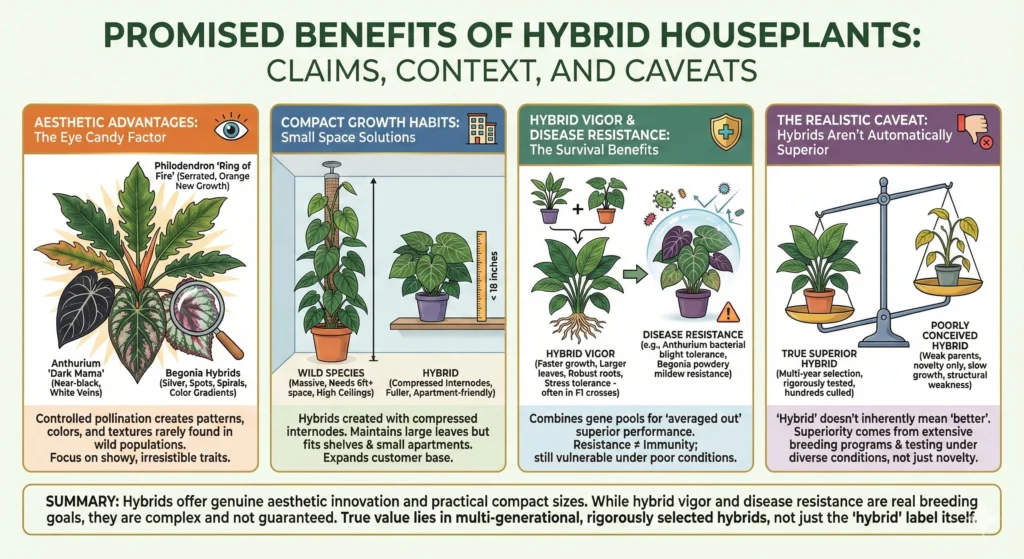
Promised Benefits of Hybrid Houseplants
Breeders and marketers make bold claims about hybrid superiority, and while some are legitimate, others require context and caveats.
Aesthetic Advantages: The Eye Candy Factor
This is where hybrids genuinely excel and justify their existence. Through controlled pollination and rigorous selection, breeders have produced foliage patterns, color combinations, and leaf textures that rarely if ever occur in wild populations. The velvety leaves of hybrids like Philodendron ‘Ring of Fire’ (with its serrated edges and orange new growth) or the near-black leaves with white veins of Anthurium ‘Dark Mama’ represent extremes that natural selection might not favor—plants invest considerable energy into these showy traits—but that we humans find irresistible. Begonia hybrids particularly demonstrate this, with cultivars displaying metallic silver overlays, polka-dot patterns, spiral leaf forms, and color gradients from lime green through purple to near-black on a single plant. If your primary goal is aesthetic impact, hybrids deliver combinations that species alone cannot provide.
Compact Growth Habits: Small Space Solutions
Many wild Philodendron and Anthurium species are massive, requiring 6-foot climbing structures and high ceilings to accommodate their mature size. Breeders have successfully created hybrids with compressed internodes (the stem spacing between leaves), resulting in fuller, more compact plants suitable for shelves and small apartments. A philodendron hybrid like ‘Painted Lady’ maintains the large, colorful leaves of climbing species but with tighter growth that requires less vertical space. Similarly, Anthurium breeders have crossed large-leafed species with naturally compact ones, producing hybrids that deliver dramatic foliage on plants under 18 inches tall. This isn’t purely aesthetic—it’s practical, expanding the potential customer base to include apartment dwellers and those without space for floor plants.
Hybrid Vigor and Disease Resistance: The Survival Benefits
Here’s where claims require careful examination. True F1 hybrids between distinct species often do exhibit hybrid vigor: faster growth, larger leaves, more robust root systems, and sometimes enhanced stress tolerance compared to either parent. This isn’t magical—it’s genetics. When you combine two different gene pools, you often mask deleterious recessive traits that might impair either parent, resulting in offspring with “averaged out” genetics that perform well. However, this advantage typically appears strongest in F1 crosses and can diminish in subsequent generations or when hybrids are vegetatively propagated over many cycles.
Disease resistance is a legitimate breeding goal but more complex in practice. Some Anthurium species demonstrate genuine resistance to bacterial blight, and crosses incorporating these species can produce more resilient hybrids. Begonia breeders have selected for powdery mildew resistance in certain lines. However, resistance isn’t immunity—a disease-resistant hybrid is less likely to succumb but can still get sick under poor conditions. Additionally, what breeders select for in greenhouse conditions may not translate perfectly to your home environment. That “disease-resistant” hybrid was tested under controlled temperatures, ideal air circulation, and professional care; in a stuffy corner with poor airflow, it might still develop fungal issues.
The Realistic Caveat: Hybrids Aren’t Automatically Superior
It’s crucial to understand that “hybrid” doesn’t inherently mean “better.” A poorly conceived philodendron hybrid from weak parents selected only for novelty might perform worse than a straight species adapted by evolution to similar conditions. Some hybrids are one-hit wonders: they look spectacular but grow slowly, root reluctantly, or develop structural weaknesses over time. The truly superior hybrids are those resulting from multi-year selection programs where breeders culled hundreds of siblings and tested the winners under diverse conditions—but you rarely know this history when buying at retail.
Downsides and Limitations
No article on hybrid houseplants would be complete without confronting their genuine limitations and the potential disappointments awaiting uninformed buyers.
Seeds From Hybrids: The Genetic Lottery
If you’ve purchased an expensive philodendron hybrid or begonia hybrid and thought about propagating it from seeds to share with friends, prepare for disappointment. Seeds collected from hybrids—especially complex hybrids or F1 crosses—exhibit enormous variation in the F2 generation. That stunning foliage pattern your parent plant displays might appear in only 10% of seedlings, while the rest resemble one grandparent, the other, or fall somewhere in between. This isn’t a flaw in your cultivation; it’s Mendelian genetics at work. The only reliable way to maintain the exact characteristics of a hybrid you love is vegetative propagation: cuttings, division, or tissue culture. Each cutting or division is a genetic clone of the parent, guaranteeing identical traits. The seed unpredictability frustrates collectors who want to expand their collection cheaply but also protects breeders’ investments—if you can’t reliably reproduce a hybrid from seed, you’re more likely to purchase additional plants from the original producer.
Premium Pricing: Economics of Scarcity
Hybrid houseplants, particularly recently released ones, command prices that can shock newcomers: $50 to $500 for a small plant isn’t unusual for sought-after philodendron hybrids or rare begonia cultivars. This pricing reflects real costs: years of breeding investment, tissue culture setup expenses, marketing, and artificial scarcity when demand outstrips supply. However, it also reflects hype and speculation—some hybrids are expensive primarily because collectors drive up prices, not because the plant has inherent superiority over a $20 species. Prices typically drop as tissue culture propagation scales up production, but this can take 2 to 5 years. If budget is a concern, consider waiting for the inevitable price reduction or focus on older, established hybrids that have been in circulation long enough for prices to stabilize.
Genetic Instability: When Hybrids Revert
Some hybrids exhibit genetic instability, particularly those involving complex crosses or those propagated through tissue culture. You might purchase an Anthurium hybrid with perfectly defined white veins, only to have new leaves emerge with faded or irregular venation. This “reversion” can occur because the genetic combination creating the desired trait isn’t fully stabilized, or because tissue culture propagation introduced epigenetic changes (changes in gene expression without altering DNA sequence). Variegated hybrids are particularly prone to this, sometimes producing fully green shoots that outcompete the variegated portions. While reputable producers cull unstable lines before release, some instability only becomes apparent after several years in home cultivation. This isn’t common in well-established hybrids from professional breeders, but it’s a risk with newer or less-tested releases.
Care Requirements: Not Always Easier
Marketing sometimes implies that hybrids are inherently more adaptable or forgiving than species plants, but this isn’t universally true. A philodendron hybrid combining two humidity-loving species will still demand high humidity; crossing them doesn’t magically eliminate this requirement. Some hybrids are actually more demanding, particularly if they combine traits that come with baggage—for instance, velvety leaves that look spectacular but are more susceptible to mechanical damage or water spotting. Before purchasing, research the care requirements of the parent species to estimate what the hybrid might need; a begonia hybrid with rex ancestry will likely need similar humidity and light conditions as rex begonias, regardless of what else is in its background.
Care Needs: What to Expect
While every hybrid has specific requirements based on its parentage, certain care trends apply broadly to hybrids in these genera.
Philodendron Hybrids: Generally Forgiving, With Exceptions
Most philodendron hybrids inherit the genus’s baseline tolerance for typical indoor conditions: moderate indirect light (though many appreciate brighter conditions for best coloration), watering when the top inch or two of potting mix dries, and average household temperatures (65–80°F). Climbing types need support—a moss pole, wooden plank, or trellis—to display their mature foliage; without it, they’ll maintain juvenile leaf forms indefinitely. Hybrids involving species from higher-elevation cloud forests (P. verrucosum, P. melanochrysum) benefit from cooler nights (down to 60°F) and higher humidity (60–70%) to develop their trademark velvety leaf texture fully, though they’ll survive in lower humidity with somewhat less spectacular results. Fertilize lightly but regularly during active growth—diluted balanced fertilizer every 2–3 weeks—as philodendrons grow vigorously when happy but can develop burnt leaf edges if over-fertilized.
Begonia Hybrids: Humidity-Loving Beauties
Begonia hybrids generally demand more attention than Philodendrons, particularly regarding humidity and watering precision. Most prefer bright indirect light to maintain foliage color intensity but will scorch in direct sun. Humidity needs vary by type: rex-parentage hybrids often sulk below 50% humidity, developing crispy leaf edges and slowed growth, while cane-type hybrids tolerate drier air more gracefully. Watering requires judgment—begonias hate constantly wet roots but also dislike drying out completely; aim for evenly moist soil, letting the surface dry slightly between waterings. They’re sensitive to water quality, with chlorinated tap water sometimes causing leaf edge browning; if you notice this, switch to filtered or dechlorinated water. Temperature stability matters: avoid cold drafts below 60°F and sudden temperature swings. Begonia hybrids are often easier to maintain in terrariums or humidity-controlled cabinets if your home air is dry, though you’ll need to manage airflow to prevent fungal issues.
Anthurium Hybrids: The Patient Grower’s Reward
Anthurium hybrids, particularly foliage types, are often slower-growing than Philodendrons but ultimately rewarding. They prefer warmth (70–85°F), high humidity (60–80% for velvety-leaf types), and chunky, well-draining potting mix—many growers use a mix of orchid bark, perlite, and peat or coir that dries relatively quickly between waterings. Overwatering or constantly soggy substrate is the fastest way to lose an anthurium hybrid to root rot. Bright indirect light encourages the best leaf development and coloration, though they tolerate moderate light with slower growth. Fertilize sparingly (diluted fertilizer monthly during active growth) as anthuriums are lighter feeders than philodendrons. The payoff for this patience is longevity: a well-grown anthurium hybrid can live for decades, continuously producing larger and more impressive leaves as it matures.
Propagation Considerations
Most philodendron hybrids root easily from stem cuttings in water, sphagnum moss, or perlite, making them beginner-friendly. Begonia hybrids vary wildly: rex types can be propagated from leaf cuttings (score the leaf veins and lay flat on moist substrate), cane types from stem cuttings, and rhizomatous types from rhizome division. Anthurium hybrids typically don’t root from leaf cuttings; you need stem sections with at least one node or division of mature plants. Some complex hybrids propagate more reluctantly than their parents, a trade-off for their novel characteristics—research your specific hybrid’s propagation reputation before attempting it.
Ethical Considerations in Hybrid Production
The explosion in hybrid houseplant production raises legitimate ethical questions that thoughtful collectors should consider.
Mass Production and Genetic Diversity
When a single philodendron hybrid becomes wildly popular and thousands of tissue-cultured clones flood the market, we’re essentially creating a monoculture—thousands of genetically identical plants. From a conservation perspective, this isn’t inherently problematic if the species used as breeding stock are abundant, but it does raise questions about long-term resilience. A disease or pest that affects one clone affects all of them identically, creating vulnerability. Some critics argue that the focus on hybrids draws attention and resources away from conserving rare species and maintaining diverse genetic collections. Counterarguments point out that hybrid popularity often increases overall interest in a genus, indirectly funding conservation efforts and introducing people to species they’d never otherwise encounter. Personally, I advocate for balance: enjoy your hybrids, but also maintain at least a few straight species in your collection to support genetic diversity, and prioritize nurseries that ethically source their breeding stock rather than collecting from threatened wild populations.
Source Verification: Wild Collection vs. Ethical Breeding
Not all nurseries acquire parent plants ethically. While most reputable breeders in the US, Europe, and Asia maintain cultivated stock or purchase from legal suppliers, some smaller operators have been caught collecting endangered species from wild populations in Central and South America to use as breeding stock. CITES (Convention on International Trade in Endangered Species) regulates international trade in certain species, but enforcement is imperfect. As a consumer, research your supplier’s reputation, ask about the origin of parent plants (reputable breeders can document their stock sources), and be suspicious of hybrids featuring extremely rare or endangered species that suddenly appear on the market at scale. Supporting ethical breeders with verified stock not only aligns with conservation values but also ensures you’re getting legally sourced plants that won’t be confiscated if import documentation is questioned.
Accessibility and Hobby Breeding
The high prices and proprietary nature of some hybrids raise questions about accessibility. Should plant breeding be democratized, with techniques and parent stock widely available, or should professional breeders be able to protect their investments through plant patents, trademarks, and controlled distribution? In the US, the Plant Variety Protection Act allows breeders to patent certain new cultivars, giving them exclusive propagation rights for up to 20 years. While this protects the substantial investment breeding requires, it can also restrict access for hobbyists and smaller growers. The community is divided: some argue that patent protection is necessary to fund professional breeding programs that create genuinely superior plants, while others believe plant genetics should remain common heritage. Wherever you land philosophically, be aware that propagating and selling certain protected cultivars without authorization is illegal, though enforcement varies.

Worth the Hype? Key Factors to Consider
Whether hybrid houseplants justify their reputation and price depends entirely on your personal circumstances and goals.
For Casual Plant Parents: Mixed Value
If you’re newer to houseplants and primarily want easy-care greenery that survives typical home conditions, many hybrids offer questionable value. A proven, inexpensive species like Philodendron hederaceum or Begonia ‘Tiger Paws’ (an older, affordable hybrid) may serve you better than a $200 newly released philodendron hybrid that’s untested in home conditions and has a 50/50 chance of thriving under your care. The aesthetics might be more exciting, but the risk-to-reward ratio isn’t favorable when you’re still learning basic care. Exception: Some hybrids genuinely are more forgiving or compact than their parent species, making them legitimately better choices for beginners, but this requires research to distinguish actual improvements from marketing claims.
For Collectors: Often Worth It
If you’re an established collector with appropriate growing conditions (humidity control, proper lighting, stable temperatures) and you derive genuine joy from owning unusual plants, hybrids absolutely earn their place. The aesthetic diversity, the thrill of growing something few others have, and the satisfaction of successfully cultivating a challenging hybrid can justify the expense. Additionally, collectors often participate in trading networks where rare hybrids function as currency; a well-grown specimen of a sought-after begonia hybrid or anthurium hybrid might trade for three or four other desirable plants. From this perspective, the initial investment compounds in value over time.
The Sweet Spot: Established Hybrids
For most people, the best value lies in hybrids that have been in circulation for 5+ years. These have survived the test of time, proving they’re genuinely superior and stable rather than flash-in-the-pan novelties. Prices have stabilized, propagation techniques are well-documented, and community knowledge about care requirements is extensive. Hybrids like Begonia ‘Sophie Cecile’, Philodendron ‘White Princess’, or Anthurium ‘Superbum’ × ‘Magnificum’ represent this sweet spot: distinctive enough to be special, proven enough to be reliable, and affordable enough not to cause financial anxiety if something goes wrong.
Shop Smart: Your Hybrid Houseplant Checklist
Before committing to an expensive hybrid, run through these verification steps to avoid costly disappointments.
1. Research Parent Species and Their Requirements
If the seller or online listing identifies parent species, research each one’s care needs. A philodendron hybrid of (P. gloriosum × P. melanochrysum) will likely need the high humidity and cooler temperatures both parents prefer. If parentage isn’t disclosed for a complex hybrid, search online communities (forums, Reddit’s r/houseplants, specialty groups on Facebook) where experienced growers discuss specific cultivars and their quirks. Knowing what you’re getting into prevents the frustration of purchasing a plant that’s incompatible with your growing conditions.
2. Verify Naming and Cultivar Authenticity
For expensive purchases, ask the seller to verify the cultivar identity. Reputable sellers can provide documentation: photos of the mother plant, information about the tissue culture source, or registration details if the cultivar is officially registered. Be wary of hybrids sold only by common trade names without botanical backup—these may be mislabeled, or you might be paying premium prices for a generic type rather than the specific clone you wanted. Cross-reference photos: if you’re buying a Begonia ‘Autumn Ember’, search that exact name online to compare your plant’s appearance with verified specimens; significant differences suggest mislabeling or genetic instability.
3. Health Check: Inspect Before You Buy
Whether buying online or in-person, examine photos carefully or inspect the actual plant thoroughly. Look for active growth (new leaves emerging), vibrant coloration appropriate to the cultivar, and absence of pests (check leaf undersides, soil surface, and stem crevices for insects, webbing, or sticky residue). Avoid plants with extensive yellowing, brown leaf edges (unless that’s characteristic of the hybrid), mushy stems, or roots visibly circling the pot’s perimeter—these indicate stress or neglect that may have long-term consequences. Don’t be shy about asking the seller about the plant’s history: How long have they been growing it? Has it been recently repotted or treated for pests? Transparent sellers welcome these questions; evasive ones are red flags.