Kalanchoe Care: Master This Cheerful Succulent
Introduction: The Cheerful Survivor
Walk into any garden center during the holidays and you’ll spot them instantly: clusters of vibrant red, pink, orange, yellow, or white blooms perched atop glossy, scalloped leaves. Kalanchoe blossfeldiana, often called Flaming Katy or Christmas Kalanchoe, is the perfect gateway plant for anyone curious about succulents. It offers weeks of bright, long-lasting flowers, forgiving care requirements, and a compact size that fits comfortably on any windowsill.
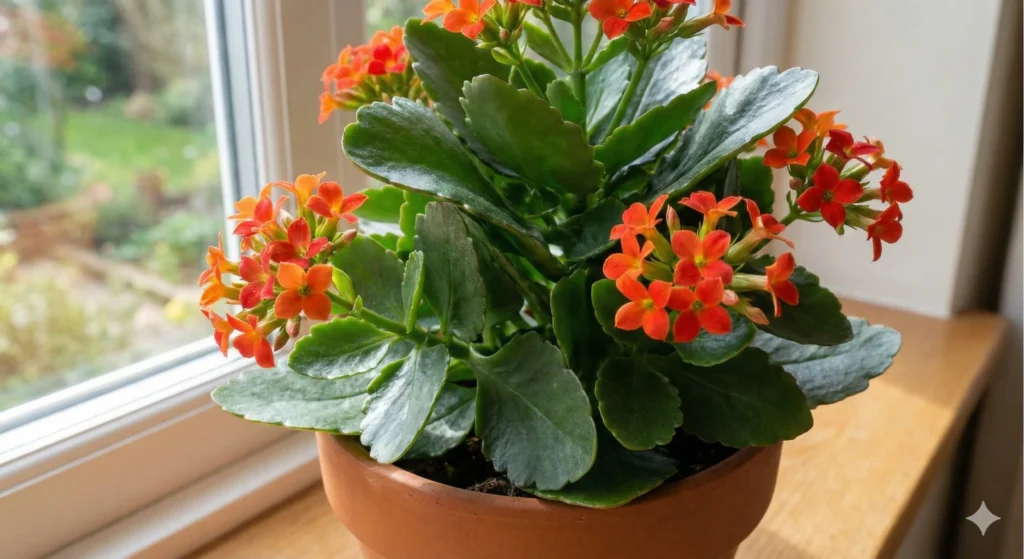
Native to Madagascar [web:5], this flowering succulent evolved in an environment of seasonal drought and intense sunlight—which explains why it stores water in its thick, waxy leaves and thrives on benign neglect rather than fussing. Understanding Kalanchoe blossfeldiana care starts with recognizing what it needs from its natural habitat: bright light, infrequent watering, and well-draining soil.
Here’s the thing most people don’t realize: that cheerful blooming plant you received as a gift or bought on impulse isn’t disposable. Despite the common practice of tossing Kalanchoe plants after their flowers fade, these are perennial succulents [web:10] that can rebloom year after year with simple but specific care. Many gardeners treat them as temporary decorations, never discovering that with the right light cycle and minimal effort, the same plant can deliver multiple seasons of spectacular blooms.
This guide will walk you through everything you need to know about kalanchoe plant care—from basic daily maintenance to the surprisingly simple “trick” that triggers reblooming. Whether you’re a complete beginner or an experienced houseplant enthusiast looking to master how to care for a kalanchoe plant indoors, you’ll find practical, tested advice that actually works.
Quick Reference: The Cheat Sheet
Before diving into the details, here’s your at-a-glance guide to kalanchoe care:
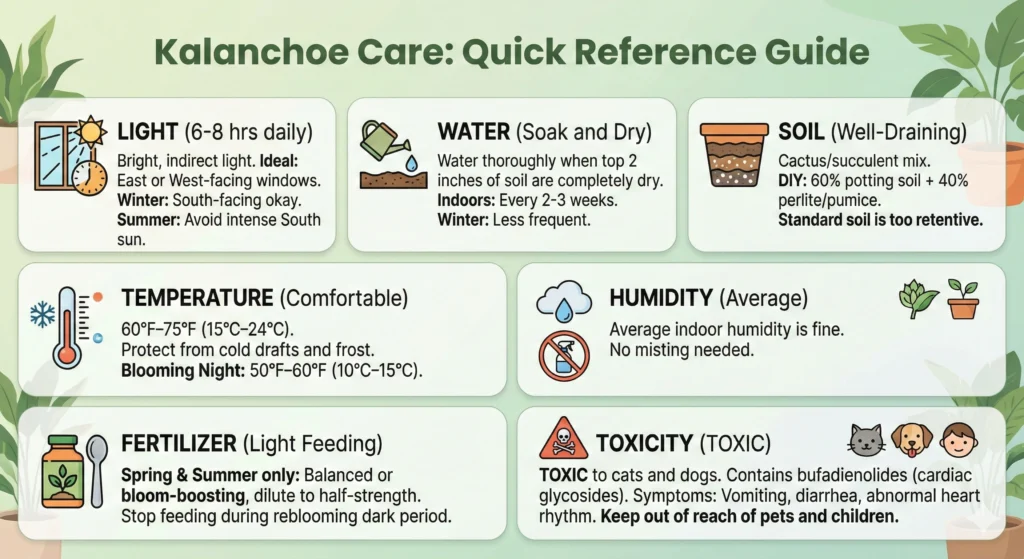
Light: Bright, indirect light for 6-8 hours daily [web:7]. East or west-facing windows are ideal. South-facing windows work in winter but may be too intense in summer [web:4].
Water: The “soak and dry” method. Water thoroughly when the top 2 inches of soil are completely dry [web:2], typically every 2-3 weeks indoors [web:5]. Less frequent in winter.
Soil: Well-draining cactus/succulent mix, or create your own with 60% potting soil + 40% perlite or pumice [web:3]. Standard potting soil alone is too moisture-retentive.
Temperature: Comfortable room temperatures between 60°F–75°F (15°C–24°C) [web:10]. Protect from cold drafts and never expose to frost. Ideal nighttime temperatures for blooming are 50°F–60°F (10°C–15°C) [web:4].
Humidity: Average indoor humidity is perfectly fine. No misting needed [web:4].
Fertilizer: Light feeding with balanced or bloom-boosting fertilizer during spring and summer only [web:3]. Dilute to half-strength. Stop feeding during the reblooming dark period.
Toxicity: Kalanchoe is toxic to cats and dogs. All parts of the plant contain bufadienolides (cardiac glycosides) [web:22] that can cause vomiting, diarrhea, and in severe cases, abnormal heart rhythm. Keep out of reach of pets and children.
Core Care Requirements
Lighting for Longevity
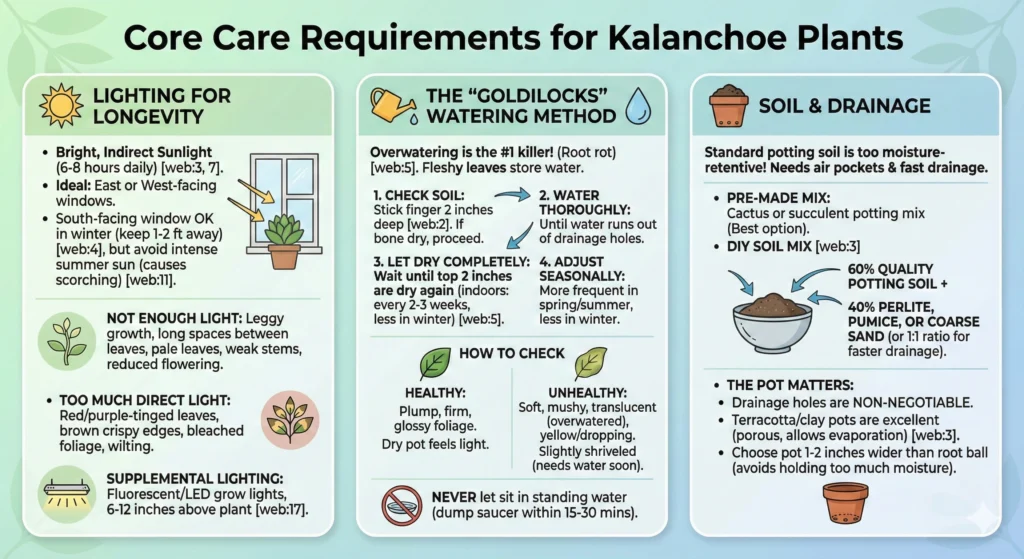
Getting kalanchoe light requirements right makes the difference between a thriving, compact plant and a sad, stretched-out disappointment. Kalanchoe blossfeldiana thrives in bright, indirect sunlight [web:3]—think of the quality of light that streams through an east-facing window in the morning or a west-facing window in the afternoon.
The sweet spot is 6-8 hours of bright light daily [web:7]. A spot within a foot or two of a south-facing window works beautifully [web:4], especially during winter when the sun’s angle is lower. However, during intense summer months, that same south window can deliver too much direct sun, causing leaves to bleach, develop red tinges, or develop scorched brown edges [web:11].
Signs your kalanchoe isn’t getting enough light:
- Leggy, stretched growth as the plant reaches toward the nearest light source
- Long spaces between leaves on the stem (etiolation)
- Weak, floppy stems that can’t support themselves
- Pale or yellowing leaves [web:11]
- Reduced or absent flowering
Signs of too much direct light:
- Red-tinged or purple-tinged leaves (not always bad, but indicates stress)
- Brown, crispy leaf edges that look scorched
- Leaves that appear bleached or faded [web:7]
- Wilting despite adequate watering
If you don’t have a suitable bright window, supplemental lighting can work. Fluorescent tubes or LED grow lights placed 6-12 inches above the plant can provide sufficient light for healthy growth [web:17].
The “Goldilocks” Watering Method
Here’s the uncomfortable truth: overwatering kills more kalanchoe plants than any other problem. Root rot from waterlogged soil is the #1 cause of death for this succulent [web:5], and it happens fast. The thick, fleshy leaves of Kalanchoe blossfeldiana evolved to store water for weeks of drought—they genuinely do not want to sit in constantly moist soil.
The correct approach is what succulent growers call “soak and dry.” Here’s how it works:
- Check the soil first. Stick your finger 2 inches into the soil [web:2]. If it feels even slightly damp, don’t water. If it’s bone dry all the way down, it’s time to water.
- Water thoroughly. When you do water, do it properly: water until liquid runs out of the drainage holes, ensuring the entire root ball gets saturated.
- Let it dry completely. Then wait until the top 2 inches (or more) of soil are completely dry again before the next watering. Indoors, this typically means watering every 2-3 weeks [web:5], though it varies with temperature, humidity, pot size, and season.
- Adjust for seasons. During active growth in spring and summer, your kalanchoe may need slightly more frequent watering. In winter, when growth slows, you might only water once a month.
How to check if your watering is on track:
- Healthy leaves: Plump, firm, glossy foliage
- Slightly shriveled leaves: Probably needs water soon
- Soft, mushy, translucent leaves: Overwatered—root rot may be setting in
- Yellow, dropping leaves: Classic overwatering symptom
Another useful trick: lift the pot. A dry pot feels noticeably lighter than a freshly watered one. After a few weeks, you’ll develop an intuitive sense of when watering is due just from the weight.
Never let your kalanchoe sit in a saucer of standing water. If water collects in the saucer after watering, dump it out within 15-30 minutes.
Soil & Drainage
Standard potting soil—the kind you’d use for a fern or a philodendron—is far too moisture-retentive for kalanchoe plants. These succulents need air pockets around their roots and soil that drains water quickly.
The simplest solution: Buy a pre-made cactus or succulent potting mix. These are formulated specifically for plants that need fast drainage.
DIY soil mix: Combine approximately 60% quality potting soil with 40% perlite, pumice, or coarse sand [web:3]. This creates a light, airy mixture that holds just enough moisture for roots to absorb but doesn’t stay soggy. Some growers prefer a 1:1 ratio of potting soil to gritty material [web:3] for even faster drainage.
The pot matters too. Choose a container with drainage holes—non-negotiable for kalanchoe care. Terracotta or clay pots [web:3] are excellent choices because they’re porous and allow excess moisture to evaporate through the sides, providing an extra safety margin against overwatering.
Size your pot appropriately: choose one that’s only 1-2 inches wider than the root ball. An oversized pot holds too much soil and moisture, increasing the risk of root rot.
Maintenance & Grooming
Deadheading
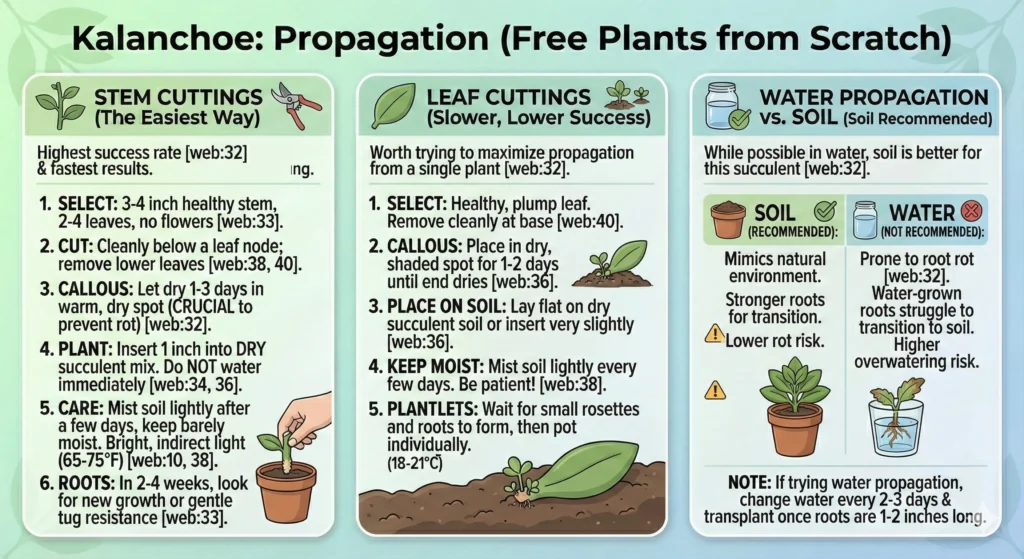
Deadheading—removing spent flower clusters—is one of the simplest ways to keep your blooming kalanchoe plant looking tidy and encourage more blooms. As individual flowers fade and dry out, they become brown and papery. Leaving them on the plant doesn’t harm it, but removing them directs energy back into foliage growth and, potentially, new flower bud formation.
How to deadhead a kalanchoe:
- Wait until the entire flower cluster has finished blooming and looks clearly spent.
- Follow the flower stem down to where it meets the foliage.
- Using clean scissors or pruning shears, snip the entire flower stem off at its base [web:6], or simply pinch it off with your fingertips.
- Remove any dead or yellowing leaves while you’re at it.
Deadheading is especially beneficial if you catch the plant early in its bloom cycle—removing the first faded clusters can sometimes encourage a second flush of flowers before the plant enters dormancy.
Pruning for Bushiness
Left to their own devices, kalanchoe plants can become leggy and sparse, especially in lower light conditions [web:11]. The plant stretches toward the light source, creating long stems with widely spaced leaves and a generally scraggly appearance.
Pruning keeps your kalanchoe compact, bushy, and attractive:
When to prune: The best time for major pruning is after the plant finishes blooming, typically in late winter or early spring [web:11]. However, light pruning and pinching can be done year-round to maintain shape.
How to prune:
- Use clean, sharp pruning shears or scissors.
- Cut stems back to just above a leaf node (the spot where leaves attach to the stem) [web:2].
- For leggy stems, cut them back by one-third to one-half of their length.
- To encourage branching, pinch off the growing tips of stems.
- Remove any crossing branches or stems rubbing against each other [web:11].
Don’t be afraid to be somewhat aggressive with pruning. Kalanchoe responds well to cutting back and will produce fresh, bushy growth. And here’s a bonus: those pruned stem cuttings are perfect for propagation (more on that later).
Feeding
Kalanchoe plants are not heavy feeders [web:3]. In fact, they’ll grow just fine with no fertilizer at all if they have good light and proper watering. However, light fertilization during the active growing season can support healthier foliage and more abundant blooms.
Fertilizing guidelines:
- When to feed: Spring through summer only (roughly April through September in the Northern Hemisphere)
- What to use: Balanced houseplant fertilizer (like 10-10-10) or a bloom-boosting formula with higher phosphorus (the middle number)
- How much: Dilute to half the strength recommended on the package. Succulents are sensitive to fertilizer burn.
- How often: Once every 2-4 weeks during active growth [web:4]
When NOT to fertilize:
- During the dark period when you’re trying to trigger reblooming
- In fall and winter when the plant is growing slowly or dormant [web:16]
- If the plant looks stressed or unhealthy (fix the underlying problem first)
Remember: fertilizer does not replace proper light exposure when it comes to reblooming. You cannot fertilize a kalanchoe into flowering if it hasn’t received the necessary dark period.
The “Secret” to Reblooming (Photoperiodism)
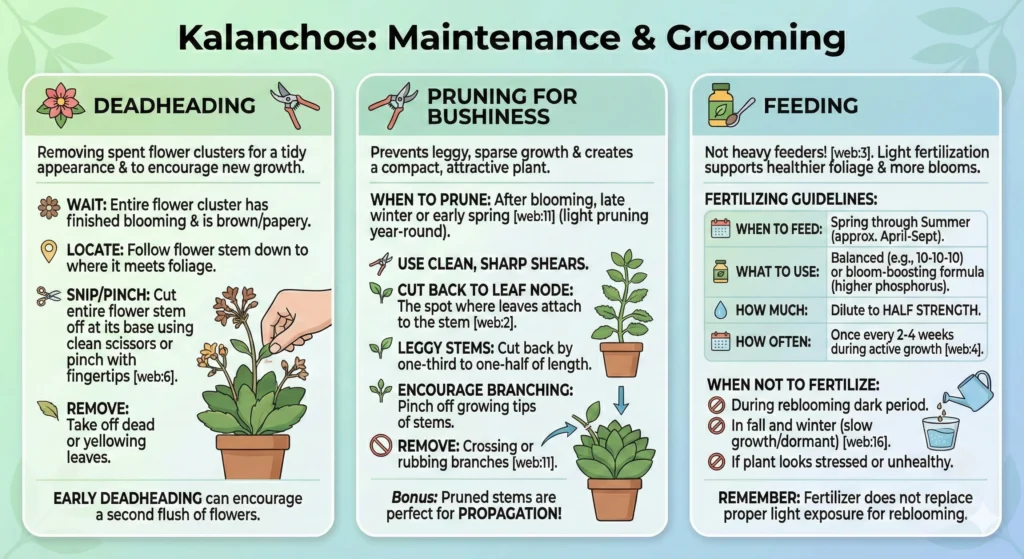
This is where kalanchoe care gets genuinely interesting. Understanding how to get kalanchoe to bloom—or more specifically, how to make kalanchoe bloom again after the first flowering—requires a basic grasp of photoperiodism.
What is photoperiodism? It’s a plant’s response to the relative lengths of day and night. Some plants are “long-day” plants that flower when days are long (like summer vegetables). Others are “short-day” plants that initiate flowering when nights are long and days are short. Kalanchoe blossfeldiana is a short-day plant [web:12], like poinsettias and Christmas cacti.
In nature, as fall arrives in Madagascar and day length shortens, kalanchoe plants receive the signal to set buds. After about 6-8 weeks of these shortened days, flower buds form. Then, as the buds mature and open, the plants deliver their spectacular winter and spring bloom display.
The problem indoors: In our homes, artificial lighting from lamps, TVs, streetlights, and other sources interrupts the natural dark period [web:14]. Even a few minutes of light during what should be the dark period can prevent bud formation [web:20]. A single minute of red light during the dark cycle was shown in studies to prevent blooming entirely [web:20].
The Reblooming Routine: Step by Step
If you want to know how to get kalanchoe to bloom again, here’s the protocol that actually works:
1. Timing (6-10 weeks before desired bloom)
Start the dark treatment in early to mid-fall if you want winter holiday blooms [web:12]. The plant needs 6-8 weeks of the special light regimen [web:2], though some sources suggest up to 10 weeks for best results [web:12]. After the dark period, it takes another 4 months for flowers to fully develop and open [web:8].
2. Provide 12-14 hours of complete darkness every single night
This is the non-negotiable core of the process. Your kalanchoe needs 12-14 hours of absolute, uninterrupted darkness [web:12] each day for the entire 6-8 week period.
Methods to ensure darkness:
- Move to a closet or dark room: Put the plant in a completely dark closet or spare bedroom from approximately 5-6 PM to 7-8 AM [web:12]. Set phone alarms to remind yourself.
- Use a light-proof cover: Place a cardboard box, large pot, or black cloth over the plant [web:14]. Make absolutely certain it’s light-proof—even small light leaks can disrupt the process.
- Dedicate a dark space: Some growers clear a shelf in a coat closet or place plants under the kitchen sink [web:12], tying the task to an existing routine (taking off your coat, morning coffee) to remember to move them.
3. During the day, provide bright indirect light
Don’t keep the plant in 24-hour darkness! During the non-dark hours (the other 10-14 hours of each day), the plant needs bright, indirect light to photosynthesize and maintain health [web:12]. Place it back in its normal bright spot.
4. Reduce watering and stop fertilizing
During the reblooming period, cut back on watering [web:21]—let the soil dry out almost completely between waterings. Stop all fertilization [web:15]. The plant is entering a rest period and needs less moisture and nutrients.
5. Keep temperatures moderately cool
Ideal nighttime temperatures during bud formation are around 60°F (15°C) [web:12], with daytime temperatures around 65°F–70°F (18°C–21°C) [web:4]. Cooler temperatures help prolong bloom life once flowers open, but temperatures above 45°F–50°F (7°C–10°C) should be maintained [web:6].
6. Watch for buds and return to normal care
After 6-8 weeks of the dark treatment, check for small flower buds forming at the stem tips. Once buds are clearly visible, you can stop the dark period routine [web:12]. Move the plant back to its regular bright location, resume normal watering, and wait for the buds to mature and open—usually within a few weeks.
Common Reblooming Pitfalls
Why kalanchoe not blooming:
- Inconsistent darkness: Missing even a few nights of the dark period can reset the process. You need every single night for 6-8 weeks.
- Light leaks: Streetlights shining through windows, hallway light seeping under a door, LED indicator lights on electronics, or forgetting to close the closet door completely all disrupt the dark period [web:12].
- Not enough bright light during the day: The plant still needs to photosynthesize during daytime hours. If it doesn’t get enough light, it won’t have the energy to produce blooms.
- Too young or too small: Plants need to be mature enough to bloom. If you’re working with a very young cutting or offset, it may need several more months of growth before it’s capable of flowering [web:15].
- Giving up too early: Some people stop the dark treatment after 3-4 weeks, not realizing the full 6-8 weeks are necessary.
When do kalanchoe bloom naturally? In regions with natural seasonal day length changes between October and March [web:16], kalanchoe may bloom on their own without intervention, provided no artificial lights disrupt their nights. In tropical areas where day length doesn’t change much, or in homes with always-on lighting, they require the manual dark treatment.
Propagation: Free Plants from Scratch
One of the most satisfying aspects of kalanchoe plant propagation is how absurdly easy it is. Whether you’re looking to share plants with friends, expand your own collection, or rescue a leggy plant by starting fresh cuttings, propagation is straightforward and reliable.
Stem Cuttings (The Easiest Way)
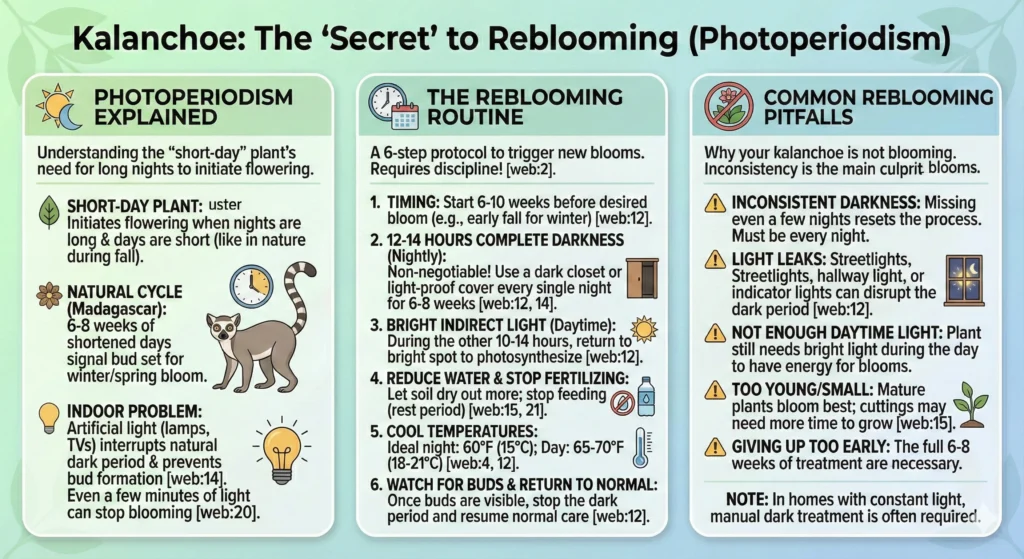
Stem cutting propagation has the highest success rate [web:32] and fastest results for Kalanchoe blossfeldiana.
Step-by-step process:
- Select your cutting: Choose a healthy, mature stem that’s 3-4 inches long with at least 2-4 leaves [web:33]. Avoid flowering stems—the cutting should put energy into roots, not blooms. Make sure the stem looks plump and healthy, not thin or stretched.
- Make the cut: Using clean, sharp scissors or pruning shears sterilized with rubbing alcohol [web:40], cut just below a leaf node (the bump where leaves attach to the stem). Remove the lower leaves, leaving 2-3 leaves at the top of the cutting [web:38].
- Let it callous: This is crucial for succulents. Place the cutting in a warm, dry spot out of direct sun for 1-3 days [web:32] until the cut end forms a dry callous. This prevents rot when you plant it.
- Plant in dry soil: Fill a small pot (3-4 inches) with dry cactus/succulent mix. Insert the calloused end of the cutting about 1 inch into the soil [web:36], making sure no leaves touch the soil surface.
- Wait before watering: This is where kalanchoe differs from some other plants. Do NOT water immediately [web:34]. Wait a few days, then mist the soil lightly or give it a very light watering. Keep the soil barely moist (not wet) for the first few weeks.
- Provide bright, indirect light: Place the pot in a bright spot but out of direct sun [web:38]. Ideal temperatures are 65°F–75°F (18°C–24°C) [web:10].
- Watch for roots: In 2-4 weeks [web:33], roots should develop. You’ll know roots have formed when the cutting resists a gentle tug or when you see new leaf growth at the top. Once roots are established, treat it like a mature plant.
Leaf Cuttings
Leaf propagation works for kalanchoe but takes longer and has a lower success rate than stem cuttings [web:32]. It’s worth trying if you only have access to a leaf or want to maximize your propagation from a single plant.
Process:
- Select a healthy leaf: Choose a mature, plump leaf with no damage or discoloration. Remove it cleanly at the base where it attaches to the stem [web:40].
- Let it callous: Place the leaf in a dry, shaded spot for 1-2 days [web:36] until the cut end dries.
- Place on soil: Lay the calloused leaf flat on top of dry succulent soil, or insert the cut end very slightly into the soil. Some growers just rest it on the surface [web:36].
- Keep lightly moist: Mist the soil lightly every few days [web:38] to keep it barely damp. Be patient—it can take several weeks for tiny roots and plantlets to emerge from the base of the leaf.
- Wait for plantlets: Eventually, you’ll see small rosettes of leaves forming at the base. Once these baby plants develop a few leaves of their own and have visible roots, you can gently separate them and pot individually.
Water Propagation vs. Soil
Some houseplant enthusiasts like to root cuttings in water because they can watch the roots develop. While you technically can root kalanchoe cuttings in water [web:32], it’s not recommended for this succulent.
Why soil is better:
- Kalanchoe’s delicate roots are prone to rot in water [web:32]
- Water-grown roots often struggle to transition to soil
- The risk of overwatering is higher
- Soil propagation mimics the plant’s natural environment
If you do try water propagation, change the water every 2-3 days and transplant to soil as soon as roots are 1-2 inches long.
Troubleshooting Common Issues
Even with proper kalanchoe blossfeldiana care, problems occasionally arise. Here’s how to diagnose and fix the most common issues:
Yellowing Leaves
Most common cause: Overwatering. When roots sit in soggy soil, they begin to rot and can’t absorb nutrients properly. Leaves turn yellow, often starting with the lower leaves, and may feel soft or mushy.
What to check:
- How often are you watering? If it’s more than once a week, that’s probably too much.
- Does the pot have drainage holes? If not, that’s your problem.
- Is the soil staying wet for days after watering? You need better-draining soil.
How to fix it:
- Stop watering immediately and let the soil dry out completely
- Check the roots—if they’re black, mushy, or smell bad, you have root rot
- For severe root rot, cut away all affected roots and stem sections, let the healthy parts callous, and replant in fresh, dry soil (essentially taking cuttings from the healthy parts)
- Going forward, water less frequently and ensure proper drainage
Wilting or Drooping While Soil is Wet
This paradoxical symptom—a wilted plant in moist soil—is a classic sign of root rot. The roots are too damaged to absorb water, so even though moisture is available, the plant can’t access it.
Emergency action:
- Remove the plant from its pot and examine the roots
- Healthy roots should be white or pale tan and firm. Rotted roots are black, brown, mushy, or slimy
- Cut away ALL rotted roots and any soft, discolored stem tissue with sterilized scissors
- Let the remaining healthy parts (if any) dry and callous for a day or two
- Replant in completely dry, fresh succulent soil
- Wait 3-5 days before lightly watering
- Cross your fingers—sometimes you can save them, sometimes the damage is too extensive
Prevention is always easier than cure: proper watering practices and well-draining soil prevent root rot in the first place.
Leggy, Stretched Growth
Causes: Insufficient light [web:11] or lack of pruning
Kalanchoe that doesn’t get enough light will stretch toward the nearest light source, developing long stems with leaves spaced far apart. This “etiolated” growth is weak and floppy.
Solutions:
- Move the plant to a brighter location (but not harsh direct sun)
- Prune back leggy stems to encourage bushier growth
- Consider supplemental grow lights if you don’t have bright windows
- Pinch off stem tips regularly to promote branching
White Fuzz or Cottony Spots (Mealybugs)
Kalanchoe can occasionally attract mealybugs [web:14], small white insects that cluster in leaf axils and along stems. They leave behind white cottony residue that looks like specks of cotton [web:14].
How to identify: Look for actual insects (they’re visible to the naked eye), cottony white material, and sticky honeydew residue on leaves.
Treatment:
- Isolate the plant from others
- Wipe visible bugs off with a cotton swab dipped in rubbing alcohol
- Spray the entire plant with insecticidal soap or neem oil, following product directions
- Repeat treatment weekly for 3-4 weeks to catch newly hatched insects
- Increase air circulation and avoid overwatering (mealybugs thrive in humid, stagnant conditions)
Kalanchoe Not Blooming
If your plant refuses to flower despite seeming healthy, revisit the reblooming requirements:
- Did you provide the full 6-8 weeks of 12-14 hour darkness?
- Was the darkness truly complete, with no light leaks?
- Is the plant mature enough to bloom (at least 6-9 months old [web:15])?
- Does it get enough bright light during the day?
- Are temperatures appropriate (not too hot)?
Sometimes patience is required. Even with perfect conditions, some kalanchoe take longer than others to respond to the dark treatment.
Pet Toxicity & Safety
This section deserves your full attention if you share your home with cats or dogs.
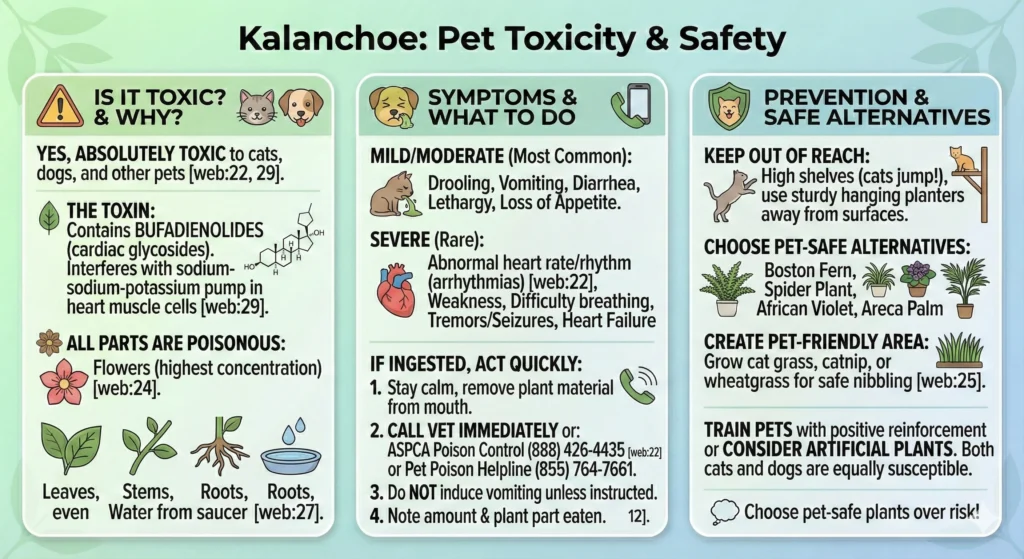
Is kalanchoe toxic to cats and dogs? Yes, absolutely. All parts of Kalanchoe plants are toxic to cats, dogs, and other pets [web:22] if ingested.
What makes kalanchoe toxic: The plant contains bufadienolides [web:22], which are cardiac glycosides similar to digitalis compounds. These toxins interfere with the sodium-potassium pump in heart muscle cells [web:29], potentially causing serious cardiac effects.
Symptoms of kalanchoe toxicity in pets:
Mild to moderate cases (most common):
- Drooling or excessive salivation
- Vomiting (sometimes severe and persistent)
- Diarrhea
- Lethargy or depression
- Loss of appetite
Severe cases (rare but possible):
- Abnormal heart rate or rhythm (arrhythmias) [web:22]
- Weakness or collapse
- Difficulty breathing
- Tremors or seizures
- In extreme cases, heart failure
The flowers contain the highest concentration of toxins [web:24], but all parts of the plant—leaves, stems, roots—are poisonous. Even the water from a vase or saucer can contain enough toxins to cause problems [web:27].
What to do if your pet ingests kalanchoe:
- Stay calm but act quickly
- Remove any plant material from your pet’s mouth
- Call your veterinarian immediately or contact:
- ASPCA Animal Poison Control: (888) 426-4435 [web:22]
- Pet Poison Helpline: (855) 764-7661
- Do not induce vomiting unless specifically instructed by a veterinary professional
- Note how much was eaten and what part of the plant (if known)
Most pets who ingest small amounts of kalanchoe will experience gastric upset but recover fully [web:28] with supportive care. However, if a large amount is consumed, more serious intervention may be necessary. Prompt veterinary treatment significantly improves outcomes.
Prevention strategies:
- Keep plants completely out of reach: Remember that cats are skilled climbers and jumpers. “High shelves” often aren’t high enough.
- Use hanging planters with sturdy hooks, but ensure cats can’t jump to nearby surfaces to reach them
- Choose pet-safe alternatives: Boston ferns, spider plants, African violets, and areca palms are all non-toxic options that add greenery without risk
- Create a pet-friendly plant area: Grow cat grass, catnip, or wheatgrass [web:25] to give pets something safe to nibble
- Train pets to avoid plants: With patience and positive reinforcement, some pets can learn that plants are off-limits
- Consider artificial plants if you have particularly curious pets who won’t be deterred
Are kalanchoe toxic to cats more than dogs? No—both species are equally susceptible to kalanchoe poisoning. Birds [web:29] and other small animals can also be affected.
If you’re a pet owner who loves kalanchoe, you’ll need to make a choice: either commit to keeping plants in truly inaccessible locations or choose different, pet-safe houseplants instead. The vibrant blooms aren’t worth the risk to a beloved pet.
Conclusion: A Rewarding Long-Term Companion
Kalanchoe blossfeldiana deserves its reputation as an easy-care flowering succulent, but “easy” doesn’t mean “no care at all.” Success comes down to respecting what this Madagascar native actually needs: bright light, infrequent watering, fast-draining soil, and—if you want those gorgeous repeat blooms—a commitment to several weeks of disciplined darkness.
The disposable plant myth persists because most people never learn about the photoperiod requirement. They enjoy the initial blooms, water dutifully (often too often), and then watch the plant grow into a pleasant but flowerless houseplant. Eventually, it gets leggy and lands in the trash. What a waste of potential.
You now know better. You understand that kalanchoe care isn’t complicated, but it is specific. The core pillars are:
- Bright, indirect light from east or west windows
- “Soak and dry” watering—thoroughly but infrequently
- Well-draining soil that doesn’t stay soggy
- The reblooming routine—6-8 weeks of 12-14 hours of complete darkness
- Pet safety precautions if you share your home with animals
Master these fundamentals, and your kalanchoe will reward you for years. There’s genuine satisfaction in seeing those first flower buds emerge after you’ve carefully managed the dark period. When tiny clusters of color begin to show at the stem tips, you’ll know your efforts paid off—and that you’ve graduated from buying temporary decorations to actually growing something remarkable.
The techniques in this guide work. Thousands of hobbyists successfully rebloom their kalanchoe plants every year using these exact methods. The reblooming process requires commitment and consistency, but it’s not difficult. Set alarms, establish routines, and trust the process. Your kalanchoe wants to bloom; you just need to give it the right signals.
Whether this is your first flowering succulent or you’re adding to an established collection, Kalanchoe blossfeldiana offers something rare: the bright, cheerful spirit of a gift plant combined with the durability of a true perennial houseplant. Treat it right, and it’ll keep surprising you—season after season, year after year.