Effortless Water Propagation for Pothos & Philodendron
Introduction
Pothos (Epipremnum aureum) and heartleaf Philodendron (Philodendron hederaceum) are two of the most popular beginner houseplants because they tolerate a wide range of indoor conditions, recover quickly from mistakes, and grow fast. Their trailing vines and heart-shaped leaves also make them ideal candidates for propagation.
Propagation simply means making new plants from an existing plant. In this case, you’ll be using stem cuttings to create genetically identical plants—a form of vegetative (asexual) propagation.
Water propagation is especially beginner-friendly because you can clearly see root development, quickly spot problems, and avoid many soil-related issues. In this guide, you’ll learn exactly where to cut, how to root Pothos and Philodendron in water, how to care for cuttings, and when (or if) to transfer them to soil.
Section 1: Why Propagate in Water?
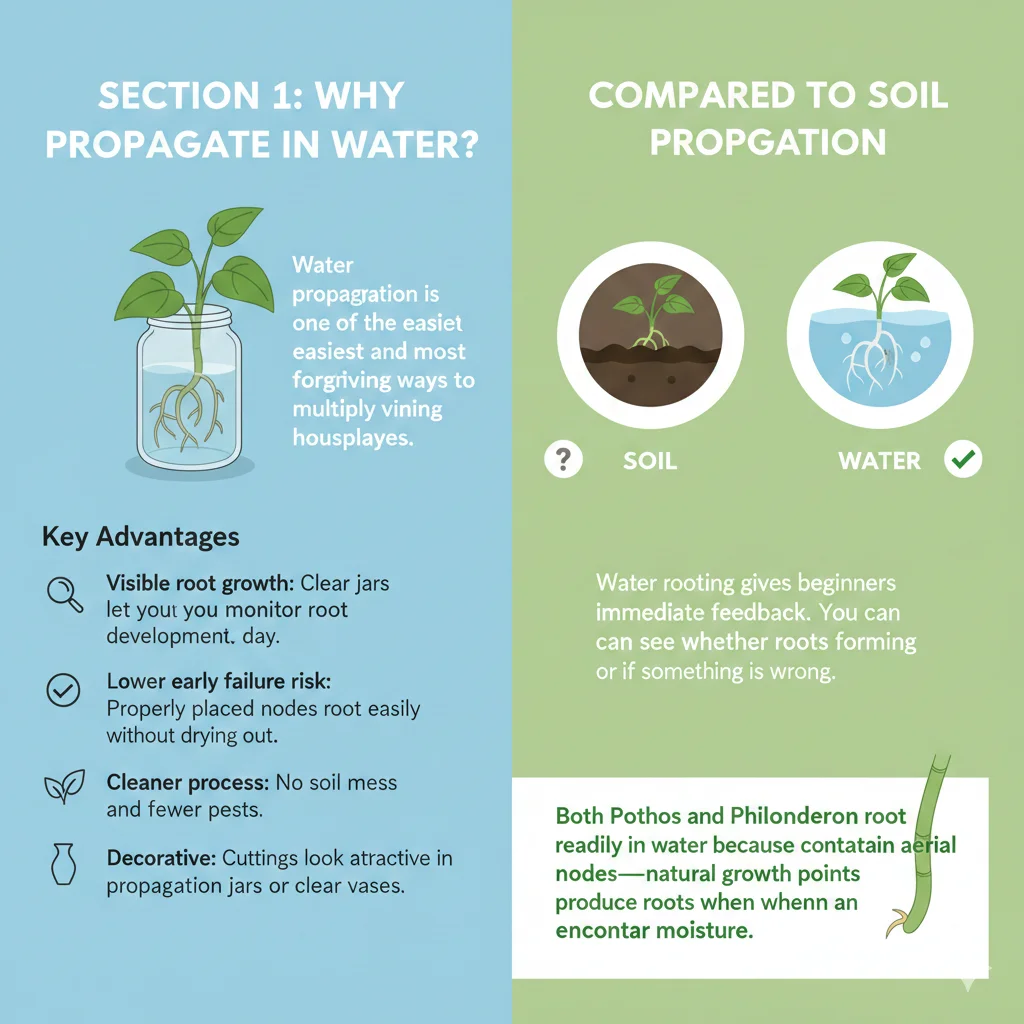
Water propagation is one of the easiest and most forgiving ways to multiply vining houseplants.
Key advantages
- Visible root growth: Clear jars let you monitor root development day by day.
- Lower early failure risk: Properly placed nodes root easily without drying out.
- Cleaner process: No soil mess and fewer pests.
- Decorative: Cuttings look attractive in propagation jars or clear vases.
Compared to soil propagation, water rooting gives beginners immediate feedback. You can see whether roots are forming or if something is wrong.
Both Pothos and Philodendron root readily in water because their vines contain aerial nodes—natural growth points designed to produce roots when they encounter moisture.
Section 2: Materials You’ll Need
You don’t need specialized equipment. Keep everything clean to reduce bacterial growth.
Essentials
- Clean, sharp scissors or pruning shears
- Glass jars or clear vases (transparent containers are best)
- Fresh, filtered, or dechlorinated water
- Bright, indirect light source (near a window, not direct sun)
Optional
- Rooting hormone
- Pros: Can speed up root initiation
- Cons: Not necessary for Pothos or Philodendron and often skipped by beginners
Section 3: Identifying Nodes and Cutting Properly
Understanding nodes is the most important step in any beginner pothos water propagation guide.
What is a node?
A node is the point on the stem where leaves, aerial roots, and new growth emerge. Roots only form from nodes—not from smooth stem sections called internodes.
How to identify a node
- Look for a leaf attachment point
- Often slightly raised or knobby
- May have a small brown aerial root nub
Where to cut
- Cut ½–1 inch below a node
- Use clean, sharp scissors to avoid crushing the stem
Recommended cutting size
- Length: 4–6 inches
- Nodes: 1–2 nodes minimum
- Leaves: 2–3 healthy leaves
- Remove any leaves that would sit underwater
This applies to both single-node cuttings and multi-node cuttings.
Section 4: Setting Up Your Cuttings in Water
Proper placement prevents rot and encourages fast rooting in water.
How to place the cutting
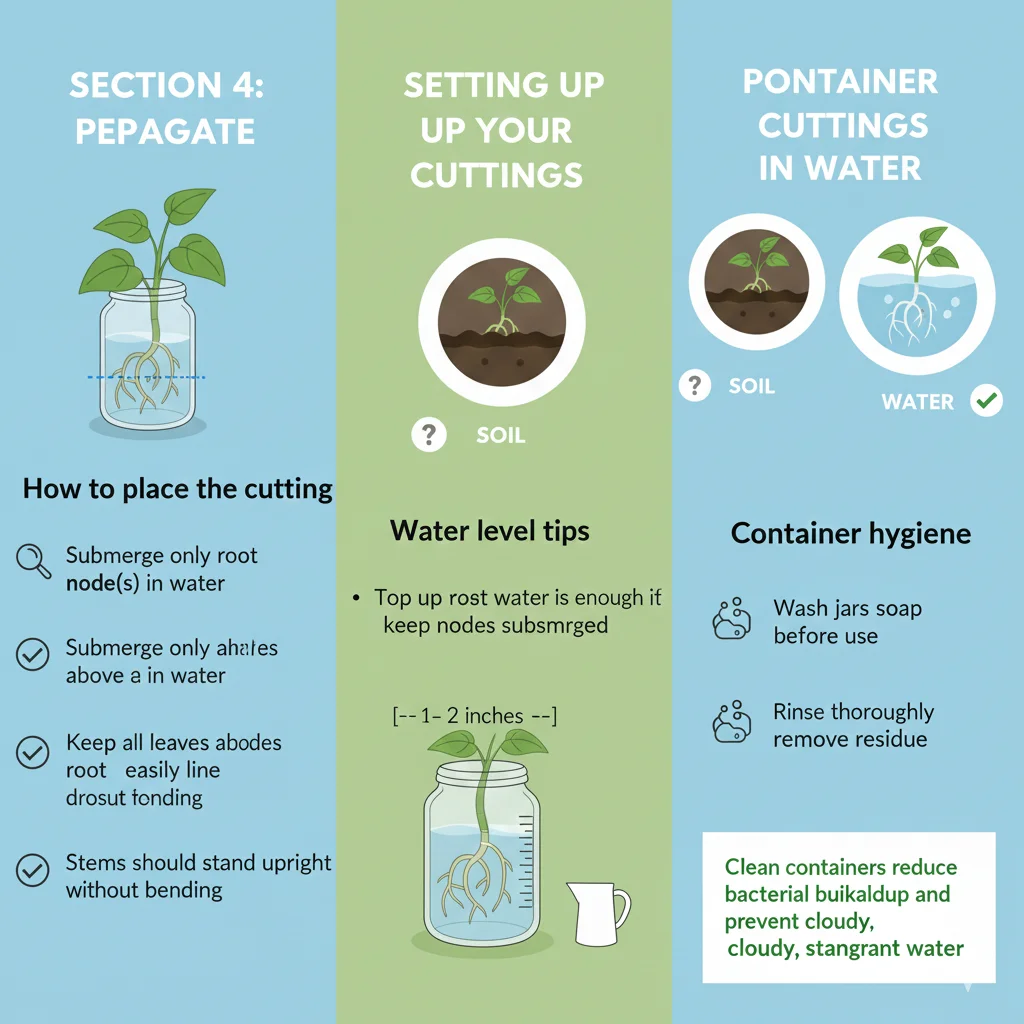
- Submerge only the node(s) in water
- Keep all leaves above the water line
- Stems should stand upright without bending
Water level tips
- 1–2 inches of water is usually enough
- Top up as needed to keep nodes submerged
Container hygiene
- Wash jars with soap before use
- Rinse thoroughly to remove residue
Clean containers reduce bacterial buildup and prevent cloudy, stagnant water.
Section 5: Caring for Your Cuttings
Once set up, care is simple but specific.
Light
- Bright, indirect light
- Avoid direct sun, which overheats water and damages stems
Temperature
- Ideal range: 18–27°C (65–80°F)
- Keep away from cold drafts and heaters
Water care
- Change water every 3–5 days
- Use filtered or dechlorinated water when possible
Common mistakes to avoid
- Submerging leaves (leads to rot)
- Letting water sit too long
- Placing cuttings in low light
Section 6: Watching for Root Development
Root development timing varies slightly between plants and environments.
Expected timelines
- Pothos: Roots in 1–2 weeks
- Philodendron: Roots in 2–4 weeks
Healthy root signs
- White or light tan color
- Firm texture (not slimy)
- Multiple roots branching from the node
Ready for soil transfer when
- Roots are 2–5 cm (1–2 inches) long
- Several roots are present, not just one
Be patient. Cooler temperatures or lower light slow rooting but don’t mean failure.
Section 7: Transferring to Soil (Optional)
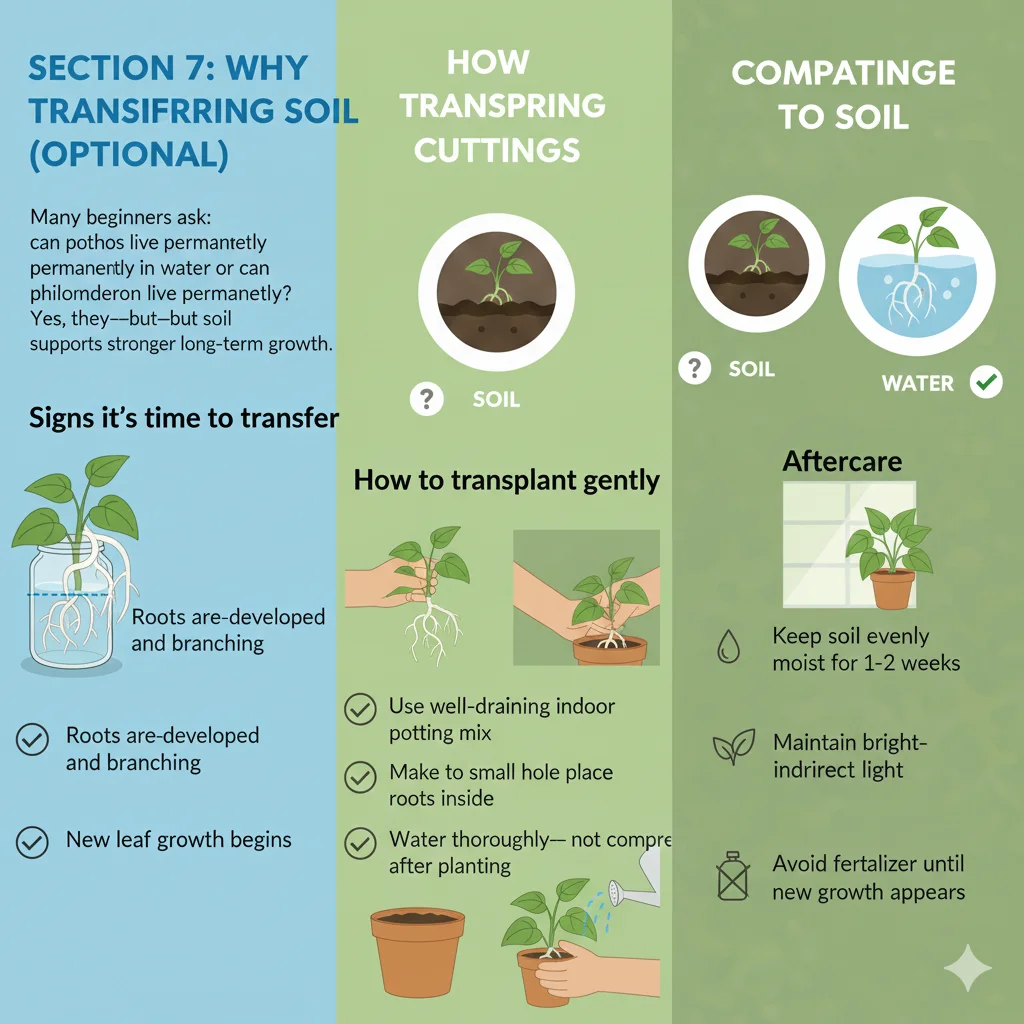
Many beginners ask: can pothos live permanently in water or can philodendron live permanently in water?
Yes, they can—but soil supports stronger long-term growth.
Signs it’s time to transfer
- Roots are well-developed and branching
- New leaf growth begins
How to transplant gently
- Use a well-draining indoor potting mix
- Make a small hole and place roots inside
- Firm soil lightly—do not compress
- Water thoroughly after planting
Aftercare
- Keep soil evenly moist for 1–2 weeks
- Maintain bright, indirect light
- Avoid fertilizer until new growth appears
Section 8: Troubleshooting and FAQs
Problem: No roots forming
- Symptom: Cutting stays green but inactive
- Cause: No node submerged or low light
- Fix: Recut below a node; move to brighter indirect light
Problem: Yellowing leaves
- Symptom: Leaves turn soft or yellow
- Cause: Leaf submerged or energy stress
- Fix: Remove submerged leaves; reduce leaf count
Problem: Cloudy water
- Symptom: Milky or smelly water
- Cause: Bacteria buildup
- Fix: Change water immediately; clean container
Can tap water be used?
Yes. Let it sit for 12–24 hours to allow chlorine to dissipate if possible.
Can cuttings stay in water permanently?
Yes, but:
- Growth is slower
- Nutrients must eventually be supplemented
- Roots adapted to water may struggle when moved to soil later
Conclusion
Water propagation is one of the simplest and most rewarding ways to multiply Pothos and Philodendron. With a clear understanding of nodes, clean water, and proper light, even first-time growers can succeed.
Experiment with single-node and multi-node cuttings, share extras with friends, and track how different conditions affect root development. With each cutting, you’ll gain confidence—and a steadily growing indoor garden.