Thrive in Drought: Low-Water Veggie Secrets
Climate patterns shift. Reservoirs shrink. Water bills climb. Yet the urge to grow your own food intensifies with each passing season. If you’ve hesitated to start a vegetable garden because your region faces water restrictions or you simply want to conserve this precious resource, you’re about to discover that abundant harvests and water-wise practices go hand in hand.
A low water vegetable garden isn’t about sacrifice or compromise. It’s about working intelligently with your environment, choosing resilient crops, and applying proven techniques that reduce irrigation needs by 50-70% compared to conventional methods. Whether you’re a complete beginner facing your first summer of restrictions or an experienced grower adapting to a drier climate, the strategies ahead will transform how you think about growing food with little water.

This guide draws from two decades of arid-zone agriculture research and thousands of hours helping home gardeners succeed where rainfall is scarce and temperatures soar. You’ll learn exactly which vegetables thrive on minimal moisture, how to prepare soil that holds every drop, and which watering methods deliver maximum results with minimum waste. No filler, no theory without practice—just the essential knowledge you need to cultivate a productive, drought-tolerant vegetable garden starting today.
1. Understanding Low-Water Gardening
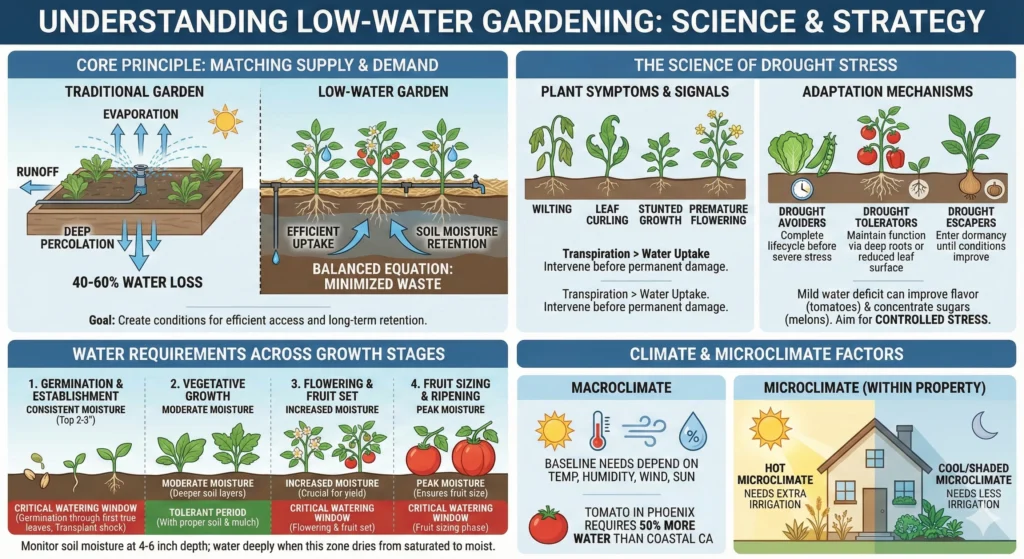
Low-water gardening operates on a fundamental principle: match water supply to plant demand while eliminating waste. Traditional gardens often lose 40-60% of applied water to evaporation, runoff, and deep percolation beyond root zones. Water efficient gardening flips this equation by creating conditions where plants access moisture efficiently and soil retains it longer.
The Science of Drought Stress in Plants
Plants experience drought stress when water loss through transpiration exceeds water uptake through roots. Visual symptoms include wilting, leaf curling, stunted growth, and premature flowering. Understanding these signals helps you intervene before permanent damage occurs.
Different vegetables handle water scarcity through distinct mechanisms:
- Drought avoiders complete their life cycle before severe stress hits (lettuce, peas)
- Drought tolerators maintain function during water deficit through deep roots or reduced leaf surface (tomatoes, peppers)
- Drought escapers enter dormancy until conditions improve (not applicable to annuals)
Your goal isn’t preventing all stress—mild water deficit actually improves flavor in tomatoes and concentrates sugars in melons. You’re aiming for controlled stress that strengthens plants without compromising yield.
Water Requirements Across Growth Stages
Vegetables need different moisture levels during germination, vegetative growth, flowering, and fruiting. Seedlings and transplants demand consistent moisture in the top 2-3 inches of soil. Once established, most vegetables tolerate drier surface soil if deeper layers stay moist.
Critical watering windows when skimping causes major yield loss:
- Germination through first true leaves
- Transplant shock period (first 10-14 days)
- Flowering and fruit set
- Fruit sizing phase
Between these windows, many drought resistant vegetables for beginners tolerate extended dry periods, especially with proper soil preparation and mulching.
Climate and Microclimate Factors
Your baseline water needs depend on temperature, humidity, wind, and sun exposure. A tomato plant in Phoenix requires 50% more water than the same variety in coastal California. Within your property, south-facing walls create hot microclimates needing extra irrigation, while north sides and shaded areas need less.
Calculate your baseline by monitoring soil moisture at 4-6 inch depth. When this zone dries from saturated to merely moist, it’s time to water deeply. Sandy soils reach this point in 2-3 days; clay soils may take 7-10 days.
2. Choosing Drought-Tolerant Vegetables
Not all vegetables suit water-scarce conditions equally. Some crops evolved in arid regions and possess biological adaptations—deep taproots, waxy leaf coatings, or reduced foliage—that make them natural candidates for drought tolerant vegetable garden ideas.
Top Performers for Dry Climate Gardens
These vegetables consistently produce abundant harvests with 30-50% less water than high-demand crops:
| Vegetable | Water Needs | Key Advantages | Harvest Window |
|---|---|---|---|
| Tomatoes (paste varieties) | Low–Medium | Deep roots, heat tolerant varieties available | 70–90 days |
| Peppers (all types) | Low | Thick cuticle reduces moisture loss | 60–90 days |
| Eggplant | Low–Medium | Thrives in heat, extensive root system | 65–80 days |
| Summer squash | Medium | Fast-growing, produces before peak heat | 45–55 days |
| Winter squash | Low–Medium | Long taproot, once established needs little water | 85–110 days |
| Beans (pole and bush) | Medium | Nitrogen-fixing, adapts to moderate drought | 50–65 days |
| Armenian cucumber | Low | Actually a melon, extremely drought-adapted | 60–70 days |
| Okra | Very Low | Thrives in extreme heat, keeps producing | 50–65 days |
| Swiss chard | Low–Medium | Cut-and-come-again, tolerates heat and cold | 30–60 days |
| Cowpeas | Very Low | Traditional arid-climate crop, improves soil | 60–90 days |
Heat Tolerant Vegetable Varieties
Within each crop species, specific varieties show superior drought tolerance. Seek out these characteristics when selecting seeds:
- Determinate tomatoes (produce concentrated harvest, finish before peak summer stress)
- Small-fruited types (cherry tomatoes outperform beefsteaks in heat)
- Heritage varieties from Mediterranean, Middle Eastern, or Southwest American regions
- Open-pollinated seeds you can save and adapt to your conditions over seasons
Varieties to prioritize: ‘Juliet’ tomato, ‘Beaver Dam’ pepper, ‘Black Beauty’ eggplant, ‘Amish Pie’ squash, ‘Rattlesnake’ pole bean, ‘Clemson Spineless’ okra.
Crops to Avoid or Adapt
These vegetables demand abundant, consistent moisture and struggle in water-wise gardens without significant accommodation:
- Lettuce and salad greens (shallow roots, bolt quickly)
- Corn (extremely high water needs during tasseling)
- Celery (requires perpetually moist soil)
- Cauliflower and broccoli (need consistent moisture for head formation)
If you must grow high-water crops, plant them in the shadiest area, use drip irrigation with precise scheduling, and accept shorter harvest windows by planting in spring or fall rather than summer.
Succession Planning
Plant fast-maturing crops like beans and summer squash in early spring when moisture from winter remains in the soil. Replace them with heat-loving, drought-tolerant crops (peppers, eggplant, okra) as temperatures climb. This succession maximizes productivity while matching water availability to crop needs across the growing season.
3. Preparing the Soil for Water Efficiency
Soil structure determines how much water your garden retains and how easily roots access it. A well-prepared soil holds moisture like a sponge, releases it gradually to roots, and prevents both waterlogging and rapid drying. This preparation happens before you plant a single seed and pays dividends throughout the growing season.
Soil Texture and Water Holding Capacity
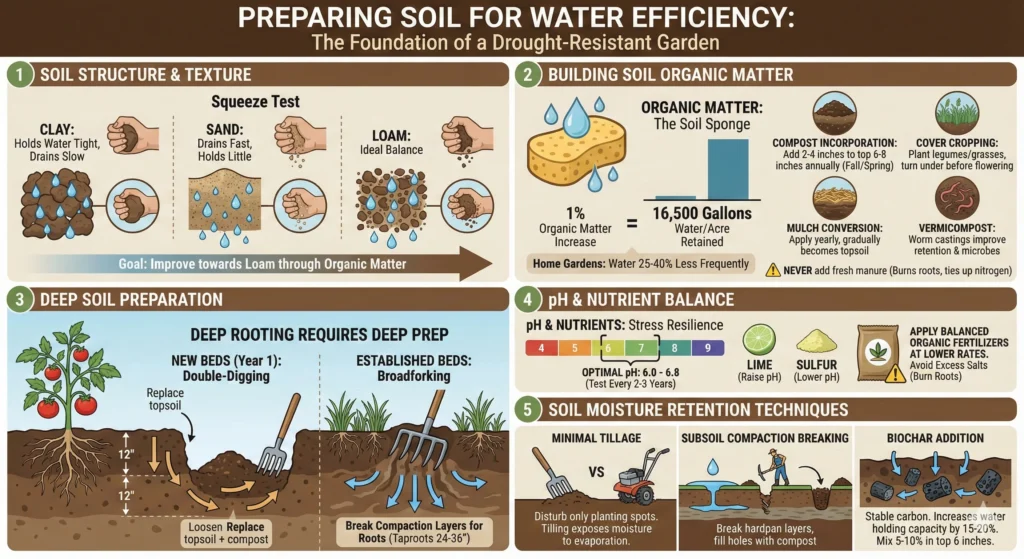
Clay soils hold water tenaciously but drain slowly and become waterlogged. Sandy soils drain quickly but hold little water. Loam—the gardener’s ideal—balances both properties. Your goal is moving your existing soil toward loam characteristics through organic matter additions.
Test your soil texture: Moisten a handful of soil and squeeze it. If it forms a tight ball that doesn’t crumble, you have clay. If it won’t hold together, you have sand. If it forms a ball that crumbles with gentle pressure, you’re close to loam.
Building Soil Organic Matter
Organic matter acts as a sponge within soil, increasing water holding capacity by up to 10 times its weight. Each 1% increase in soil organic matter helps soil retain 16,500 gallons of water per acre in the top foot. For home gardens, this translates to watering 25-40% less frequently.
Methods to boost organic matter:
- Compost incorporation: Add 2-4 inches of finished compost to the top 6-8 inches of soil annually
- Cover cropping: Plant legumes or grasses in fallow beds, then cut and turn under before flowering
- Mulch conversion: Apply organic mulch and compost yearly; it gradually incorporates into topsoil
- Vermicompost: Worm castings improve water retention and add beneficial microbes
Work compost into soil in fall or early spring, allowing several weeks for microbial activity to stabilize before planting. Never add fresh manure directly to planting beds—it burns roots and ties up nitrogen during decomposition.
Deep Soil Preparation
Deep root watering requires deeply prepared soil. Most vegetable roots concentrate in the top 12-18 inches, but drought-tolerant crops send taproots 24-36 inches deep when soil allows. Break up compaction layers that block root penetration and water movement.
For new beds: Double-dig the first year, removing soil from the top 12 inches, loosening the layer below to 12 more inches with a fork, then replacing topsoil mixed with compost. For established beds: Use a broadfork annually to fracture compaction without inverting soil layers.
pH and Nutrient Balance
Drought stress intensifies when plants struggle with nutrient deficiencies or pH imbalances. Most vegetables thrive at pH 6.0-6.8. Test soil every 2-3 years and adjust with lime (to raise pH) or sulfur (to lower pH) according to test recommendations.
Apply balanced organic fertilizers at lower rates than package recommendations—drought-stressed plants can’t utilize excess nutrients, and unused fertilizer salts concentrate in soil as water evaporates, potentially burning roots.
Soil Moisture Retention Techniques
Beyond organic matter, these practices lock moisture in your soil profile:
- Minimal tillage: Tilling pulverizes soil structure and exposes moist soil to evaporation. After initial bed preparation, disturb soil only where you’re planting.
- Subsoil compaction breaking: If water pools on the surface after irrigation, you likely have a hardpan layer. Break it with a pickaxe or auger holes every 18 inches, filling with compost.
- Biochar addition: This stable carbon increases water holding capacity by 15-20% and persists for decades. Mix 5-10% biochar by volume into the top 6 inches.
4. Smart Watering Strategies
How you water matters more than how much you water. Efficient irrigation delivers moisture directly to root zones, applies it at optimal times, and eliminates runoff and evaporation losses. These water efficient irrigation methods reduce total water use by 40-60% compared to overhead sprinklers.
Deep Root Watering
Surface watering encourages shallow root systems that make plants vulnerable to drought. Deep root watering trains roots to grow downward, accessing moisture and nutrients in lower soil layers while reducing irrigation frequency.
Apply water slowly enough that it soaks in rather than running off. Deliver enough volume to wet soil to 12-18 inches depth. Check penetration by probing with a soil knife or moisture meter 24 hours after watering.
For established plants, water deeply and infrequently rather than shallowly and often. One deep watering per week beats three shallow waterings for drought tolerance. During extreme heat, increase frequency but maintain depth.
Drip Irrigation Systems
Drip irrigation delivers water at low pressure directly to the soil surface through emitters spaced along tubing. Water soaks in without waste from evaporation or overspray. Properly designed drip systems achieve 90-95% efficiency compared to 60-75% for sprinklers.
Basic drip setup for vegetable beds:
- Run mainline tubing along bed edges
- Connect drip tape or emitter tubing in rows 12-18 inches apart
- Choose emitters spaced 12 inches apart with 0.5-1.0 gallon per hour flow
- Add a filter, pressure regulator (10-15 PSI), and timer at the water source
- Cover tubing with mulch to prevent UV degradation and soil clogging
Run drip systems in early morning when evaporation is minimal and wind is calm. Water long enough to achieve your target depth, usually 45-90 minutes depending on flow rate and soil type.
Ollas and Clay Pot Irrigation
Buried unglazed clay vessels (ollas) provide ancient, ultra-efficient watering for individual plants or small gardens. Fill the olla through its opening; water seeps gradually through porous walls directly to nearby roots. Plants take only what they need, and evaporation is nearly zero.
Install ollas at planting time, burying them so the neck protrudes 1-2 inches above soil surface. Space them 18-24 inches apart. Each olla services plants within a 12-18 inch radius. Refill every 3-7 days depending on size, weather, and plant demand.
Hand Watering Best Practices
When watering by hand with a hose or watering can, use these techniques to maximize efficiency:
- Remove spray nozzles—direct water at soil surface around plant bases, not foliage
- Water in batches: Wet each plant until water begins to pool, move to the next plant, then return for a second round after the first application soaks in
- Use a water breaker wand for gentle flow that doesn’t erode soil or displace mulch
- Apply water to the drip line (edge of leaf canopy) rather than against stems
Rainwater Harvesting for Vegetables
Capturing rainfall reduces dependence on municipal or well water while providing plants with chlorine-free water at optimal temperature. A 1,000 square-foot roof yields approximately 600 gallons from one inch of rain.
Simple rainwater harvesting strategies:
- Connect downspouts to 55-gallon barrels with overflow routing to additional barrels or the garden
- Install mesh screens over barrel openings to exclude mosquitoes and debris
- Elevate barrels 12-24 inches for gravity-fed flow to drip systems
- Use harvested water within 5-7 days or add a small fountain pump to prevent stagnation
In arid regions with infrequent rain, size your storage to capture water from occasional storms for use during extended dry periods.
Greywater Use in Home Gardens
Greywater—relatively clean wastewater from washing machines, showers, and bathroom sinks—can irrigate vegetable gardens under specific conditions:
- Use only on fruiting vegetables (tomatoes, peppers, squash), never on root crops or leafy greens
- Apply subsurface through drip lines or mulch basins, never through overhead sprinklers
- Use only biodegradable, low-sodium soaps and detergents
- Rotate greywater with fresh water to prevent salt buildup
- Check local regulations—some jurisdictions restrict or prohibit greywater use
Properly managed greywater systems can supply 30-50% of garden irrigation needs, though they require more maintenance and monitoring than rainwater systems.
Timing and Frequency
Early morning watering (5-9 AM) is ideal. Soil absorbs moisture before evaporation accelerates, and foliage dries quickly if accidentally wetted, reducing disease pressure. Evening watering is second-best but leaves foliage wet overnight, inviting fungal problems.
Reduce watering frequency as plants mature and roots reach deeper soil layers. Seedlings may need daily moisture, but established tomatoes and peppers often thrive on one deep watering per week, even in hot climates.
Monitor soil moisture rather than following rigid schedules. Push your finger 3-4 inches into soil near plants. If it feels dry at that depth, water deeply. If moist, wait another day or two.
5. Garden Design for Drought Conditions
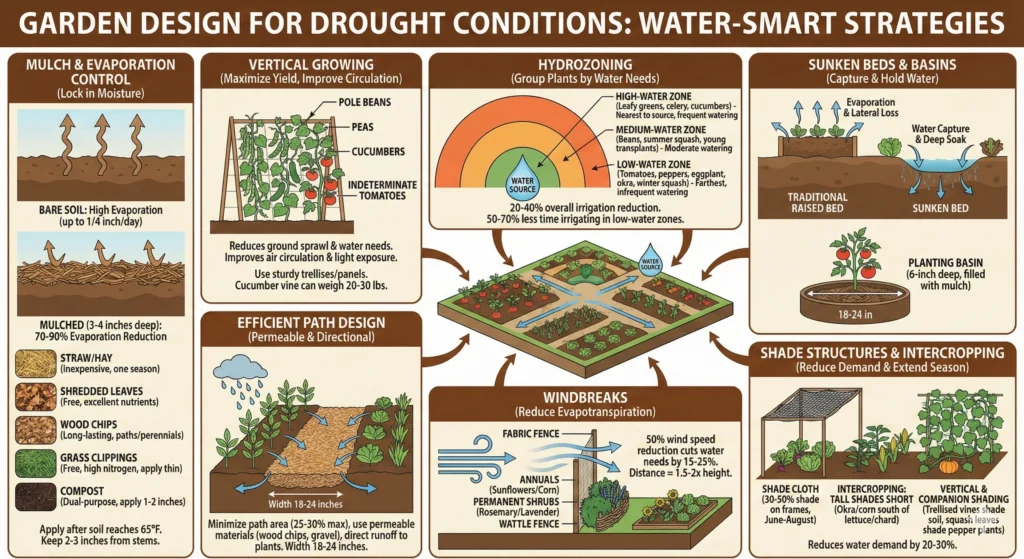
Strategic garden layout and water smart garden design minimize water waste while creating favorable microclimates for drought-tolerant crops. Thoughtful placement of plants, paths, and structures reduces overall irrigation needs by 20-40% compared to conventional row layouts.
Hydrozoning
Group plants by water requirements so you can irrigate each zone appropriately without over-watering drought-tolerant crops or under-watering thirsty ones. Create three distinct zones:
- High-water zone: Leafy greens, celery, cucumbers (if grown)—place nearest to water source for easy frequent watering
- Medium-water zone: Beans, summer squash, young transplants
- Low-water zone: Tomatoes, peppers, eggplant, winter squash, okra—place these drought-tolerant crops farthest from water source
Within low-water zones, you’ll spend 50-70% less time irrigating compared to traditional mixed plantings, and plants receive precisely the moisture they need.
Sunken Beds and Basins
In arid climates, traditional raised beds lose moisture rapidly to evaporation and lateral movement. Sunken beds and individual planting basins capture and hold water, directing it to root zones.
Create sunken beds by excavating pathways and mounding soil into beds 2-3 inches below grade. Water flows into beds and soaks in rather than running off. For individual plants like tomatoes or peppers, form 6-inch-deep basins around each plant, 18-24 inches in diameter. Fill basins with mulch after watering to reduce evaporation.
Shade Structures and Intercropping
Filtered shade reduces plant water demand by 20-30% during peak summer heat while extending the growing season for heat-sensitive crops. Use these techniques:
- Install 30-50% shade cloth on frames over beds from June through August
- Plant heat-tolerant, tall crops (okra, pole beans) on the south side of beds to shade lower-growing, more sensitive crops (lettuce, chard)
- Train vining crops like cucumbers or pole beans on vertical trellises to shade soil and reduce evaporation
- Use companion plantings where large leaves of squash or melon shade soil between pepper or eggplant plants
Windbreaks
Wind dramatically increases evapotranspiration rates. A windbreak reducing wind speed by just 50% cuts plant water needs by 15-25%. Install physical barriers or living windbreaks perpendicular to prevailing winds:
- Temporary fabric fences on stakes (install spring, remove fall)
- Fast-growing annual plants like sunflowers or corn on north and west edges
- Permanent shrub hedges (rosemary, lavender, privet) for perennial gardens
- Wattle fences made from bundled branches
Position windbreaks far enough from crops to avoid excessive shade—distance should equal 1.5-2 times the windbreak height.
Efficient Path Design
Paths serve two purposes in water-wise gardens: access for maintenance and barriers that prevent root competition and moisture loss to uncultivated areas. Design paths that:
- Minimize total path area (25-30% of garden space maximum)
- Use permeable materials (wood chips, decomposed granite, gravel) that allow rainfall infiltration
- Direct runoff from paths into planted areas rather than away from the garden
- Are wide enough for easy access with tools and wheelbarrows (18-24 inches minimum)
Vertical Growing
Training vining crops upward rather than allowing ground sprawl reduces water needs while maximizing yields per square foot. Vertical plants improve air circulation (reducing disease), receive better light exposure, and their elevated foliage doesn’t trap moisture against soil.
Best vegetables for vertical growing: pole beans, peas, cucumbers, small squash varieties, indeterminate tomatoes. Use sturdy trellises, cattle panels, or teepees made from bamboo or saplings. Ensure structures can handle crop weight when fully loaded—a 6-foot section of cucumber vine can bear 20-30 pounds of fruit.
Mulch and Evaporation Control
Bare soil loses moisture to evaporation at rates up to 1/4 inch per day in hot, dry conditions. Organic mulch and compost applied 3-4 inches deep reduces evaporation by 70-90% while moderating soil temperature.
Best mulches for vegetable gardens:
- Straw or hay: Inexpensive, widely available, breaks down in one season
- Shredded leaves: Free, excellent nutrient value as they decompose
- Wood chips: Long-lasting (2-3 years), best for pathways and around perennial crops
- Grass clippings: Free, high nitrogen, but apply in thin layers to prevent matting and odor
- Compost: Dual-purpose mulch and fertilizer, apply 1-2 inches thick
Apply mulch after soil warms in spring (wait until soil temperature reaches 65°F for heat-loving crops). Keep mulch 2-3 inches away from plant stems to prevent rot and pest harboring. Replenish as needed throughout the season—3-4 inches compressed to 1-2 inches as organic mulches decompose.
6. Maintenance and Monitoring
Consistent observation and minimal intervention keep water-efficient gardens productive. Regular monitoring helps you detect stress early, adjust watering schedules, and prevent small problems from becoming major setbacks.
Soil Moisture Monitoring
Checking soil moisture accurately prevents both under-watering and over-watering. Use one or more methods:
- Finger test: Push your finger 3-4 inches into soil. If dry at that depth, water deeply. If moist, wait.
- Soil moisture meter: Inexpensive probe-style meters give instant readings at various depths. Take readings in multiple locations.
- Tensiometer: Professional-grade device measures soil water tension. More accurate than moisture meters but requires calibration.
- Visual indicators: Install clear observation tubes at different depths to see moisture levels
Check moisture at root depth, not at the surface where soil dries first. For established plants, monitor 6-8 inches deep. For shallow-rooted crops, check 3-4 inches.
Plant Stress Indicators
Learn to distinguish between temporary wilting and serious drought stress:
- Temporary wilting: Leaves droop during hottest part of day but recover by evening—normal in heat, doesn’t require immediate watering
- Persistent wilting: Leaves remain wilted in cool morning hours—water immediately
- Leaf curling: Edges curl upward or leaves cup—moderate stress, water within 24 hours
- Leaf discoloration: Yellowing or browning from leaf tips inward—severe stress, water immediately and provide temporary shade
Check plants early morning and late afternoon. Compare their condition between these times to assess whether stress is temporary or worsening.
Weed Management
Weeds compete aggressively for water, sometimes consuming more than your vegetables. A single large pigweed can transpire 1-2 gallons per day—water you intended for crops. Remove weeds when small, before extensive root systems develop.
Mulching prevents 90% of annual weed germination. For weeds that emerge through mulch, remove by hand weekly rather than allowing them to establish. Never let weeds go to seed in or near your garden.
Pruning and Training
Moderate pruning reduces plant water demand without sacrificing yields:
- Remove lower leaves on tomatoes once fruits form to improve air circulation and reduce transpiration
- Pinch off squash leaves showing powdery mildew or other disease
- Trim excessive lateral growth on peppers and eggplants after fruits set
- Remove dead or yellowing foliage throughout the season
Avoid over-pruning. Leaves produce energy through photosynthesis and provide shade for fruits, preventing sunscald. Remove no more than 25% of foliage at one time.
Fertilization Adjustments
Plants under drought stress can’t utilize heavy fertilizer applications. Excess nutrients accumulate as salts, worsening drought effects. Reduce fertilizer rates by 25-50% compared to recommendations for well-watered gardens.
Apply fertilizers in split applications: half at planting, quarter at flowering, quarter at fruit set. Use slow-release organic sources (compost, aged manure, organic granular blends) that release nutrients gradually as plants need them.
Water immediately after fertilizing to move nutrients into the root zone and prevent salt concentration at the soil surface.
Pest and Disease Management
Drought-stressed plants are more susceptible to certain pests (spider mites, aphids) and diseases (powdery mildew). However, reduced irrigation naturally suppresses fungal diseases requiring wet foliage.
Integrated pest management for water-wise gardens:
- Inspect plants weekly for pest colonies, treating small infestations before they explode
- Use strong water spray to dislodge aphids and mites (do this early morning so foliage dries quickly)
- Plant aromatic herbs (basil, oregano, thyme) between vegetables to confuse pests
- Accept minor pest damage rather than spraying—predatory insects need prey populations to sustain themselves
- Remove severely diseased plants entirely to prevent spread
7. Seasonal Adjustments
Water requirements and garden management shift dramatically across seasons. Adapting your practices to seasonal changes maximizes production while minimizing water use year-round.
Spring Strategies
Spring offers optimal growing conditions in most climates—moderate temperatures, lingering soil moisture from winter, and frequent rainfall (in many regions). Take advantage:
- Plant cool-season crops (lettuce, peas, spinach) that mature before summer heat arrives
- Establish drought-tolerant transplants (tomatoes, peppers, eggplant) while soil moisture is high, allowing deep root development before heat stress begins
- Build soil organic matter through compost incorporation and cover crop turn-under
- Install irrigation infrastructure before planting rather than working around established plants
- Apply mulch as soil warms to 65°F to lock in spring moisture throughout summer
Water transplants daily for the first week, every other day for the second week, then transition to weekly deep watering as roots establish.
Summer Management
Peak summer presents maximum water stress—high temperatures, intense sun, and rapid evaporation. Focus on conservation and plant support:
- Add supplemental shade cloth over heat-sensitive crops during extreme heat waves (above 95°F sustained)
- Apply extra mulch if existing layers have decomposed thin
- Increase watering frequency for plants in active fruiting, but maintain deep watering approach
- Harvest regularly to reduce plant energy and water demand
- Plant heat-loving, drought-tolerant crops (okra, cowpeas, Armenian cucumber) to replace cool-season crops
- Avoid transplanting during peak heat—wait for cooler weather or provide intensive care
During heat waves above 100°F, provide temporary shade for all crops if possible. Many vegetables stop fruit set when temperatures exceed 95°F, regardless of watering.
Fall Opportunities
Fall is the second prime planting window, with cooling temperatures and often increased rainfall (depending on region). Seasonal adjustments:
- Plant cool-season crops for fall/winter harvest as summer crops decline
- Reduce watering frequency as temperatures drop and evaporation slows
- Allow summer crops (tomatoes, peppers, squash) to finish producing without supplemental water once temperatures moderate—this concentrates flavors and doesn’t significantly reduce late-season yields
- Mulch heavily in late fall to insulate soil for winter and spring
- Plant cover crops in empty beds to protect soil and add organic matter
Winter Considerations
In mild winter climates, gardens continue producing with minimal intervention. In cold climates, prepare for next season:
- Maintain mulch layers to prevent erosion and soil temperature fluctuations
- Clean and repair irrigation systems before freezing weather
- Plan next season’s garden layout, seed orders, and improvements
- Build compost piles with fall leaves and garden debris
- In frost-free climates, grow winter vegetables (greens, brassicas, root crops) with minimal watering—often rainfall alone suffices
Even dormant soil benefits from occasional deep watering in winter dry spells to maintain microbial activity and prevent soil structure degradation.
Adapting to Climate Extremes
When weather deviates from normal patterns—extended drought, heat waves, or unusual rainfall—adjust practices accordingly:
- During drought: Prioritize high-value crops (tomatoes, peppers) over space-intensive, lower-value crops (squash, melons); harvest slightly early to reduce plant stress
- During heat waves: Apply supplemental shade; water in early morning and late evening if necessary; mist foliage briefly in extreme heat (evaporative cooling) only if you can wet all foliage thoroughly
- During wet periods: Reduce irrigation completely; improve drainage if water pools; watch for fungal diseases
Conclusion
You now hold the complete framework for growing abundant food while using 40-70% less water than conventional gardens. Every technique in this guide has been tested across thousands of gardens in water-scarce regions—they work because they align with how plants actually function in their natural, often arid, environments.
Start small if you’re new to water wise vegetable gardening tips. Choose five drought-tolerant vegetables from the chart in section 2. Prepare one 4×8 foot bed using the soil-building methods in section 3. Install a simple drip system or plan for ollas. Apply 4 inches of mulch. Water deeply once weekly, monitoring soil moisture between irrigations.
As these plants thrive, expand. Add a second bed. Experiment with greywater or rainwater harvesting. Try heat-tolerant varieties you’ve never grown. Each season, your soil improves, your observation skills sharpen, and your water efficiency increases.
The most inspiring part of low-water gardening isn’t the water you save—though that matters immensely. It’s discovering that limitation breeds creativity and resilience. Your garden becomes a living demonstration that abundance doesn’t require abundance. You’re growing more than vegetables; you’re cultivating self-reliance, ecological wisdom, and food security in an uncertain climate future.
Water restrictions aren’t obstacles. They’re invitations to garden smarter, to work with nature rather than against it, to prove that thriving and conservation aren’t opposites but partners. Your water-efficient garden starts today. Your first harvest begins with the next seed you plant.
Now stop reading and start growing.