Introduction: Why Windowsill Herbs Go Wrong
Most beginner indoor herb gardens fail for the same handful of reasons, and none of them mean you lack a green thumb. Windowsill herbs die because they’re being treated like decorative houseplants when they’re actually productive crops with specific needs. A basil plant on your kitchen counter faces challenges wildly different from its life in a sunny garden bed, and if you don’t adjust your care routine, you’ll see yellow leaves, leggy stems, and plants that give up after a few weeks.
The good news: once you understand what herbs actually need indoors, fixing problems is straightforward. This guide walks through every common mistake beginners make with windowsill herb gardens, shows you exactly what’s going wrong, and gives you concrete steps to turn things around.
Not Enough (or Too Much) Light
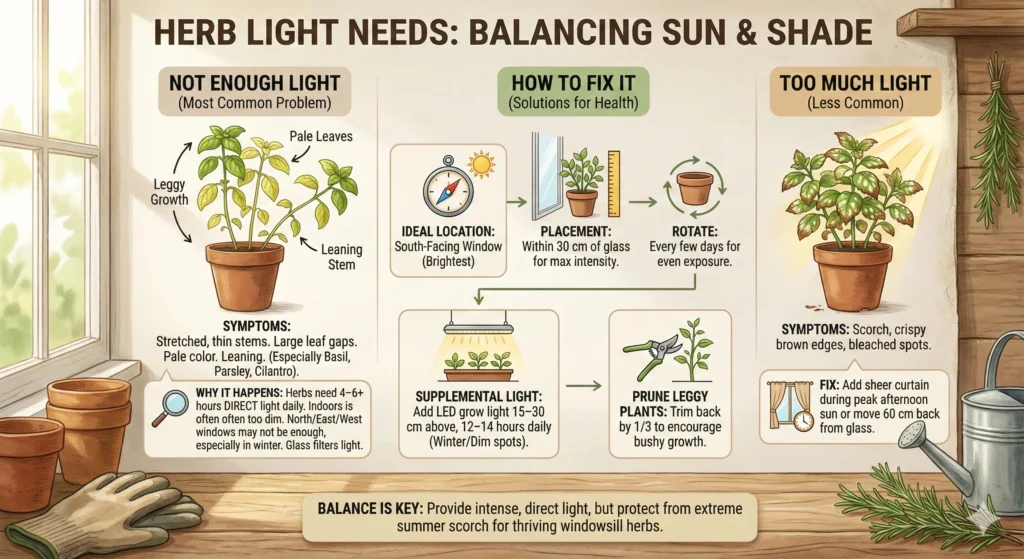
What you’ll see: Stems that stretch tall and thin with large gaps between leaves (called leggy growth). Leaves turn pale green or yellow. The plant leans hard toward the window. Basil, parsley, and cilantro especially show these symptoms when light-starved.
Why it happens: Most culinary herbs evolved in Mediterranean climates with intense sun. They need at least 4–6 hours of bright, direct light daily. A “bright” room to your eyes isn’t bright enough for herbs. Standard window glass also filters out some useful light spectrum. North-facing windows rarely provide sufficient intensity, and even east or west windows often fall short in winter months.
Too much direct sun through south-facing glass in summer can scorch delicate leaves, causing brown, crispy edges and bleached spots, but this is far less common than insufficient light.
How to fix it:
- Move herbs to your brightest window, ideally south-facing in the northern hemisphere
- Place plants within 30 cm of the glass where light intensity is strongest
- Rotate pots every few days so all sides get even exposure
- In winter or dim locations, add a basic LED grow light positioned 15–30 cm above plants, running 12–14 hours daily
- For excessive sun scorch, add a sheer curtain during peak afternoon hours or move plants 60 cm back from the glass
- If plants are already leggy, trim them back by one-third to encourage bushier, more compact new growth
Overwatering and Poor Drainage
What you’ll see: Yellow or brown lower leaves that feel soft and musty. Soil stays wet for days after watering. A sour or moldy smell from the pot. Small black flies (fungus gnats) hovering around plants. In severe cases, stems become soft and collapse at the soil line—that’s root rot.
Why it happens: This is the number one killer of indoor herbs. Beginners water on a schedule rather than checking if the plant actually needs it. Indoor pots dry out much slower than outdoor garden soil because there’s less air movement and heat. Sitting in soggy soil, roots suffocate and rot. Containers without drainage holes turn into swamps. Heavy potting soil that contains clay or garden soil holds too much moisture.
How to fix it:
- Only water when the top 1–2 cm of soil feels dry to your finger—this simple touch test prevents most overwatering
- Always use pots with drainage holes at the bottom; if you love a decorative pot without holes, use it as an outer sleeve and grow herbs in a draining plastic pot inside
- Choose a light, fast-draining potting mix specifically made for containers, not heavy garden soil
- After watering, always empty any water that collects in saucers within 15 minutes
- If you’ve overwatered, stop watering immediately, improve air circulation with a small fan, and if the soil is waterlogged, gently remove the plant and repot in fresh, dry mix
- For root rot (black, mushy roots), trim away dead roots with clean scissors, repot in fresh soil, and reduce watering frequency going forward
Using the Wrong Containers and Soil
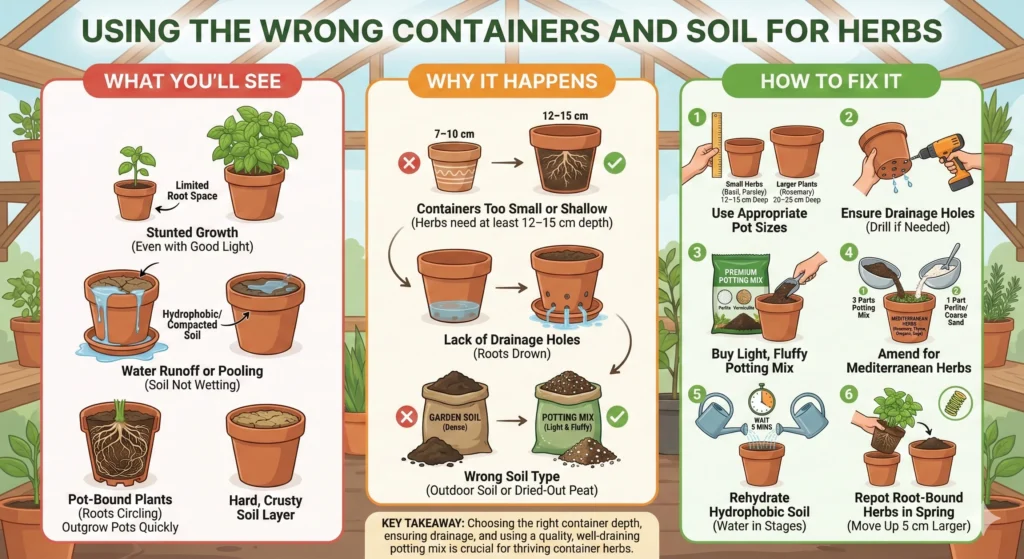
What you’ll see: Stunted growth even with good light. Water either runs straight through without wetting the soil or pools on the surface. Plants outgrow their pots quickly, with roots circling the bottom or poking through drainage holes. Soil compacts into a hard, crusty layer.
Why it happens: Many beginners plant herbs in containers that are too small, lack drainage, or use the wrong soil type. A 7–10 cm decorative pot might look cute, but most herbs need at least 12–15 cm depth for proper root development. Dense soil made for outdoor gardens or containing peat that’s dried out completely won’t hold moisture properly in containers.
How to fix it:
- Use pots at least 12–15 cm deep for single herbs like basil or parsley, and 20–25 cm for larger plants like rosemary
- Each pot must have drainage holes—drill them yourself if needed
- Buy proper potting mix (not garden soil) that’s light and fluffy; it should contain perlite or vermiculite for drainage
- For Mediterranean herbs (rosemary, thyme, oregano, sage), mix in extra perlite or coarse sand—roughly one part amendment to three parts potting mix
- If soil has become hydrophobic (water runs off instead of soaking in), water in stages: add a little, wait a few minutes for it to absorb, then water again
- Repot herbs that have outgrown containers in spring, moving up to a pot 5 cm larger
Treating Herbs Like Houseplants
What you’ll see: Herbs survive but barely grow. Leaves stay small. You harvest once, and the plant never recovers. Woody herbs like rosemary drop leaves steadily until they’re bare sticks.
Why it happens: Herbs aren’t meant to just sit and look pretty. They’re vegetables—productive crops bred to be harvested regularly. Without harvesting, annual herbs like basil bolt (rush to flower and seed), then decline. Herbs also have different moisture needs: Mediterranean types (rosemary, thyme, sage) want drier conditions, while soft herbs (basil, cilantro, parsley) need consistent moisture. Treating them all identically causes stress.
How to fix it:
- Harvest regularly, even if you don’t need the herbs yet; this triggers bushier growth
- Learn your herbs’ native climates: Mediterranean herbs tolerate drought and want soil to dry between waterings; leafy herbs like basil prefer slightly moist (not wet) soil
- For woody herbs, mist occasionally or use a pebble tray (a shallow dish of water with pebbles to raise the pot above water level) to add humidity
- Fertilize every 3–4 weeks during active growth with half-strength liquid fertilizer; herbs in containers exhaust soil nutrients quickly
- Pinch off flower buds as soon as they form to keep annual herbs productive longer
Plant Crowding and Wrong Varieties
What you’ll see: Multiple plants in one small pot where leaves are tangled together. Lower leaves yellow and drop as plants compete for light. Growth is weak across all plants. Alternatively, one herb type thrives while others in the same pot struggle or die.
Why it happens: Those supermarket herb pots contain 10–20 seedlings crammed together for visual fullness, not long-term health. They’re meant to be divided or used up within a week. Different herbs have incompatible needs—you can’t grow water-loving basil in the same pot with drought-tolerant rosemary and expect both to thrive.
Some herb varieties simply fail indoors. Large-leaf basil types often succeed where others don’t. English lavender hates indoor conditions. Standard cilantro bolts quickly, but slow-bolt varieties last longer.
How to fix it:
- If you bought a supermarket herb pot, immediately separate it into 3–4 sections and plant each clump in its own 12–15 cm pot with fresh potting mix
- Space plants properly: one basil, parsley, or cilantro per 12–15 cm pot; one rosemary or sage per 20–25 cm pot
- Never mix herbs with different water needs in the same container
- Choose beginner-friendly varieties: Genovese or sweet basil (not Thai or purple), flat-leaf parsley, slow-bolt cilantro, Greek oregano, common thyme
- Skip lavender, dill, and tarragon indoors—they rarely perform well on windowsills
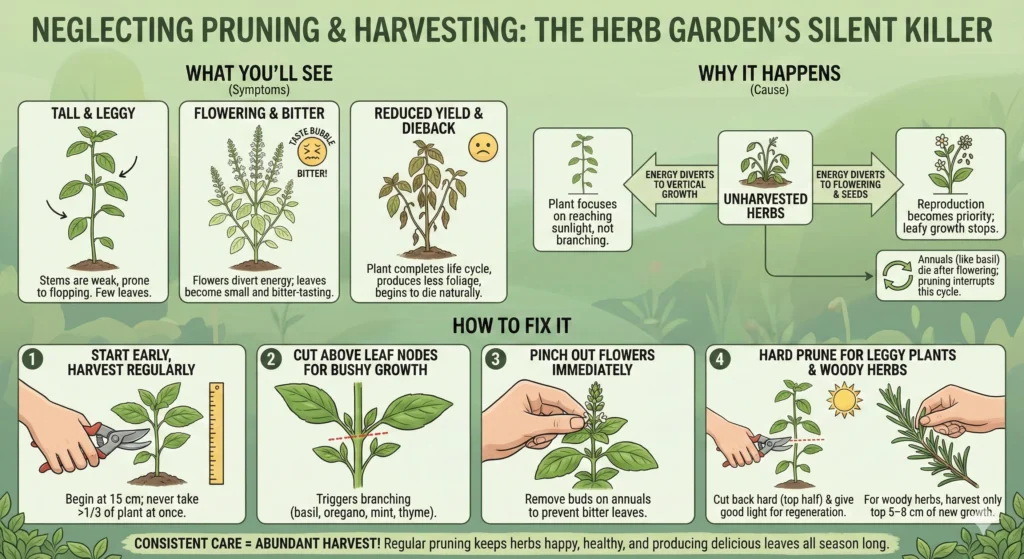
Neglecting Pruning and Harvesting
What you’ll see: Tall, single-stemmed plants with leaves only at the top. Basil develops flower spikes with tiny white flowers. Leaves become smaller and bitter-tasting. The plant produces less usable foliage over time.
Why it happens: Herbs left unharvested put energy into vertical growth and reproduction (flowering) rather than producing the bushy, leafy growth you want. Once annual herbs like basil flower, they begin dying back naturally because they’ve completed their life cycle. Without pruning to encourage branching, you get tall, weak stems prone to flopping over.
How to fix it:
- Start harvesting when plants reach 15 cm tall; never take more than one-third of the plant at once
- For branching herbs (basil, oregano, mint, thyme), always cut just above a leaf node (where leaves attach to stem)—this triggers two new branches to grow from that point
- Pinch out growing tips weekly on basil once it’s established to keep it bushy
- Remove flower buds immediately on annual herbs; for basil, pinch out the entire central spike as soon as you see it forming
- For woody herbs like rosemary, harvest the top 5–8 cm of new growth regularly; never cut into old, brown wood
- If a plant has already gotten leggy and flowered, cut it back hard (remove the top half), give it good light, and it may regenerate
Ignoring Early Warning Signs
What you’ll see: Leaf tips turn brown and crispy. Edges curl under or yellow. Small pale spots appear on leaves. White powdery coating on soil surface. You notice these changes but assume they’ll resolve on their own.
Why it happens: Small problems snowball quickly indoors where herbs can’t recover as easily as they would in nature. Brown leaf tips often signal fertilizer salt buildup or low humidity. Yellowing with green veins means nutrient deficiency (usually iron or nitrogen). White crust on soil indicates mineral deposits from tap water or overfertilizing. Ignoring these signs allows root damage or pest infestations to take hold.
How to fix it:
- Check plants every time you water, looking at leaf color, stem strength, and soil surface
- For brown leaf tips, flush soil with room-temperature water until it drains freely, then reduce fertilizer frequency
- Yellow leaves with green veins mean feed with a balanced liquid fertilizer immediately
- Overall yellowing (older leaves first) usually means nitrogen deficiency—increase fertilizing
- White crust on soil: scrape it off and water with filtered or room-temperature tap water that’s been left to sit overnight so chlorine evaporates
- Sudden leaf drop on woody herbs signals stress (usually watering problems)—review your watering routine and check for root rot
Pests and Indoor Climate Problems
What you’ll see: Tiny green or black insects clustered on new growth (aphids). Fine webbing between leaves with tiny moving dots (spider mites). Small flying insects around soil (fungus gnats). Leaves with stippled yellow spots or a dusty appearance.
Indoor climate issues look different: leaves develop brown edges in heated rooms, or growth stalls completely in cold drafts near windows.
Why it happens: Indoor herb pests usually hitchhike in on plants from stores or enter through open windows. Spider mites thrive in dry, warm indoor air. Fungus gnats breed in constantly moist soil. Unlike outdoor gardens, you don’t have beneficial insects to control pests indoors.
Temperature extremes stress herbs: below 10°C, basil and other tender herbs sustain cold damage. Above 27°C with low humidity, plants struggle with moisture stress even when watered.
How to fix it:
- For aphids, spray plants thoroughly with water in the sink to dislodge them, then apply insecticidal soap weekly until gone
- Spider mites hate moisture: increase humidity with a pebble tray and spray foliage daily with water; for severe infestations, use neem oil spray
- Fungus gnats: let soil dry more between waterings, scrape off the top 2 cm of soil and replace with fresh mix, and place yellow sticky traps near plants
- Inspect new plants carefully before bringing them near your herb collection
- Keep herbs away from heating vents and cold window glass in winter
- Maintain temperatures between 15–24°C for best growth
- In dry winter air, group herbs together or use a small humidifier nearby (especially important for basil)
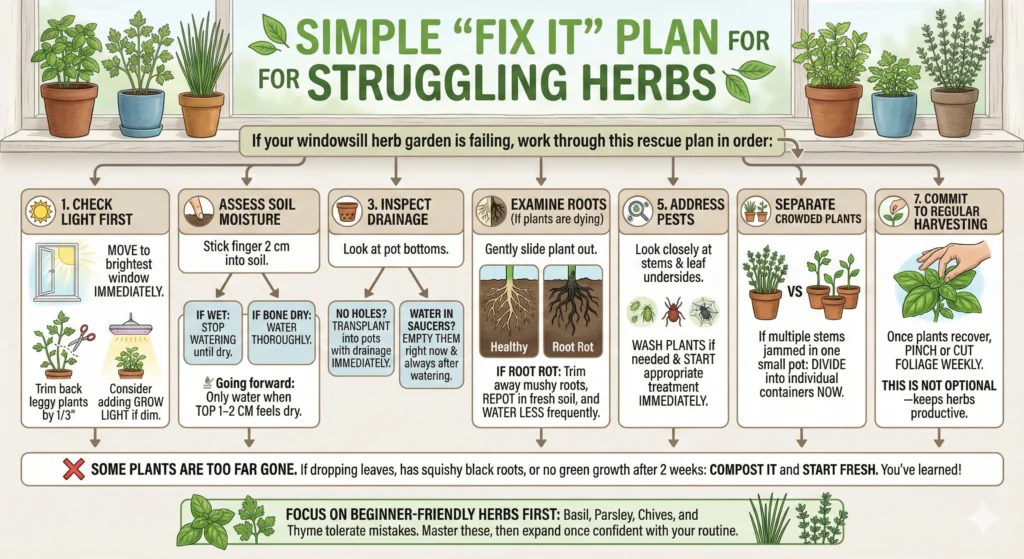
Simple “Fix It” Plan for Struggling Herbs
If your windowsill herb garden is failing, work through this rescue plan in order:
- Check light first: Move plants to the brightest window immediately. If leaves are extremely leggy or pale, trim plants back by one-third. Consider adding a grow light if your windows are dim.
- Assess soil moisture: Stick your finger 2 cm into the soil. If it’s wet, stop watering entirely until it dries. If bone dry, water thoroughly. Going forward, only water when the top 1–2 cm feels dry.
- Inspect drainage: Look at pot bottoms. No holes? Transplant into proper pots with drainage immediately. Water sitting in saucers? Empty them right now and always do so after watering.
- Examine roots (if plants are dying): Gently slide the plant out of its pot. Healthy roots are white or tan and firm. Black, mushy roots mean root rot—trim them away, repot in fresh soil, and water much less frequently.
- Address pests: Look closely at stems and leaf undersides for insects or webbing. Wash plants if needed and start appropriate treatment immediately.
- Separate crowded plants: If multiple stems are jammed in one small pot, divide them into individual containers now.
- Commit to regular harvesting: Once plants recover, pinch or cut foliage weekly. This is not optional—it’s how you keep herbs productive.
Some plants are too far gone. If an herb has dropped most leaves, has squishy black roots throughout, or shows no green growth after two weeks of improved care, compost it and start fresh. You’ve learned what went wrong, and the next plant will do better with your new knowledge.
Focus your efforts on beginner-friendly herbs first: basil, parsley, chives, and thyme tolerate beginner mistakes better than fussy types. Master these, then expand to more challenging varieties once you’ve built confidence and developed a reliable care routine for your specific windowsill conditions.